
Presentation
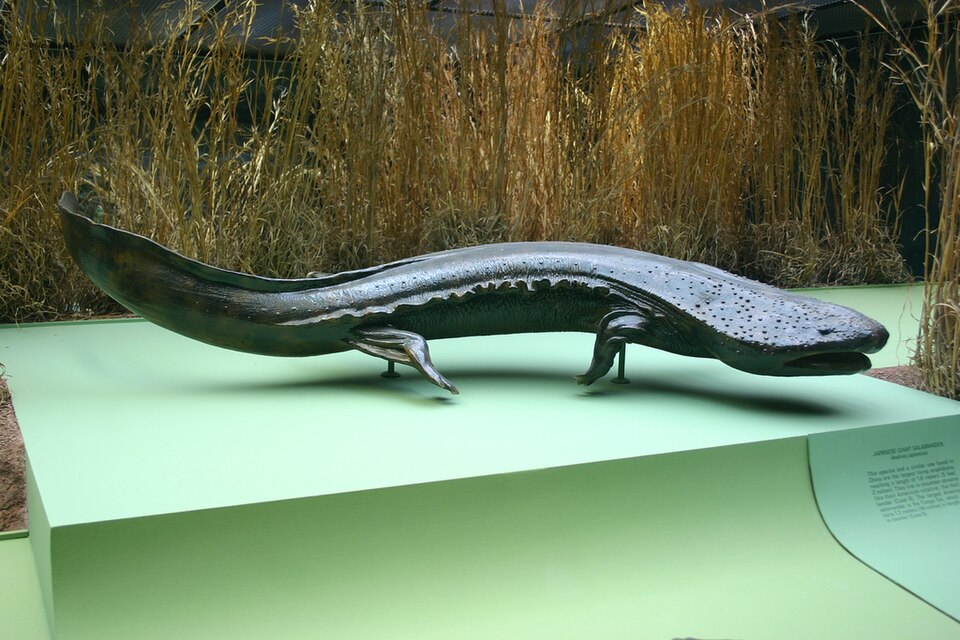
The Japanese giant salamander (Andrias japonicus) is a large caudate amphibian found only in the cool rivers of Japan. It ranks among the world's largest living amphibians, with a flattened body and wrinkled skin. Nocturnal and primarily aquatic, it lives hidden under rocks in mountain streams. Its exceptional longevity and slow growth make it an emblematic but vulnerable species. It has been protected by Japanese law since 1952 as a special natural monument.
Its massive, flattened body reaches up to 1.5 m in length, covered with rough, wrinkled skin of brownish-grey color with spots, offering effective camouflage among rocks. Its eyes are small and lack moveable eyelids, with poor vision. It breathes mainly through the skin, which is richly supplied with blood vessels and wrinkled to maximize gas exchange in cold, oxygen-rich water. Its short limbs bear short digits adapted for bottom-dwelling rather than swimming.
Characteristics
Indicative values: they vary by subspecies, sex and region.
Habitat and distribution
The species lives in clear, cool, well-oxygenated rivers and streams of the mountainous and forested regions of Japan. It prefers rocky bottoms with natural shelter such as crevices and undercut banks. Water quality and cool temperature are essential conditions for its survival. Dams and water management schemes severely fragment its natural habitat.
CURRENT RANGE
The Japanese giant salamander is endemic to the Japanese archipelago, found mainly in central and western Honshū, as well as on Shikoku and Kyūshū. Its range is fragmented along mountainous watersheds. Hybrid populations with the introduced Chinese giant salamander now pose a conservation concern regarding genetic integrity.
Behaviour
A solitary and territorial animal, mainly active at night, it remains hidden under rocks or in submerged cavities during the day. Males defend a breeding territory called a 'den' that they actively protect from intruders during breeding season. Its movements are slow and energy-efficient, reflecting a metabolism adapted to cold water. It communicates little, mainly through physical and chemical contact.
Reproduction
Breeding occurs in late summer and autumn in burrows dug beneath river banks. The dominant male, known as the 'master of the lair', fertilises eggs laid by one or several females and guards them. A single clutch can contain several hundred eggs arranged in gelatinous strings. Larvae hatch after several weeks and take years to reach sexual maturity.
Peculiarities
It can live for several decades, with some captive individuals exceeding 50 years. Its capacity for tissue regeneration, though less developed than in some other salamanders, remains notable. Its Japanese name, 'Ōsanshōuo', evokes Sichuan pepper because of a musky odour it releases when stressed. It is regarded as a living fossil, little changed over millions of years.
Threats and conservation
Habitat degradation and fragmentation caused by dams and river modifications pose the main threat. Water pollution and hybridisation with the introduced Chinese giant salamander also threaten its genetic integrity. Historical poaching for consumption has also contributed to its decline. It benefits from strict legal protection status in Japan.
Numbers and trends vary across sources and regions. See the IUCN assessment for the latest reference data.
Gallery
1 documented photographs.
References
Profile updated 07 September 2026 · Reviewed by the TunisieVet editorial team.
Comments (0)
No comments yet.
CONSERVATION STATUS
Near threatened (NT)
IUCN source, latest published assessment.
Species health
Documented diseases for this species.
This information is provided for educational purposes only and is not a substitute for a veterinary consultation. If you have any concerns about your animal's health, consult a veterinarian.
To discover around: Japanese Giant Salamander
Videos, facts, stories and records linked to this species.
RECORD
up to 5 feet
One of the largest amphibians alive today
Total length measured in the largest known wild and captive specimens.
Similar animals
Other species documented in Animalpedia.

TunisieVet in your pocket 📱🐾 Access your veterinary services wherever you are. [ Download the app ]
Learn more