
Presentation
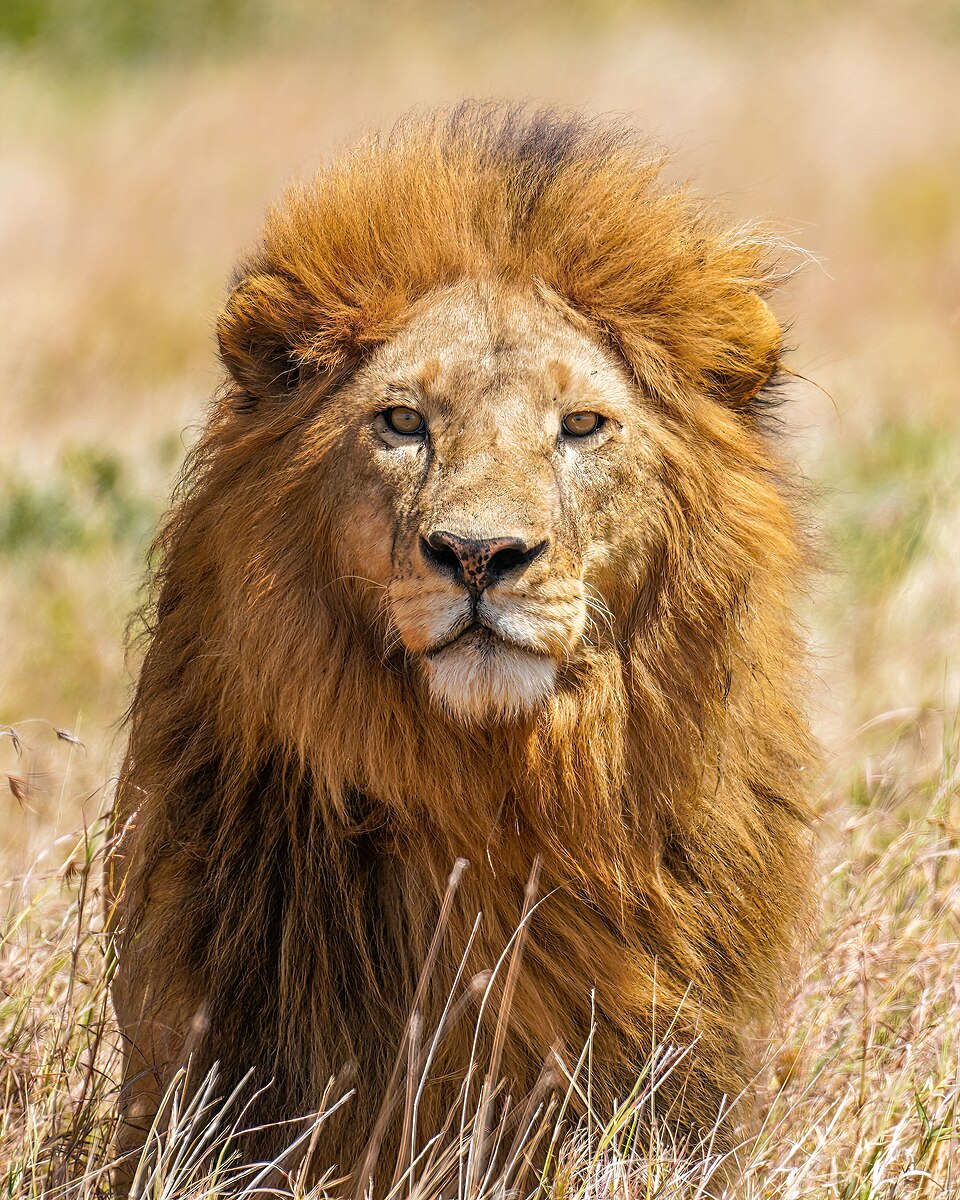
The Lion is the largest feline in Africa and one of the most powerful carnivores on the continent. It is a majestic animal, easily recognizable by its massive silhouette and, in the male, by its imposing mane which frames the head. The undisputed king of the savannah, he embodies strength and domination in his ecosystem.
The male Lion is distinguished by its voluminous mane, the shade of which varies from blond to dark brown depending on age and genetics. The female, more slender, lacks it. Both have muscular bodies, powerful legs and a tail ending in a tuft of black hair. Their golden eyes, combined with their sturdy jaw, reflect their status as an apex predator.
Did you know?
How far away can a lion's roar be heard?
Characteristics
Indicative values: they vary by subspecies, sex and region.
Habitat and distribution
The Lion inhabits open or semi-open African savannahs, grassy prairies, and sparse woodlands. It prefers environments with medium vegetation cover which provides hiding places for hunting, as well as sufficient presence of prey. Contrary to popular belief, it avoids dense forests and deserts devoid of game.
CURRENT RANGE
Lion was once widely distributed in Africa and Asia, but its range has been significantly reduced. Today, it is mainly concentrated in sub-Saharan Africa, notably in the large reserves of East Africa (Tanzania, Kenya) and in southern Africa (Botswana, Zimbabwe, South Africa). A relict population persists in India (Gir Forest). It is completely absent from North Africa and the Maghreb.
Behaviour
The Lion is one of the few truly social felids, living in groups called "prides." A pride usually has between 10 and 15 individuals, made up of related females and a few males. Males spend a lot of time resting (up to 20 hours per day), while females manage hunting and raising young. Powerful roars are used to demarcate territory and communicate.
Reproduction
Lionnes reach sexual maturity around 3-4 years old and generally reproduce all year round, without a defined season. After repeated mating, the female carries her young for about 110 days. A litter typically has 2 to 4 babies, rarely more. Lionnes within a pride often synchronize their reproductive cycles and help each other raise the young, thereby strengthening group cohesion.
Peculiarities
The Lion's roar is one of the most powerful calls in the animal kingdom, audible over 9 km away. Each male has a unique vocal signature. The male's mane is not only used for intimidation: its dark color generally indicates better health and greater ability to reproduce. Lions are among the rare felids to hunt in a coordinated group, demonstrating a true collective strategy.
Threats and conservation
Lions populations face several major threats: habitat loss due to agricultural and urban expansion, reduction of wild prey, overhunting, and conflicts with ranchers who kill Lions to protect their livestock. The fragmentation of territories isolates populations and reduces their genetic diversity. Diseases, including carnivorous plague, also affect wild Lions.
Numbers and trends vary across sources and regions. See the IUCN assessment for the latest reference data.
Gallery
1 documented photographs.
References
UICN — Liste rouge des espèces menacées
Profile updated 31 August 2026 · Reviewed by the TunisieVet editorial team.
Comments (0)
No comments yet.
CONSERVATION STATUS
Vulnerable (VU)
IUCN source, latest published assessment.
Species health
Documented diseases for this species.
See the 4 diseases of this species Find a veterinarianThis information is provided for educational purposes only and is not a substitute for a veterinary consultation. If you have any concerns about your animal's health, consult a veterinarian.
Related species
To discover around: Lion
Videos, facts, stories and records linked to this species.
Similar animals
Other species documented in Animalpedia.

TunisieVet in your pocket 📱🐾 Access your veterinary services wherever you are. [ Download the app ]
Learn more