
Presentation
The cacomistle is a small carnivorous mammal from Central America, related to the raccoon and easily recognized by its long ringed tail, which is as long as its body. Its brownish-grey coat and slender build give it a silhouette similar to that of a civet or cat. Discreet and nocturnal, it lives mainly in humid forests and tropical mountainous areas. Though little known to the general public, it plays an important ecological role as a regulator of insects and small vertebrates. It is sometimes confused with the northern cacomistle (Bassariscus astutus), a neighboring but distinct species.
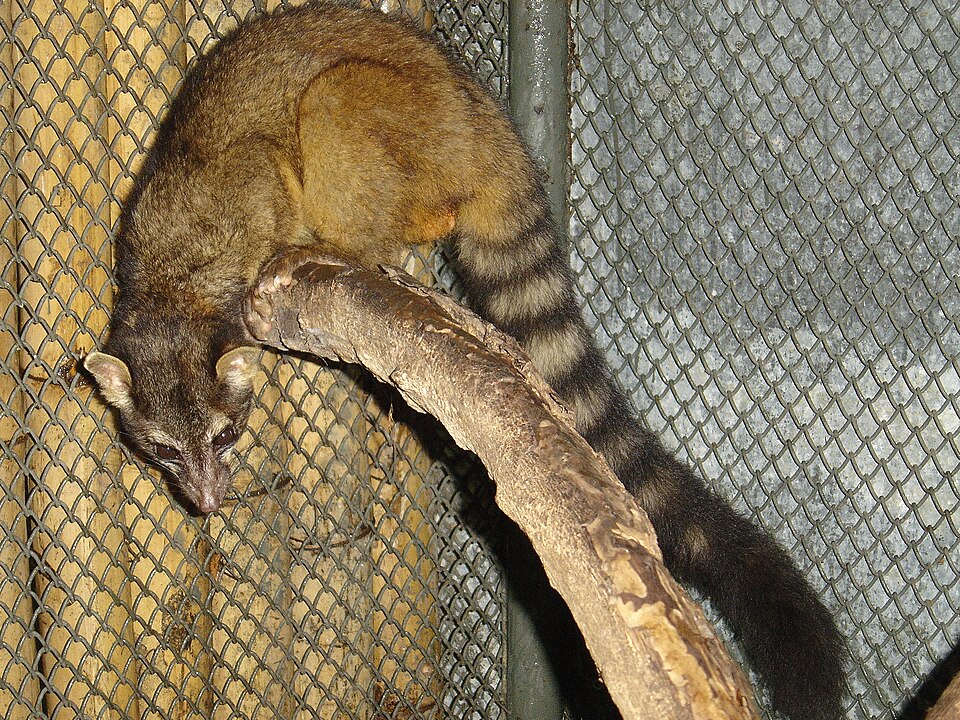
The body measures approximately 16 to 18 inches, complemented by an equally long and very bushy tail ringed with black and white. The coat is dense, brownish-grey on the back and lighter on the underside. The eyes are large, adapted for night vision, and the ears are rounded. Semi-retractile claws and agile paws make it a skilled climber.
Characteristics
Indicative values: they vary by subspecies, sex and region.
Habitat and distribution
The species frequents humid tropical forests and mountain forests, often at moderate elevations. It favors areas with dense canopy that provide shelter and varied food resources.
CURRENT RANGE
The cacomistle is found from southern Mexico through Panama and Central America. It inhabits continuous forest blocks, often in areas minimally disturbed by human activity.
Behaviour
Strictly nocturnal and arboreal, it spends most of its time in the canopy where it moves with agility. It is solitary outside the breeding season and marks its territory with scent secretions. Its long tail serves as a balance when moving through branches.
Reproduction
Females give birth once a year after a gestation of about two months, producing two to four offspring. Young are born blind and depend entirely on their mother for the first few weeks. Weaning occurs at around two to three months of age, followed by gradual independence.
Peculiarities
Its tail, as long as the body and richly furred, is its most striking distinctive feature. Unlike its northern cousin, it is almost exclusively arboreal and rarely seen on the ground.
Threats and conservation
Deforestation related to agriculture and urbanization progressively reduces its natural habitat. It is not directly hunted but suffers indirectly from forest fragmentation.
Numbers and trends vary across sources and regions. See the IUCN assessment for the latest reference data.
Gallery
1 documented photographs.
References
Profile updated 04 September 2026 · Reviewed by the TunisieVet editorial team.
Comments (0)
No comments yet.
CONSERVATION STATUS
Least concern (LC)
IUCN source, latest published assessment.
Species health
Documented diseases for this species.
This information is provided for educational purposes only and is not a substitute for a veterinary consultation. If you have any concerns about your animal's health, consult a veterinarian.
Similar animals
Other species documented in Animalpedia.

TunisieVet in your pocket 📱🐾 Access your veterinary services wherever you are. [ Download the app ]
Learn more