
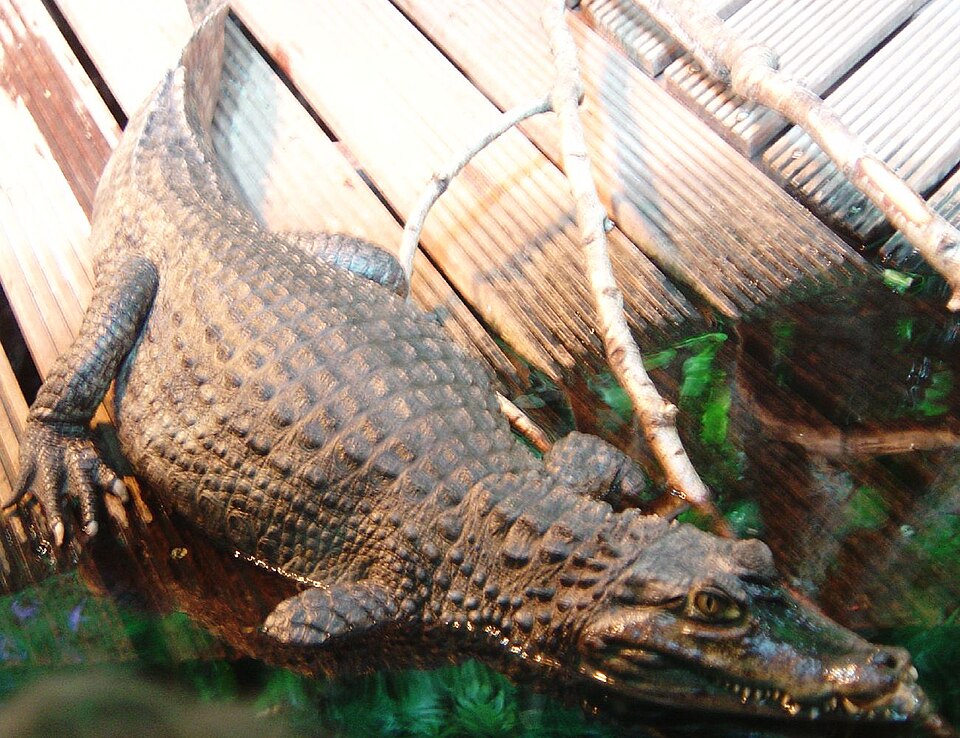
Presentation
The Caiman is a crocodilian reptile belonging to the subfamily Caimaninae, close to alligators. It lives in the wetlands of Central and South America, where it occupies the position of dominant predator of aquatic ecosystems. Its massive body, its skin covered in bony scales and its powerful jaw make it a formidable hunter. Several species exist, from the small spectacled Caiman to the black Caiman, one of the largest predators in the Amazon. It spends much of its time submerged, leaving only its eyes and nostrils visible.
The Caiman has an elongated body, a powerful tail used for swimming, and short, sturdy legs. Its skin is covered in bony plates called osteoderms, providing effective protection against predators and conspecifics. Its eyes and nostrils are positioned on the top of its head, allowing it to remain almost entirely submerged while observing its surroundings. The color varies from gray-green to black depending on the species.
Characteristics
Indicative values: they vary by subspecies, sex and region.
Habitat and distribution
The Caiman frequents rivers, lakes, marshes and marshy areas of tropical and subtropical regions. It particularly appreciates calm waters bordered by dense vegetation, offering both hunting areas and shelter. Some species tolerate more degraded or human-modified habitats, such as canals or artificial ponds. It generally avoids waters with strong currents.
CURRENT RANGE
Caiman is present in Central and South America, from Mexico to northern Argentina depending on the species. The Amazon basin constitutes one of its main strongholds, particularly for black Caiman. Some species have more restricted ranges, limited to specific river basins. It does not occur naturally on any other continent.
Behaviour
The Caiman is a primarily solitary animal, except when breeding or when food resources are concentrated. It is mainly active at dusk and night, during which it hunts actively. Rather discreet in nature towards humans, it can nevertheless be aggressive if its territory is threatened. It regulates its body temperature by alternating phases of exposure to the sun on the banks and immersion in water.
Reproduction
The female builds a nest of decomposing vegetation in which she lays her eggs, the heat of fermentation ensuring incubation. She watches the nest vigilantly throughout the incubation period, which generally lasts several weeks. When they hatch, the mother often helps the young out of the nest and sometimes carries them in her mouth to the water. Juveniles stay close to their mother during the first months of their life.
Peculiarities
The Caiman can be distinguished from the alligator by an additional bony plate on the lower eyelid and a generally thinner jaw. Some species can remain motionless for very long periods, saving their energy between hunts. Its bite is among the most powerful in the animal kingdom relative to its size.
Threats and conservation
The destruction of wetlands and pollution of waterways threaten certain local populations. Illegal hunting for its skin, highly sought after in leather goods, remains a significant pressure in several regions. Illegal trade for the novel pet market also poses a growing threat. However, some species benefit from effective conservation programs.
Numbers and trends vary across sources and regions. See the IUCN assessment for the latest reference data.
Gallery
1 documented photographs.
References
Profile updated 01 September 2026 · Reviewed by the TunisieVet editorial team.
Comments (0)
No comments yet.
CONSERVATION STATUS
Least concern (LC)
IUCN source, latest published assessment.
Species health
Documented diseases for this species.
See the 7 diseases of this species Find a veterinarianThis information is provided for educational purposes only and is not a substitute for a veterinary consultation. If you have any concerns about your animal's health, consult a veterinarian.
To discover around: Caiman
Videos, facts, stories and records linked to this species.
Similar animals
Other species documented in Animalpedia.

TunisieVet in your pocket 📱🐾 Access your veterinary services wherever you are. [ Download the app ]
Learn more