
Presentation
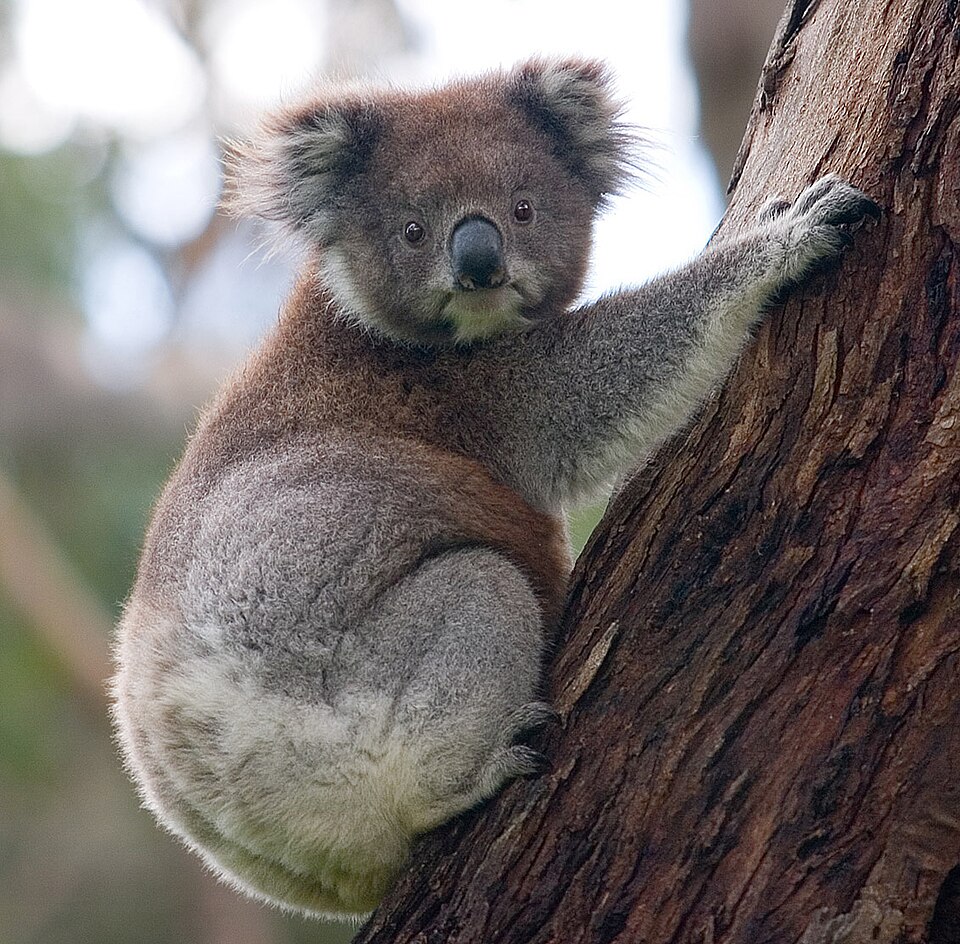
The Koala is an arboreal marsupial endemic to Australia, often called the "Koala bear" although it is not a bear. This stocky animal with a dense gray coat has a voluptuous head, large rounded ears and a characteristic black nose. Perfectly adapted to life in trees, the Koala spends the majority of its existence perched in eucalyptus trees.
The Koala has a stocky and muscular body, equipped with four short and powerful legs armed with sharp claws which allow it to cling securely to branches. Its coat is particularly thick and woolly, providing excellent thermal insulation. Its eyes are small and close together, while its highly developed sense of smell allows it to select edible eucalyptus leaves from the many species available.
Did you know?
Which animal sleeps the most?
Characteristics
Indicative values: they vary by subspecies, sex and region.
Habitat and distribution
The Koala lives exclusively in the eucalyptus forests of the eastern Australian coast, mainly in New South Wales, Queensland and Victoria. It frequents open forests, mixed forests and coastal woodlands where its preferred food plants grow. The animal prefers areas with continuous tree cover allowing it to move from tree to tree without descending to the ground.
CURRENT RANGE
Koala is endemic to eastern Australia. Its historic range extended more than 1,000 km along the coast from central Queensland to Victoria and New South Wales. Today, its distribution is fragmented into several isolated, small and discontinuous populations due to habitat destruction and environmental fragmentation. The main populations remain in New South Wales, Queensland and Victoria.
Behaviour
The Koala is a nocturnal and solitary animal, spending the majority of its 20 daily hours of rest perched in trees. It is generally not very active during the day and mainly wakes up at night to feed. Male Koalas are territorial and mark their territory with glandular secretions. During the mating season, males emit harsh, powerful calls to attract females.
Reproduction
Koala reproduction follows an annual cycle, with the peak of the rut in September-October in the southern hemisphere. After mating, gestation lasts approximately 35 days. The female gives birth to a single little Koala, called joey, which measures only 2 cm and is completely hairless and blind. The young remain in the marsupial pouch for about 6 months, then cling to its mother's back for an additional 12 to 18 months.
Peculiarities
The Koala has several remarkable features: its fingerprint is almost identical to that of a human being, which has already created confusion during criminal investigations. It also produces a very specialized “milk” rich in proteins and sugars to feed its young. Finally, the Koala almost never drinks water: it gets all the moisture it needs from the eucalyptus leaves it consumes, hence its Aboriginal name “Koala” meaning “which does not drink”.
Threats and conservation
Koala is classified as Vulnerable (VU) status by the IUCN. The main threats to the species include habitat destruction and fragmentation due to deforestation, urbanization and agriculture. Diseases, notably chlamydia, are decimating wild populations. Climate change is intensifying droughts and wildfires, which are devastating Koala distribution areas. Predation by dogs and road accidents also pose significant threats.
Numbers and trends vary across sources and regions. See the IUCN assessment for the latest reference data.
Gallery
1 documented photographs.
References
UICN — Liste rouge des espèces menacées
Profile updated 29 August 2026 · Reviewed by the TunisieVet editorial team.
Comments (0)
No comments yet.
CONSERVATION STATUS
Vulnerable (VU)
IUCN source, latest published assessment.
Species health
Documented diseases for this species.
This information is provided for educational purposes only and is not a substitute for a veterinary consultation. If you have any concerns about your animal's health, consult a veterinarian.
Related species
To discover around: Koala
Videos, facts, stories and records linked to this species.
Similar animals
Other species documented in Animalpedia.

TunisieVet in your pocket 📱🐾 Access your veterinary services wherever you are. [ Download the app ]
Learn more