
Presentation
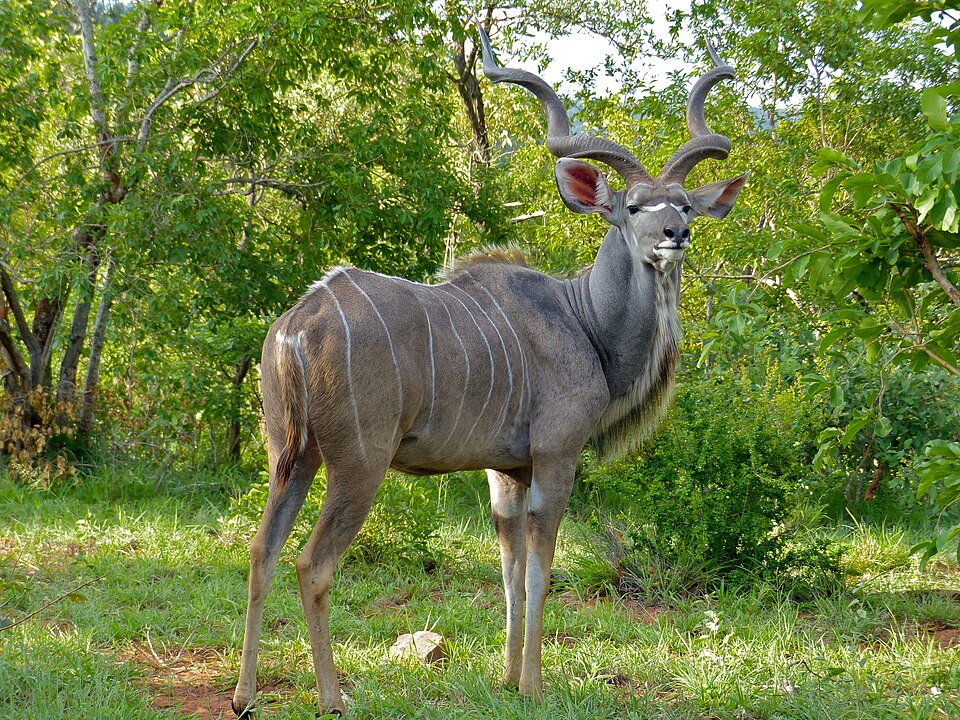
The Kudu is a large African antelope recognizable by the long twisted horns worn by the males. It belongs to the genus Tragelaphus and is found mainly in wooded and rocky areas of southern and eastern Africa. Its white-striped coat on a gray-brown background offers it effective camouflage in the wooded savannah. Discreet and shy, it lives in small groups and feeds mainly on foliage. Two main species are recognized: the large Kudu and the small Kudu.
The Kudu is distinguished by its large ears and, in the male, by spiral horns that can form up to two or three complete turns. The body is marked with six to ten white vertical stripes on the sides. Females lack horns and have a lighter silhouette. A dorsal mane and a fringe of hair under the throat complete its distinctive appearance.
Characteristics
Indicative values: they vary by subspecies, sex and region.
Habitat and distribution
The Kudu frequents wooded savannahs, rocky hills and areas of dense bush with significant plant cover. It generally avoids open plains lacking protective vegetation. Its presence strongly depends on the availability of water points and shaded areas.
CURRENT RANGE
The large Kudu is found mainly in southern and eastern Africa, including Namibia, South Africa, Zimbabwe and Tanzania. The small Kudu occupies a more restricted area, mainly in the Horn of Africa. The species is not present in North Africa or Tunisia.
Behaviour
The Kudu is a discreet and rather shy animal that avoids open areas, preferring the cover of brush. Females and young live in small family groups while adult males are often solitary or form small temporary groups. The species is mainly active at dawn and dusk. When threatened, the Kudu can leap over high obstacles with great agility.
Reproduction
Gestation lasts about eight months and usually gives birth to a single young. The female isolates her young in dense vegetation during the first weeks to protect them from predators. Weaning occurs after several months, and sexual maturity is reached around one to two years depending on the sex.
Peculiarities
The male's spiral horns, among the longest in the animal world among antelopes, are its most distinctive feature. Some local populations traditionally use these horns as a musical instrument or as a calling horn. Kudu is also known for its impressive jumps despite its imposing size.
Threats and conservation
The Kudu faces hunting pressure, particularly for its horns, which are highly sought after as trophies. Habitat loss linked to agricultural expansion and deforestation also reduces its refuge areas. Locally, epidemics such as rabies or certain viral diseases may have affected populations.
Numbers and trends vary across sources and regions. See the IUCN assessment for the latest reference data.
Gallery
1 documented photographs.
References
Profile updated 21 August 2026 · Reviewed by the TunisieVet editorial team.
Comments (0)
No comments yet.
CONSERVATION STATUS
Least concern (LC)
IUCN source, latest published assessment.
Species health
Documented diseases for this species.
See the 8 diseases of this species Find a veterinarianThis information is provided for educational purposes only and is not a substitute for a veterinary consultation. If you have any concerns about your animal's health, consult a veterinarian.
To discover around: Kudu
Videos, facts, stories and records linked to this species.
RECORD
Up to 1.2 m along the spiral
Longest spiral antelope horns
Measurement taken on the horns of adult male greater kudu.
Similar animals
Other species documented in Animalpedia.

TunisieVet in your pocket 📱🐾 Access your veterinary services wherever you are. [ Download the app ]
Learn more