
Presentation
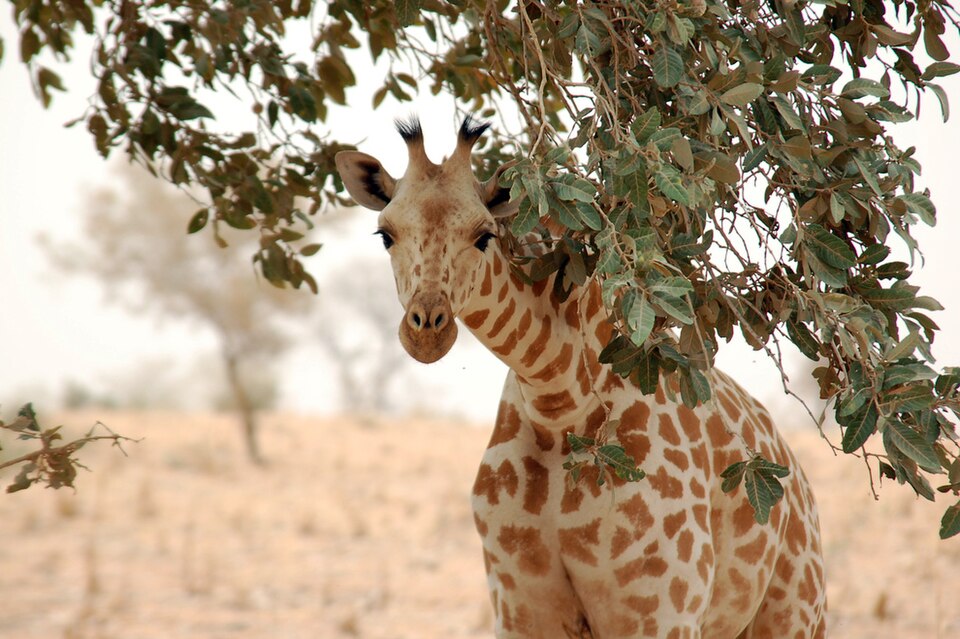
The Giraffe is the largest current land mammal, recognizable by its extraordinarily long neck and slender legs. This African artiodactyl has a coat spotted with brown and cream, a pattern unique to each individual. A peaceful herbivorous animal, the Giraffe is one of the most emblematic creatures of the African savannah.
The Giraffe is characterized by its exceptional stature and unique proportions: a very long neck supported by robust cervical vertebrae, front legs longer than the hind legs, and a fine tail ending in a plume of black hair. Its coat has polygonal reddish-brown spots separated by light lines, the pattern of which varies depending on the subspecies and the individual.
Did you know?
Why do giraffes have such long necks?
Characteristics
Indicative values: they vary by subspecies, sex and region.
Habitat and distribution
Giraffe inhabits open savannahs, tree-dotted grasslands, and transition zones between savannah and dry forest. It prefers areas with a good density of acacias and other foliiferous trees. It avoids very dense or completely treeless areas, as well as closed forests and arid deserts.
CURRENT RANGE
Giraffe is endemic to the African continent, with a fragmented distribution mainly in East and South Africa. It is found in particular in Kenya, Tanzania, Zambia, Zimbabwe, South Africa and Botswana. A few populations remain in West and Central Africa, notably in Niger. Its distribution area has been reduced considerably in recent centuries.
Behaviour
The Giraffe is a mainly diurnal and gregarious animal, living in herds which can reach several dozen individuals. It spends most of its day feeding, being able to ingest up to 35 kg of vegetation daily. Despite its size, it is a silent creature that communicates primarily through visual signals and infrasound.
Reproduction
Giraffe reaches sexual maturity between 3 and 4 years of age. Mating can occur at different times of the year depending on populations. After a gestation of approximately 14 to 15 months, the female gives birth to a single young, rarely two. The young are born with soft horns and reach their adult height around 6-7 years old.
Peculiarities
Giraffe's most notable adaptation is its exceptionally long neck, containing the same number of cervical vertebrae as most mammals but disproportionately elongated. Its hollow bones reduce its weight despite its size. The Giraffe's circulatory system has special adaptations to pump blood to its elevated brain, including a muscularized heart and anti-reflex valves.
Threats and conservation
The Giraffe faces several major threats: the loss and fragmentation of its habitat due to agricultural and urban expansion, poaching for its meat and derived products, and conflicts with humans over land use. Climate change is increasing drought and reducing the availability of vegetation. These factors have led to significant population declines.
Numbers and trends vary across sources and regions. See the IUCN assessment for the latest reference data.
Gallery
1 documented photographs.
References
UICN — Liste rouge des espèces menacées
Profile updated 30 August 2026 · Reviewed by the TunisieVet editorial team.
Comments (0)
No comments yet.
CONSERVATION STATUS
Vulnerable (VU)
IUCN source, latest published assessment.
Species health
Documented diseases for this species.
This information is provided for educational purposes only and is not a substitute for a veterinary consultation. If you have any concerns about your animal's health, consult a veterinarian.
Related species
To discover around: Giraffe
Videos, facts, stories and records linked to this species.
Similar animals
Other species documented in Animalpedia.

TunisieVet in your pocket 📱🐾 Access your veterinary services wherever you are. [ Download the app ]
Learn more