
Presentation
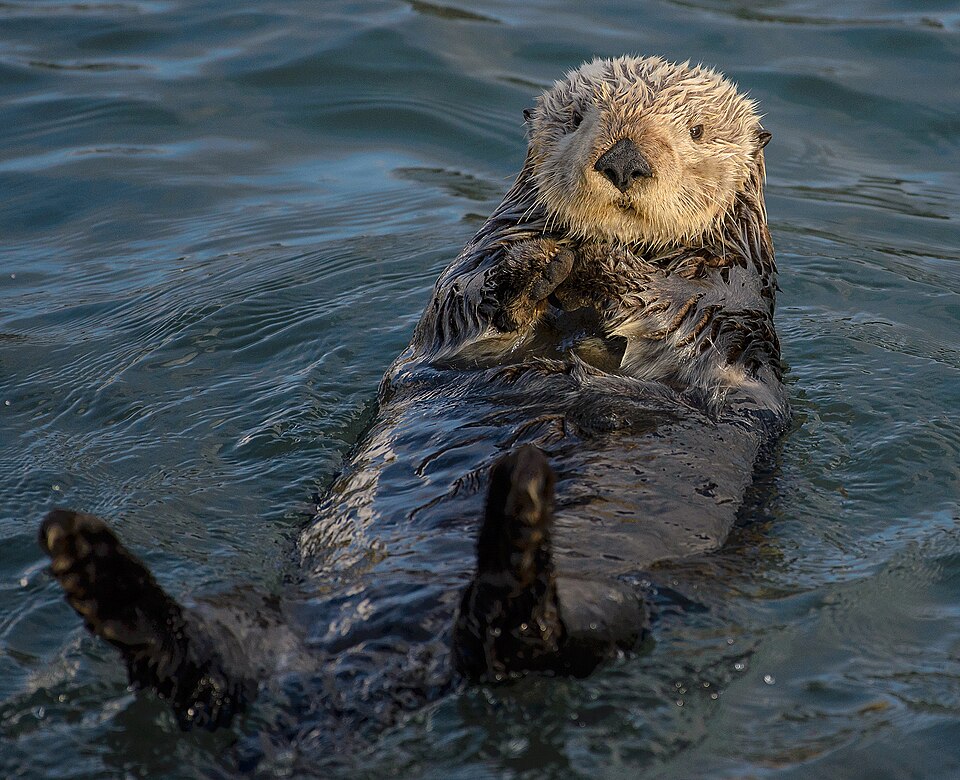
The sea otter (Enhydra lutris) is a carnivorous marine mammal living along the coasts of the northern Pacific Ocean. It is distinguished by its almost entirely aquatic lifestyle, spending most of its time floating on its back at the water's surface. Its extremely dense coat, the thickest fur in the animal kingdom, allows it to survive in cold water without an insulating blubber layer. It is known for using tools, particularly stones, to crack open the shells of its prey. A keystone species in coastal ecosystems, it regulates sea urchin populations and thereby protects kelp forests.
The sea otter has a streamlined body, short webbed hind feet, and a thick tail adapted for swimming. Its coat, composed of over one million hairs per square centimetre, traps an insulating layer of air against the cold. It has sensitive whiskers and front paws equipped with retractable pads that allow it to manipulate objects with dexterity.
Characteristics
Indicative values: they vary by subspecies, sex and region.
Habitat and distribution
The sea otter frequents shallow coastal waters, particularly rocky areas and kelp forests. It rarely ventures far from the shoreline and generally avoids the deep waters offshore. Some populations also inhabit sheltered bays and estuaries rich in invertebrates.
CURRENT RANGE
The species is found along the coasts of the North Pacific, from Russian Kamchatka to the Aleutian Islands and the west coast of North America, notably California. Its populations were severely reduced by commercial fur hunting from the 18th to 20th centuries. Reintroduction programs have allowed partial recolonization of its historical range.
Behaviour
The sea otter is a social animal that often groups together in rafts that may number several dozen individuals. It spends a large part of the day grooming to maintain the insulation of its coat, a condition vital to its survival. It sleeps floating on its back, sometimes wrapped in seaweed to avoid drifting, and is generally diurnal in its hunting activities.
Reproduction
The female gives birth to a single pup after a gestation period of approximately six to eight months, with possible delayed implantation. The pup is born with downy fur that prevents it from diving, making it highly dependent on its mother during the first few months. The mother carries her pup on her belly while floating and teaches it to hunt until weaning, around six months of age.
Peculiarities
The sea otter is one of the few non-primate mammals to use tools on a regular basis. It keeps a favourite rock that it carries in the loose fold of skin under its arm between dives. Its fur, unmatched in density among mammals, made it the primary target of the fur trade.
Threats and conservation
Main threats include marine pollution, notably oil spills that destroy the insulating properties of the fur, as well as collisions with boats. Competition with fishing operations and parasitic diseases also affect some populations. Past commercial hunting has left genetically diverse and vulnerable populations.
Numbers and trends vary across sources and regions. See the IUCN assessment for the latest reference data.
Gallery
1 documented photographs.
References
Profile updated 05 September 2026 · Reviewed by the TunisieVet editorial team.
Comments (0)
No comments yet.
CONSERVATION STATUS
Endangered (EN)
IUCN source, latest published assessment.
Species health
Documented diseases for this species.
Find a veterinarianThis information is provided for educational purposes only and is not a substitute for a veterinary consultation. If you have any concerns about your animal's health, consult a veterinarian.
To discover around: Sea Otter
Videos, facts, stories and records linked to this species.
RECORD
jusqu'à 1 million de poils/cm²
Le pelage le plus dense du règne animal
Mesure de la densité pilaire relevée chez des individus adultes en milieu naturel.
Similar animals
Other species documented in Animalpedia.

TunisieVet in your pocket 📱🐾 Access your veterinary services wherever you are. [ Download the app ]
Learn more