
Presentation
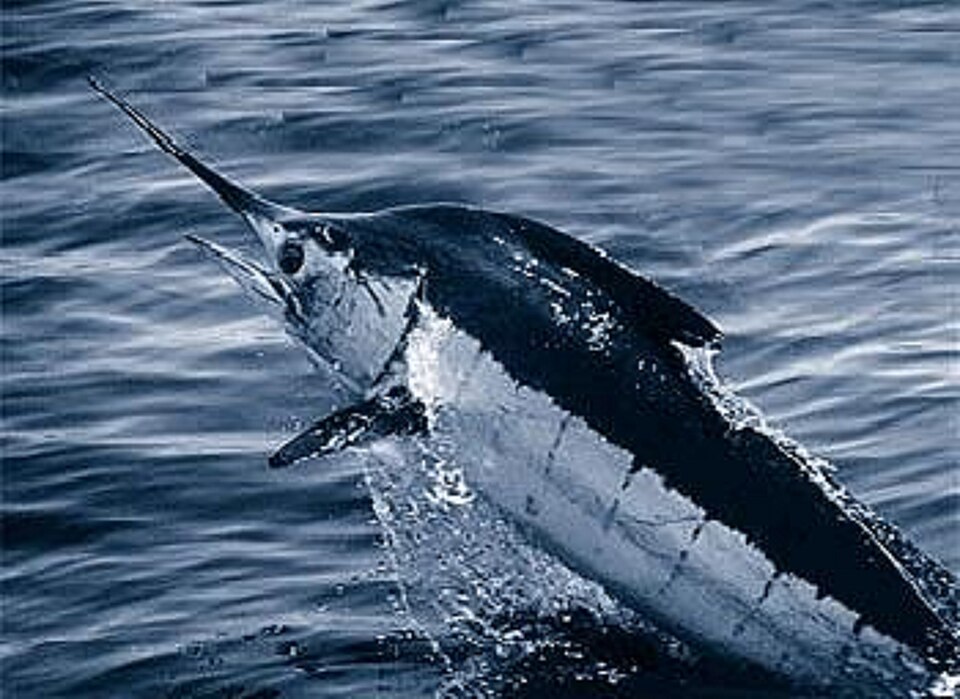
The Marlin is a large predatory fish of warm and temperate seas, recognizable by its elongated, lance-shaped rostrum and its high dorsal fin. It belongs to the Istiophoridae family, which includes several closely related species such as the blue Marlin and the black Marlin. This pelagic fish is renowned for its exceptional swimming speed and spectacular leaps out of the water. It constitutes an emblematic catch of big game fishing in many regions of the world. Its flesh is also eaten, although some species are threatened by overfishing.
The Marlin has a fusiform, muscular body, suitable for fast swimming in open water. Its pointed rostrum, an extension of the upper jaw, is used to stun its prey. Its silvery-blue skin and high, sail-shaped dorsal fin are characteristic of the genus.
Characteristics
Indicative values: they vary by subspecies, sex and region.
Habitat and distribution
The Marlin lives in warm and temperate ocean waters, mainly in the open ocean far from coasts. It frequents areas rich in prey, often near currents and deep water upwellings. It can, however, approach the coast during its migrations.
CURRENT RANGE
Marlin is present in the Atlantic, Pacific and Indian Oceans, in tropical and subtropical zones. Certain species occasionally frequent the Mediterranean. Its distribution follows warm waters favorable to its prey.
Behaviour
The Marlin is a solitary swimmer or moving in small loose groups, capable of reaching very high speeds when hunting. It carries out significant seasonal migrations following warm currents and concentrations of prey. It is known for its jumps out of the water when hooked by fishermen.
Reproduction
Marlin reproduces by spawning in the open sea, with females releasing several million eggs which are fertilized in open water. Larvae and juveniles develop in the open sea without parental care. Sexual maturity is reached after several years of growth.
Peculiarities
The Marlin's sword-like rostrum is its most distinctive feature and gives it its nickname "swordfish" in common parlance, although it is different from the true swordfish. It is one of the fastest fish in the ocean.
Threats and conservation
Overfishing, particularly linked to sport fishing and bycatch from longline fishing, threatens certain populations of Marlins. Marine pollution and climate change also affect its breeding grounds and food resources.
Numbers and trends vary across sources and regions. See the IUCN assessment for the latest reference data.
Gallery
1 documented photographs.
References
Profile updated 29 August 2026 · Reviewed by the TunisieVet editorial team.
Comments (0)
No comments yet.
CONSERVATION STATUS
Vulnerable (VU)
IUCN source, latest published assessment.
Species health
Documented diseases for this species.
This information is provided for educational purposes only and is not a substitute for a veterinary consultation. If you have any concerns about your animal's health, consult a veterinarian.
To discover around: Marlin
Videos, facts, stories and records linked to this species.
RECORD
up to 80 km/h
One of the fastest fish
Estimated top speed during short chase accelerations.

TunisieVet in your pocket 📱🐾 Access your veterinary services wherever you are. [ Download the app ]
Learn more