
Presentation
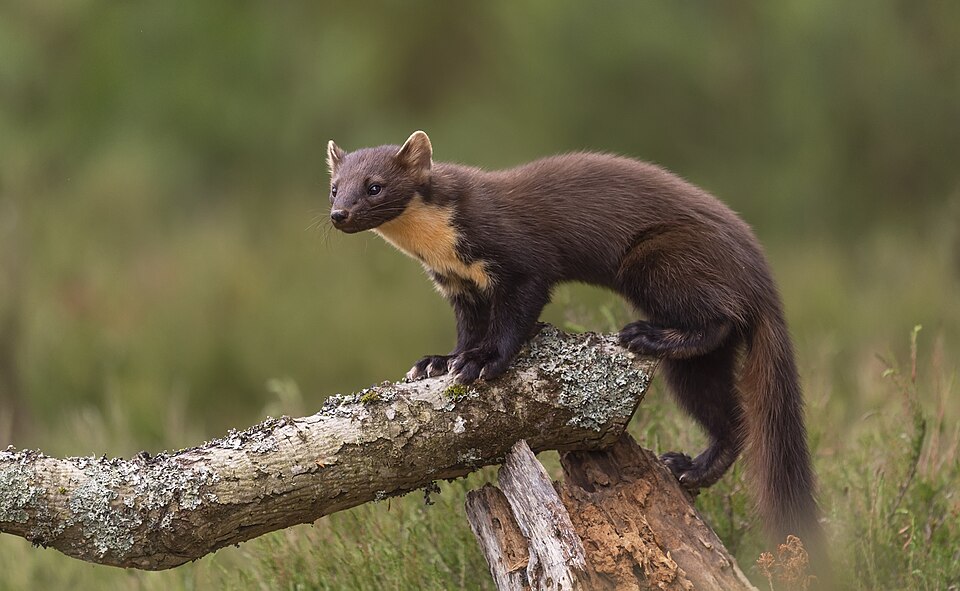
The Marten (Martes martes) is a small carnivorous mammal of the mustelid family, widespread in the forests of Europe and part of western Asia. It has an elongated, supple body, dark brown fur and a characteristic light throat patch. Discreet and mainly nocturnal, it is an excellent climber which hunts both on the ground and in trees. Its varied diet and adaptability allow it to occupy diverse forest habitats.
The Marten has a thin, elongated body measuring approximately 45 to 55 cm, extended by a bushy tail. Its fur is dark brown to reddish-brown, with a pale yellow to cream patch on the throat and chest. Its legs have semi-retractable claws adapted to arboreal life.
Characteristics
Indicative values: they vary by subspecies, sex and region.
Habitat and distribution
The Marten prefers mature forests of deciduous and coniferous trees offering numerous cavities for shelter. It also frequents wooded areas mixed with rocky or mountainous environments. She generally avoids environments that are too open or highly urbanized.
CURRENT RANGE
The species occurs across much of Europe, from the British Isles to the Urals, as well as Asia Minor and the Caucasus. It is not naturally present in North Africa or Tunisia. Its distribution generally follows the extension of temperate forest areas.
Behaviour
A solitary and territorial animal, the Marten is mainly active at dusk and at night. It marks its territory using scent glands and defends its home range against conspecifics of the same sex. An excellent climber, it moves with agility in the canopy to hunt or escape predators.
Reproduction
Mating occurs in summer, but embryo implantation is delayed until winter, a phenomenon called embryonic diapause. Females give birth in spring, giving birth to a litter of two to five young. The young are weaned after about two months and reach sexual maturity around one to two years.
Peculiarities
Marten has anal glands producing an odorous secretion used for territorial marking. Unlike many mustelids, it is particularly adapted to arboreal life thanks to its flexibility and agility. It is sometimes confused with the marten, a similar species but more dependent on anthropized environments.
Threats and conservation
The destruction and fragmentation of forest habitats poses a threat to some local populations. Marten is also trapped in some areas for its fur or due to conflicts with poultry farming. Overall, the species remains widespread and is not subject to a worrying widespread decline.
Numbers and trends vary across sources and regions. See the IUCN assessment for the latest reference data.
Gallery
1 documented photographs.
References
Profile updated 24 August 2026 · Reviewed by the TunisieVet editorial team.
Comments (0)
No comments yet.
CONSERVATION STATUS
Least concern (LC)
IUCN source, latest published assessment.
Species health
Documented diseases for this species.
See the 7 diseases of this species Find a veterinarianThis information is provided for educational purposes only and is not a substitute for a veterinary consultation. If you have any concerns about your animal's health, consult a veterinarian.
To discover around: Marten
Videos, facts, stories and records linked to this species.
Similar animals
Other species documented in Animalpedia.

TunisieVet in your pocket 📱🐾 Access your veterinary services wherever you are. [ Download the app ]
Learn more