
Presentation
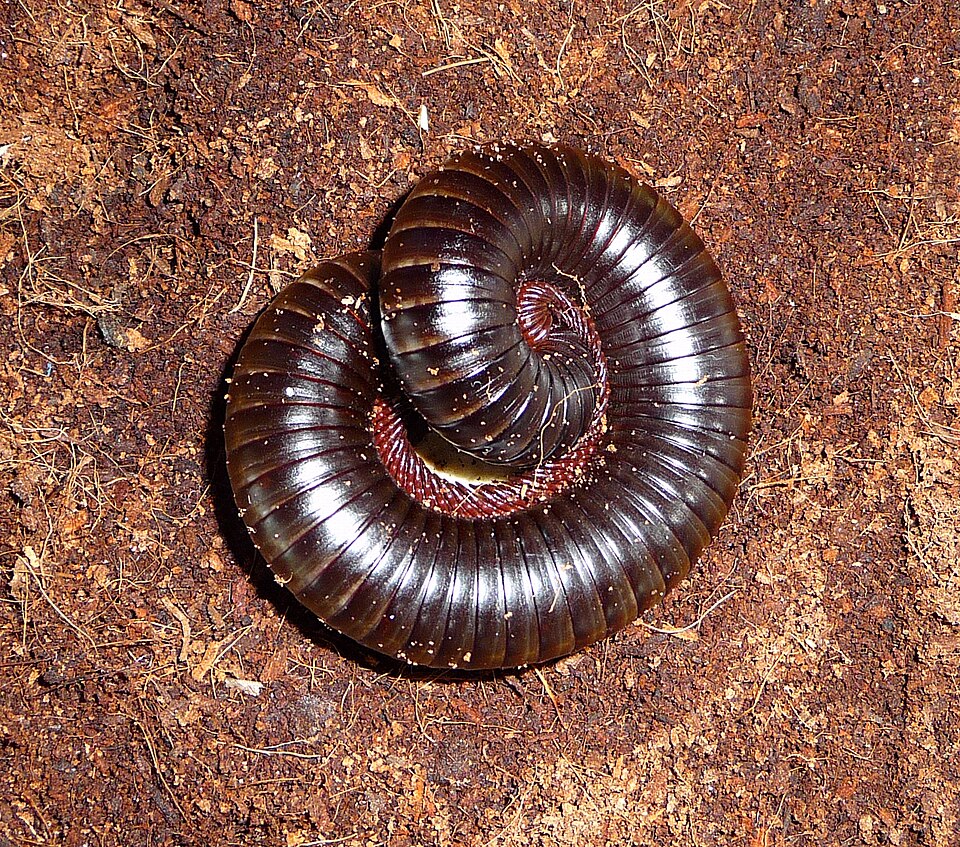
The giant millipede is a large myriapod native to the coastal forests of East Africa. Its cylindrical, segmented body is dark brown to violet in color and bears numerous short legs arranged in pairs on each segment. Despite its name suggesting a thousand legs, individual animals actually have several hundred. It is a detritivore, slow-moving and harmless to humans, and is often kept as a terrarium pet due to its docile nature. Its relatively long lifespan for an invertebrate and ease of care make it a popular choice among exotic pet enthusiasts. It also plays an important ecological role by breaking down dead plant material on the forest floor.
The body consists of between fifty and more than one hundred segments, each bearing two pairs of legs. The shell, called an exoskeleton, is rigid and dark-colored, sometimes marked with bands or rings of lighter color depending on the subspecies. The head bears two short sensory antennae and grinding mouthparts adapted to a plant-based diet. The legs move in coordinated waves, producing slow but effective locomotion.
Characteristics
Indicative values: they vary by subspecies, sex and region.
Habitat and distribution
The species lives in humid tropical forests and coastal wooded areas, where abundant soil moisture and leaf litter provide favorable conditions. It prefers loose soils rich in decomposing organic matter. It is rarely found far from vegetation cover, as it is sensitive to drying out.
CURRENT RANGE
The giant centipede originates from East Africa, particularly Kenya, Tanzania, and Mozambique. It is now widely distributed through the pet trade around the world. It is not part of the native fauna of North Africa or Tunisia.
Behaviour
It is a nocturnal and burrowing animal that hides during the day under leaf litter, stones, or in loose soil. It moves slowly and is not aggressive; when threatened, it coils into a spiral to protect its more vulnerable underside. It can secrete an irritating defensive substance through pores on its flanks, which poses no serious danger to humans but can cause skin irritation. It typically lives a solitary lifestyle.
Reproduction
Reproduction is oviparous; females lay several dozen to around one hundred eggs in a nest dug in moist soil. The young hatch with a reduced number of segments and legs, which they acquire progressively with each molt. Development to adulthood can take several months to a few years. Sexual maturity is reached after several successive molts.
Peculiarities
Despite its common name, this species never actually has a thousand legs, but rather between 200 and 300 depending on the individual. Its ability to coil in a defensive spiral and its notable longevity for a terrestrial arthropod make it a species of interest to researchers and popular in captive breeding.
Threats and conservation
The primary threat is to its natural forest habitat, which is shrinking due to deforestation and agricultural expansion in East Africa. Collection for the pet trade can locally affect certain wild populations. However, the species is not currently considered globally threatened.
Numbers and trends vary across sources and regions. See the IUCN assessment for the latest reference data.
Gallery
1 documented photographs.
References
Profile updated 08 September 2026 · Reviewed by the TunisieVet editorial team.
Comments (0)
No comments yet.
CONSERVATION STATUS
Data deficient (DD)
IUCN source, latest published assessment.
Species health
Documented diseases for this species.
This information is provided for educational purposes only and is not a substitute for a veterinary consultation. If you have any concerns about your animal's health, consult a veterinarian.
To discover around: Giant Millipede
Videos, facts, stories and records linked to this species.
RECORD
Up to 38.5 cm long
The largest centipede
Length measured in an adult specimen, the reference for the longest known myriapod species...
Similar animals
Other species documented in Animalpedia.

TunisieVet in your pocket 📱🐾 Access your veterinary services wherever you are. [ Download the app ]
Learn more