
Presentation
The Gila monster (Heloderma suspectum) is a large venomous lizard native to the southwestern United States and northwestern Mexico. It owes its name to the Gila River region of Arizona where it was first described. It is one of the few venomous lizards in the world, along with its close relative the Mexican beaded lizard. Its massive appearance, its bright colors and its discreet habits make it an emblematic species of the North American deserts. It is not present in Tunisia but is among the protected species worldwide due to its rarity and its scientific interest.
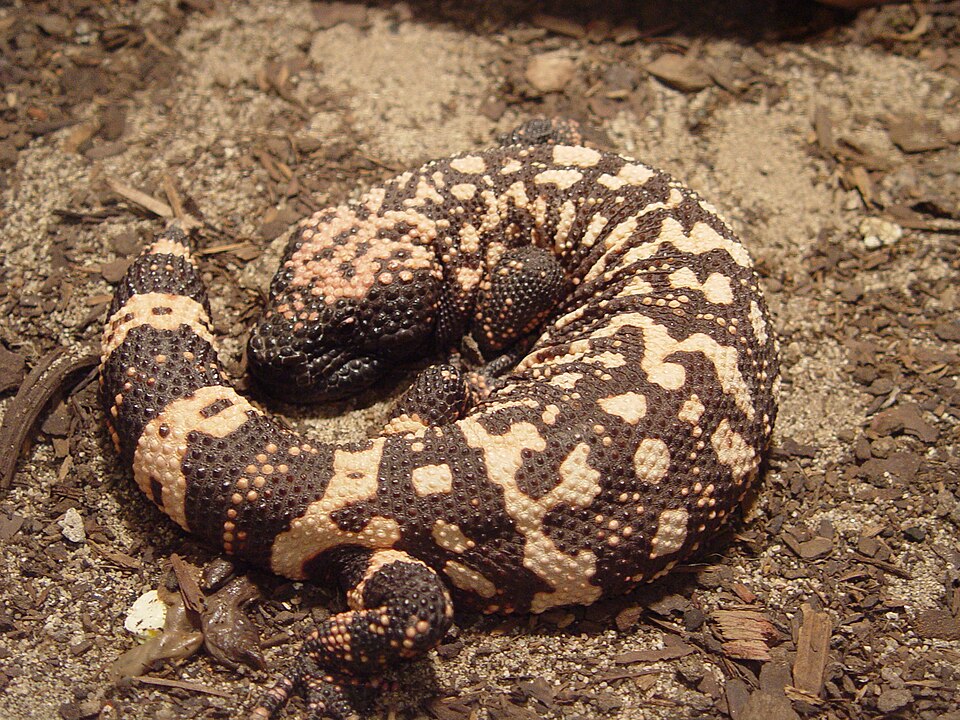
The Gila monster has a stocky body covered with black, pink, or orange beaded scales forming a characteristic reticulated pattern. Its short, thick tail serves as a fat reserve. It has venom glands located in the lower jaw, a rare feature among lizards. Its limbs are robust and clawed, adapted to burrowing.
Characteristics
Indicative values: they vary by subspecies, sex and region.
Habitat and distribution
The Gila monster frequents the deserts, brushy areas and rocky foothills of the American southwest. It likes soft soils allowing it to dig burrows or occupy those of other animals. It avoids overly arid areas devoid of vegetation and prefers the edges of seasonal watercourses or canyons.
CURRENT RANGE
The species occurs in deserts and arid areas of the southwestern United States, including Arizona, Nevada, Utah and New Mexico, as well as in northwestern Mexico. Its distribution is fragmented and linked to the availability of soft soils and rock shelters. It has no natural presence outside the North American continent.
Behaviour
The Gila monster is a slow and inactive reptile, spending most of its time in burrows or rock shelters. It is mainly twilight and diurnal depending on the season, coming out especially after rain or during the cooler hours. Its venomous bite, accompanied by a strong jaw, is mainly used for defense, the animal being generally not very aggressive if it is not handled. It can remain inactive for long periods of time by drawing on fat reserves stored in its tail.
Reproduction
Mating takes place in spring, after a period of ritual fights between males for access to females. The female lays 2 to 12 eggs which she buries in loose soil, usually in summer. Incubation lasts several months, and the young emerge the following spring, already autonomous and venomous from birth.
Peculiarities
The Gila monster is one of only two known venomous lizards in the world. Its venom, long studied, allowed the development of a drug against type 2 diabetes (exenatide), derived from an animal salivary protein. Its bite is powerful and prolonged, with the lizard chewing its venom into the wound rather than injecting it like a snake.
Threats and conservation
The species is threatened by desert habitat destruction, urbanization, and illegal collection for the exotic pet trade. It is protected by legislation in several American states and Mexico. International traffic is regulated by CITES.
Numbers and trends vary across sources and regions. See the IUCN assessment for the latest reference data.
Gallery
1 documented photographs.
References
Profile updated 02 September 2026 · Reviewed by the TunisieVet editorial team.
Comments (0)
No comments yet.
CONSERVATION STATUS
Near threatened (NT)
IUCN source, latest published assessment.
Species health
Documented diseases for this species.
This information is provided for educational purposes only and is not a substitute for a veterinary consultation. If you have any concerns about your animal's health, consult a veterinarian.
To discover around: Gila monster
Videos, facts, stories and records linked to this species.
RECORD
2 known species (genus Heloderma)
One of the only venomous lizards in the world
Observation based on the presence of functional venom glands in current lizards.
Similar animals
Other species documented in Animalpedia.

TunisieVet in your pocket 📱🐾 Access your veterinary services wherever you are. [ Download the app ]
Learn more