
Presentation
The Okapi is a forest mammal from Central Africa, which remained unknown to Western science for a long time until the beginning of the 20th century. Its reddish-brown coat and white and black stripes on its legs are reminiscent of the zebra, but it is actually the giraffe's closest living relative. Discreet and solitary, it lives in the dense forests of the Democratic Republic of Congo. Its long, prehensile tongue allows it to grasp leaves and buds with precision. The species is today threatened by deforestation, poaching and political instability in its range.
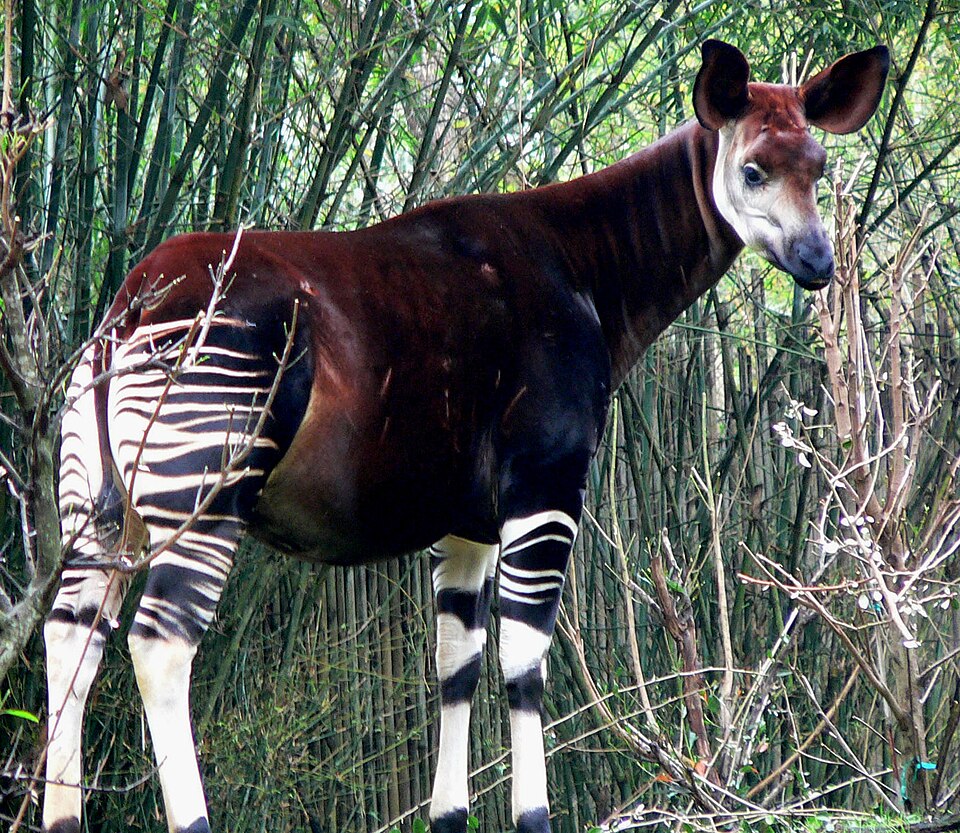
The Okapi has a stocky body similar to that of a miniature giraffe, with a long neck and large movable ears. Its coat is velvety chocolate brown, except on the rear and front legs, which are marked with horizontal white stripes. Males carry small ossicones covered with skin, absent in females. Its tongue, blue-purple, can measure up to 30 cm and is also used to clean its eyes and ears.
Characteristics
Indicative values: they vary by subspecies, sex and region.
Habitat and distribution
The Okapi lives exclusively in dense, humid tropical forests, often at moderate altitudes. It likes thick undergrowth offering both food and cover against predators such as leopards. This strict dependence on primary forest makes the species particularly vulnerable to deforestation.
CURRENT RANGE
Okapi is endemic to the Democratic Republic of Congo, where it mainly occupies the forests of the north and northeast of the country, particularly around the Okapis wildlife reserve. It does not exist in the wild anywhere else in the world. Its distribution is now fragmented due to habitat loss.
Behaviour
The Okapi is a solitary and discreet animal, active mainly at dusk and during the day in shaded areas. It marks its territory using scent glands located on its hooves and urine. Contacts between individuals are essentially limited to reproduction and mother-young relationships. Its keen hearing and large ears allow it to quickly detect predators.
Reproduction
The female gives birth to a single young after a gestation of approximately 14 to 15 months. The young remain hidden in the vegetation during the first weeks, a strategy which limits the risk of predation. Breastfeeding can continue for several months, although the little one begins to graze after a few weeks. Sexual maturity is reached around two to three years of age.
Peculiarities
The Okapi's striped coat acts as effective camouflage in the dappled light of the forest undergrowth. Its extendable tongue, comparable to that of giraffes, allows it to reach foliage inaccessible to other herbivores. Considered a living fossil due to its evolutionary antiquity, it was only scientifically described in 1901.
Threats and conservation
Deforestation linked to mining and agriculture continually reduces its natural habitat. Poaching, particularly for bushmeat, as well as political instability and armed conflict in its range complicate conservation efforts. The Okapis wildlife reserve constitutes an important refuge but itself remains threatened by illegal activities.
Numbers and trends vary across sources and regions. See the IUCN assessment for the latest reference data.
Gallery
1 documented photographs.
References
Profile updated 18 August 2026 · Reviewed by the TunisieVet editorial team.
Comments (0)
No comments yet.
CONSERVATION STATUS
Endangered (EN)
IUCN source, latest published assessment.
Species health
Documented diseases for this species.
See the 7 diseases of this species Find a veterinarianThis information is provided for educational purposes only and is not a substitute for a veterinary consultation. If you have any concerns about your animal's health, consult a veterinarian.
Similar animals
Other species documented in Animalpedia.

TunisieVet in your pocket 📱🐾 Access your veterinary services wherever you are. [ Download the app ]
Learn more