
Presentation
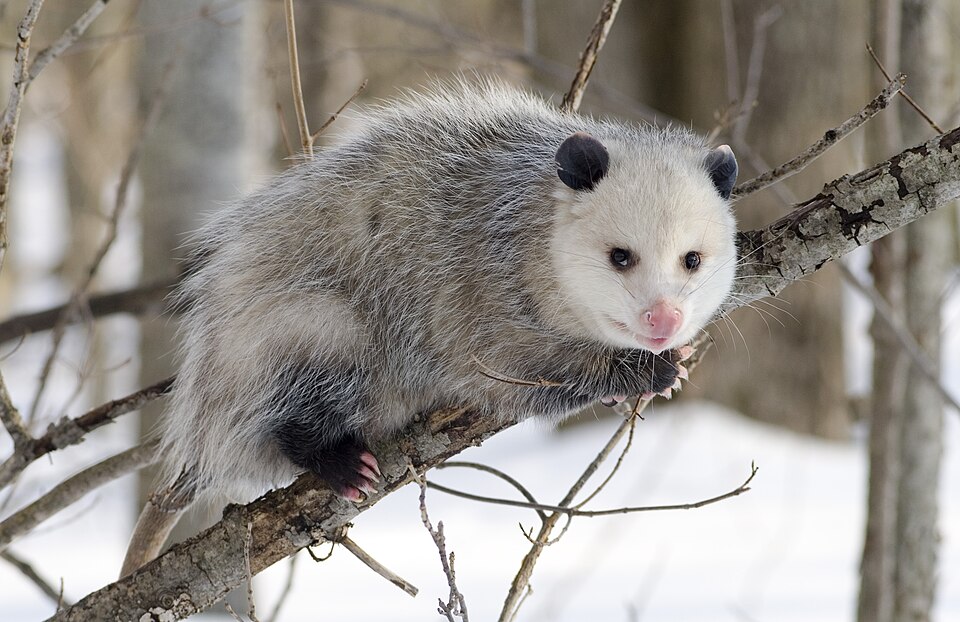
The Virginia Opossum (Didelphis virginiana) is a medium-sized marsupial, the only representative of this group present in North America. It is distinguished by its pointed snout, its prehensile hairless tail and its bristly grayish coat. An opportunistic and nocturnal animal, it has adapted well to proximity to humans, particularly in peri-urban areas. Its reputation as an effective scavenger makes it a useful ally for limiting ticks and small pests. Opossum has 50 teeth, a record among North American land mammals. Its prehensile tail serves as support for climbing and carrying nest materials. It has an opposable thumb on the rear legs, making it easier to grip the branches.
Characteristics
Indicative values: they vary by subspecies, sex and region.
Habitat and distribution
The Opossum frequents forests, humid wooded areas, meadows and peri-urban environments. It appreciates the proximity of water points and areas offering dense plant cover for hiding. Its capacity for adaptation also allows it to colonize gardens and the surroundings of human habitations.
CURRENT RANGE
The species is native to North and Central America, where it is widely distributed from the United States to Costa Rica. It has also been successfully introduced to the west coast of the United States. It has no natural distribution area outside the American continent.
Behaviour
Solitary and nocturnal, the Opossum is active mainly at nightfall. When faced with danger, it can adopt a thanatosis behavior, freezing by imitating a dead animal. It climbs trees skillfully using its prehensile tail and claws, although it spends much of its time on the ground.
Reproduction
The female has a marsupial pouch where the young, born very immature after a short gestation of around 12 to 13 days, continue their development. A litter can number up to twenty newborns, but only those reaching a teat survive, the number of teats being limited. The young then remain attached to the mother's back before becoming independent around the age of four to five months.
Peculiarities
Opossum is the only marsupial living naturally in North America. Its low body temperature makes it less receptive to the rabies virus. It also has notable resistance to snake venoms thanks to a specific blood protein.
Threats and conservation
The species is not globally threatened and its populations are considered stable. Major local threats include road collisions and predation by domestic dogs. Habitat loss linked to urbanization may affect some local populations.
Numbers and trends vary across sources and regions. See the IUCN assessment for the latest reference data.
Gallery
1 documented photographs.
References
Profile updated 26 August 2026 · Reviewed by the TunisieVet editorial team.
Comments (0)
No comments yet.
CONSERVATION STATUS
Least concern (LC)
IUCN source, latest published assessment.
Species health
Documented diseases for this species.
See the 4 diseases of this species Find a veterinarianThis information is provided for educational purposes only and is not a substitute for a veterinary consultation. If you have any concerns about your animal's health, consult a veterinarian.
To discover around: Opossum
Videos, facts, stories and records linked to this species.
Similar animals
Other species documented in Animalpedia.

TunisieVet in your pocket 📱🐾 Access your veterinary services wherever you are. [ Download the app ]
Learn more