
Presentation
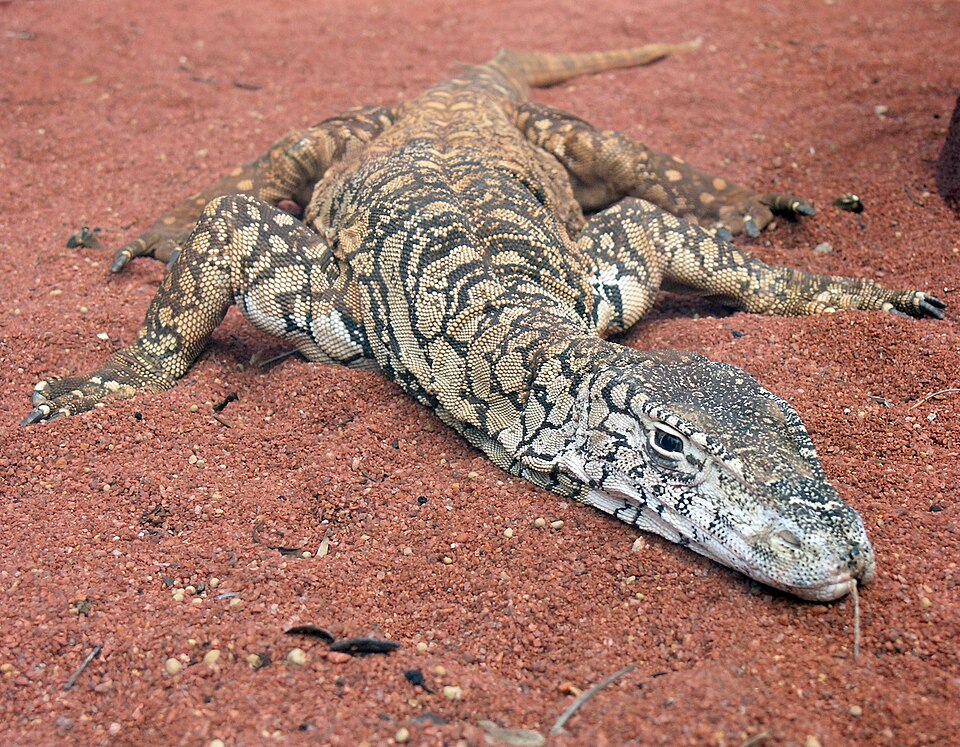
The Perentiee is the largest lizard in Australia and the fourth largest monitor lizard in the world. It has an elongated body covered with brown to yellowish scales decorated with light spots arranged in irregular bands. Its head is narrow, equipped with a forked tongue which it uses to detect prey by chemoreception. Its powerful limbs and long, tapered tail allow it to run quickly and climb rocks. This species lives in the arid, semi-desert regions of central Australia, where it occupies the top of the local food chain among reptiles.
The body is massive, covered with granular olive-brown scales with cream spots forming transverse rows. The tail, as long as the body, is compressed laterally and serves as support during the occasional bipedal position. The claws are long and sturdy, suitable for digging burrows and climbing rock outcrops.
Characteristics
Indicative values: they vary by subspecies, sex and region.
Habitat and distribution
The Perentie frequents rocky deserts, arid plains and semi-desert areas of the Australian interior. It particularly likes rocky outcrops and gorges which offer it shelter from the heat and predators. It is rarely found in wetter or coastal areas of the continent.
CURRENT RANGE
The species is endemic to Australia, where it mainly occupies the arid regions of central and western parts of the country. Its distribution covers much of the Australian outback, from sandy deserts to rocky plateaus. It is absent from fertile coastal areas and humid tropical regions of the north and east.
Behaviour
It is a solitary, diurnal animal, active mainly during the cooler hours of the day to avoid extreme heat. It takes refuge in deep burrows or rock crevices during periods of high heat. When faced with a threat, it may adopt an erect posture on its hind legs or lash vigorously with its tail. It is capable of running quickly short distances to escape predators or capture prey.
Reproduction
Breeding takes place in the austral spring, a period during which males may engage in ritual combat for access to females. The female lays between 6 and 12 eggs, which she often deposits in termite mounds, providing warmth and natural protection. Incubation lasts several months before the emergence of the young, completely autonomous from birth.
Peculiarities
The Perentie has venomous glands in its lower jaw, the secretions of which can cause swelling and pain in humans, although the bite is not fatal. It is an emblematic animal of Australian Aboriginal culture, associated with several traditional stories. Its ability to survive in extremely arid environments makes it a symbol of the resilience of Australian wildlife.
Threats and conservation
The species is not considered threatened on a global scale, its population appearing stable in its remote habitat. The main potential threats include predation by introduced foxes and cats on young individuals, as well as local habitat degradation through grazing. Too frequent bush fires can also affect its food resources.
Numbers and trends vary across sources and regions. See the IUCN assessment for the latest reference data.
Gallery
1 documented photographs.
References
Profile updated 19 August 2026 · Reviewed by the TunisieVet editorial team.
Comments (0)
No comments yet.
CONSERVATION STATUS
Least concern (LC)
IUCN source, latest published assessment.
Species health
Documented diseases for this species.
See the 8 diseases of this species Find a veterinarianThis information is provided for educational purposes only and is not a substitute for a veterinary consultation. If you have any concerns about your animal's health, consult a veterinarian.
To discover around: Perentie
Videos, facts, stories and records linked to this species.
RECORD
up to 2.5 m in length
Australia's largest lizard
Measurement taken from the tip of the snout to the tip of the tail on wild adult individua...
Similar animals
Other species documented in Animalpedia.

TunisieVet in your pocket 📱🐾 Access your veterinary services wherever you are. [ Download the app ]
Learn more