Presentation
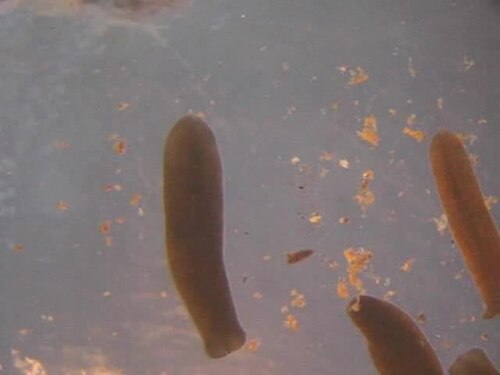
The planarian is an unsegmented flatworm belonging to the phylum Platyhelminthes, living mainly in freshwater, though some species are marine or inhabit moist terrestrial environments. Its elongated, flattened body typically measures between 5 and 30 millimetres depending on the species. It is best known for its exceptional regenerative ability: a severed fragment can develop into a complete individual. Its triangular head bears two light-sensitive spots resembling eyes, giving it a characteristic cross-eyed appearance. Discrete and relatively immobile, it moves by gliding across a thin layer of mucus using ventral cilia. It plays a minor but genuine role in aquatic food chains as a decomposer and predator of small invertebrates.
The soft, dorsoventrally flattened body has no skeleton, respiratory system, or differentiated circulatory system. The planarian breathes through direct cutaneous diffusion of oxygen. Its simple ladder-shaped nervous system is concentrated around a rudimentary cephalic ganglion. It is hermaphroditic, possessing both male and female reproductive organs.
Characteristics
Indicative values: they vary by subspecies, sex and region.
Habitat and distribution
Freshwater planarians live in rivers, streams, ponds, and lakes with calm, clean water, typically under stones or among aquatic vegetation. Some marine species inhabit rocky coastal zones, while tropical terrestrial species dwell in damp soils and forest litter. They favor environments rich in organic matter and are sensitive to water quality, making them a useful ecological indicator.
CURRENT RANGE
Planarians are found on all continents, in a wide range of aquatic and damp habitats. Freshwater species are particularly widespread in Europe, Asia, and North America, while terrestrial and marine forms exist in tropical regions. Their broad distribution reflects their strong ability to adapt to varied environmental conditions.
Behaviour
The planarian is a nocturnal and photophobic animal, actively avoiding light to take shelter under rocks or in silt. It moves slowly by ciliary gliding, leaving behind a trail of mucus. Its behaviour is essentially solitary, with no notable social interactions between individuals. It responds to chemical and tactile stimuli to locate food and avoid danger.
Reproduction
Planarians reproduce both sexually, through reciprocal exchange of sperm between two hermaphroditic individuals, and asexually by transverse division of the body. During asexual reproduction, the animal splits into two parts, each regenerating the missing organs to form two complete individuals. Eggs laid after sexual reproduction are enclosed in cocoons attached to submerged surfaces. This dual reproductive strategy gives planarians a strong capacity to colonize favorable environments.
Peculiarities
The regenerative capacity of planarians is among the most remarkable in the animal kingdom: a fragment representing only a small fraction of the body can reconstitute a complete individual within a few days. This property makes them a major scientific model for studying tissue regeneration and stem cells. Their two pigmented eyespots give them a slightly cross-eyed appearance, a trait often used for easy identification.
Threats and conservation
Planarians are not subject to particular conservation threats, their populations being generally stable and widely distributed. Freshwater pollution and degradation of water quality can locally reduce their numbers, as they are sensitive to chemical pollutants. They face no significant pressure from hunting, fishing, or commercial trade.
Numbers and trends vary across sources and regions. See the IUCN assessment for the latest reference data.
Gallery
1 documented photographs.
References
Profile updated 31 August 2026 · Reviewed by the TunisieVet editorial team.
Comments (0)
No comments yet.
CONSERVATION STATUS
Least concern (LC)
IUCN source, latest published assessment.
To discover around: Planarian
Videos, facts, stories and records linked to this species.
RECORD
Complete restoration from 1/279th of the body
The most extreme regeneration
Observed in laboratory settings in certain species of planarians that were experimentally...
Similar animals
Other species documented in Animalpedia.

Be among the first to use our app. Sign up and get early Google Play access.
Discover