
Presentation
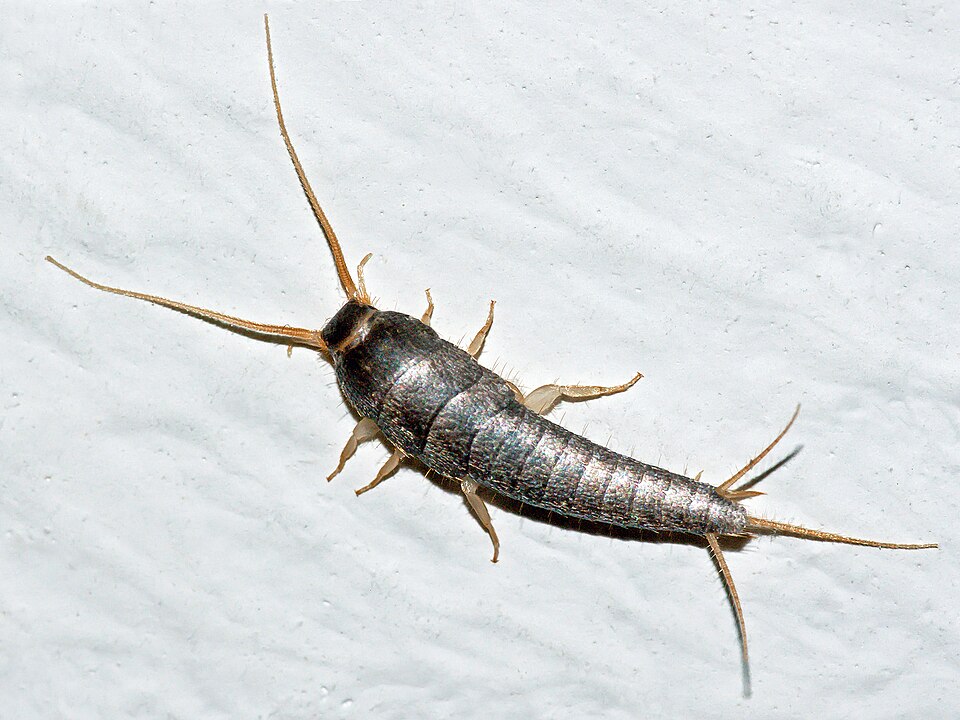
The silverfish is a primitive wingless insect recognizable by its elongated, tapered body covered in shiny silvery scales. It typically measures between 0.4 and 0.6 inches and moves through rapid undulating motions that resemble a fish swimming, which explains its name. This nocturnal insect favors dark, damp, and warm places in human homes. Evolutionarily ancient, it belongs to an order of insects that appeared long before winged insects. It is widely regarded as a household pest because of its varied diet. Its discreet nature and speed make direct observation fairly rare despite its frequent presence in homes.
Spindle-shaped body, flattened dorsoventrally, measuring 0.4 to 0.6 inches long, covered in gray to silvery scales. Three long tail-like filaments extend from the abdomen, along with two long thread-like antennae at the front. The insect lacks wings and has six short legs that enable very rapid movement. Its glossy cuticle and flexibility allow it to squeeze into the smallest crevices.
Characteristics
Indicative values: they vary by subspecies, sex and region.
Habitat and distribution
It prefers warm, humid environments such as bathrooms, kitchens, cellars, attics and libraries. It hides in crevices, under wallpaper or behind skirting boards during the day. It is occasionally found in natural habitats like under stones or bark, but today it is essentially associated with human dwellings.
CURRENT RANGE
The silverfish is found on virtually every continent due to its close association with human habitations. Probably originating from Mediterranean or Asian regions, it has spread worldwide through commerce and transport. It is common in Europe, North Africa, the Americas and Asia. In Tunisia, it is frequently observed in homes, particularly in humid areas such as bathrooms.
Behaviour
Strictly nocturnal, it avoids light and takes refuge in crevices, under furniture, or behind baseboards during the day. It moves through rapid, erratic undulating motions, making it difficult to catch. Mostly solitary, it can nonetheless gather in damp areas favorable for survival. It does not bite, does not transmit any known diseases to humans, and remains generally harmless despite its sometimes repulsive appearance.
Reproduction
The female lays her eggs in small clusters in cracks or sheltered places, depositing several dozen at a time. Development involves a series of successive moults without marked metamorphosis, with young insects already resembling miniature adults. The silverfish continues to moult throughout its adult life, which is rare among insects. Sexual maturity is reached after several months depending on temperature and humidity conditions.
Peculiarities
The silverfish ranks among the oldest insects still in existence, with an evolutionary lineage spanning several hundred million years. Unlike most insects, it continues to moult in adulthood throughout its life. Its ability to digest cellulose and adhesives makes it a dreaded inhabitant of libraries and archives.
Threats and conservation
The species is not threatened and is of no conservation concern, with populations being abundant and stable. It is instead considered a domestic pest that people seek to eliminate through pest control methods. Reducing humidity in buildings is the main way to limit its spread.
Numbers and trends vary across sources and regions. See the IUCN assessment for the latest reference data.
Gallery
1 documented photographs.
References
Profile updated 27 August 2026 · Reviewed by the TunisieVet editorial team.
Comments (0)
No comments yet.
CONSERVATION STATUS
Least concern (LC)
IUCN source, latest published assessment.
Similar animals
Other species documented in Animalpedia.

📱 عندك صفحة على فايسبوك؟ باهي… أما وين موقعك؟ الصفحة وحدها ما تكفيش. موقعك يخلي الناس تلقاك، يعرفوك أكثر ويثقو في خدمتك. 🌐 موقع باسم مشروعك 📲 يخدم أربعة وعشرين ساعة 🤝 يعطي ثقة واحترافية .📈 يعاونك تكبّر خدمتك خلّيه موجود وين الناس تلوّج عليه 🚀نعملولك موقع يشرّف مشروعك
WhatsApp