
Presentation
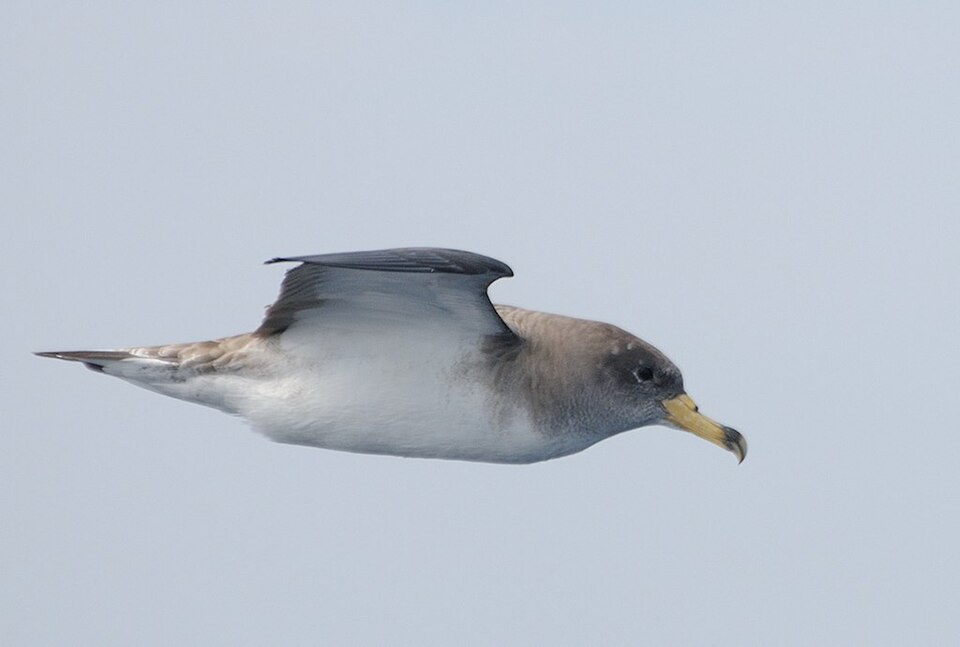
The shearwater is a pelagic seabird belonging to the petrel family, related to albatrosses. Its streamlined body, long narrow wings enable a gliding flight skimming the wave tops, a characteristic technique called shearing. It spends most of its life at sea and returns to land only to breed, often on rocky islands and islets. Several shearwater species frequent the Mediterranean, including the coasts of Tunisia, especially during migration and nesting periods. Its plumage is typically dark above and pale below, a discreet pattern that aids camouflage in flight over the water. It produces harsh, guttural calls, especially at night near colonies.
The shearwater has a fine, hooked bill suited to capturing fish and squid. Its tubular nostrils, typical of procellariiformes, allow it to excrete excess salt ingested at sea. Its rigid, narrow wings promote energy-efficient flight over long distances.
Characteristics
Indicative values: they vary by subspecies, sex and region.
Habitat and distribution
Puffins inhabit open ocean and coastal waters, coming ashore only to breed. They select rocky islands and islets free of terrestrial predators to establish their colonies. In the Mediterranean, they nest notably on coastal archipelagos, including those around Tunisia.
CURRENT RANGE
Puffins are found in oceans worldwide, with high species diversity in the Mediterranean, Atlantic, and Pacific. In Tunisia, species such as the cinereous shearwater and Yelkouan shearwater frequent the coasts and islands, particularly the Galite archipelago and the Kerkennah Islands. Mediterranean populations sometimes migrate to the Atlantic outside the breeding season.
Behaviour
The shearwater is a gregarious bird forming large breeding colonies on isolated islands. It is active at night on land to avoid aerial predators, making its colonies particularly loud after sunset. At sea, it often flies in tight groups, alternating wing beats with long glides just above the water surface.
Reproduction
Puffins nest in burrows, rocky crevices, or under low vegetation on islands. The female lays a single egg per season, incubated alternately by both parents for about six to eight weeks. The chick remains in the nest for several weeks before fledging alone to sea, without parental guidance.
Peculiarities
Puffins possess a highly developed sense of smell, unusual among birds, which helps them locate food and burrows within dense colonies. Their ability to fly close to the water surface with minimal wing effort represents a remarkable adaptation to pelagic life. They undertake transoceanic migrations covering thousands of kilometres.
Threats and conservation
Puffins are threatened by predation of eggs and chicks by introduced species such as rats and cats on breeding islands. Light pollution disorients fledglings during their first flight to sea. Accidental fishing bycatch and coastal habitat degradation also impact certain Mediterranean populations.
Numbers and trends vary across sources and regions. See the IUCN assessment for the latest reference data.
Gallery
1 documented photographs.
References
Profile updated 08 September 2026 · Reviewed by the TunisieVet editorial team.
Comments (0)
No comments yet.
CONSERVATION STATUS
Near threatened (NT)
IUCN source, latest published assessment.
Species health
Documented diseases for this species.
See the 4 diseases of this species Find a veterinarianThis information is provided for educational purposes only and is not a substitute for a veterinary consultation. If you have any concerns about your animal's health, consult a veterinarian.
Similar animals
Other species documented in Animalpedia.

TunisieVet in your pocket 📱🐾 Access your veterinary services wherever you are. [ Download the app ]
Learn more