
Presentation
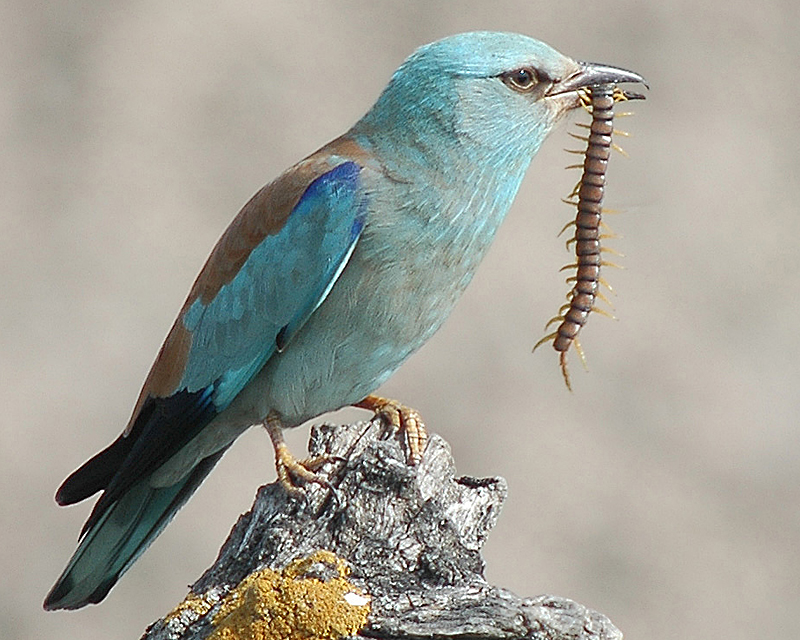
The European Roller (Coracias garrulus) is a bird with vibrant turquoise-blue plumage that contrasts strikingly with a reddish-brown back. About the size of a pigeon, it stands out for its acrobatic flight, marked by spectacular rolls and dives, especially during breeding season. A trans-Saharan migrant, it leaves Europe and the Maghreb in late summer to winter in sub-Saharan Africa. In Tunisia, it frequents open agricultural areas and wooded steppes where it hunts from a perch. Its numbers are declining across much of its range due to loss of natural habitats.
The Roller measures approximately 30 to 32 cm in length with a wingspan of about 66 cm. Its turquoise-blue plumage on the head, belly, and wings contrasts with a characteristic reddish-brown mantle. Its beak is strong, black, and slightly hooked, adapted for capturing prey on the ground. In flight, the contrasting colours of its wings are particularly striking.
Characteristics
Indicative values: they vary by subspecies, sex and region.
Habitat and distribution
The roller frequents open and semi-open habitats such as wooded steppes, traditional agricultural areas, and savannas. It favors landscapes scattered with isolated trees or old orchards that provide nesting cavities and hunting perches. In Tunisia, it is found mainly in rural zones and oases of the central and southern regions during periods of migration.
CURRENT RANGE
The roller's breeding range extends from southern Europe and the Maghreb to central Asia. The population winters in sub-Saharan Africa, particularly in East and southern Africa. Tunisia serves as both a local breeding area and an important migration corridor between Europe and Africa.
Behaviour
The Roller is a solitary bird or lives in pairs during the breeding season, becoming more gregarious during migration. It is renowned for its spectacular aerial displays, consisting of steep dives and rolls from which it gets its name. Territorial during nesting, it actively defends the area around its nest against intruders. It is a diurnal migrant that travels long distances between Europe and sub-Saharan Africa.
Reproduction
The roller nests in natural cavities, often former woodpecker holes, in trees, cliff faces, or sometimes buildings. The female typically lays 4 to 6 white eggs, incubated for approximately 18 to 19 days by both parents. Young remain in the nest for about 4 weeks before fledging, fed by both adults. Only one brood is raised per year.
Peculiarities
The name 'roller' comes from the acrobatic rolls it performs in its nuptial flight, dropping and spinning on itself. Its bright blue plumage makes it one of the most colorful birds of Europe and North Africa. It is sometimes confused with the kingfisher due to its colors, although it belongs to a different family.
Threats and conservation
The roller is threatened by loss of its natural habitats, particularly the disappearance of old cavity-bearing trees and agricultural intensification. Pesticide use reduces its insect food resources. Illegal hunting along migration routes also poses a threat in certain regions.
Numbers and trends vary across sources and regions. See the IUCN assessment for the latest reference data.
Gallery
1 documented photographs.
References
Profile updated 06 September 2026 · Reviewed by the TunisieVet editorial team.
Comments (0)
No comments yet.
CONSERVATION STATUS
Near threatened (NT)
IUCN source, latest published assessment.
Species health
Documented diseases for this species.
See the 4 diseases of this species Find a veterinarianThis information is provided for educational purposes only and is not a substitute for a veterinary consultation. If you have any concerns about your animal's health, consult a veterinarian.
Similar animals
Other species documented in Animalpedia.

TunisieVet in your pocket 📱🐾 Access your veterinary services wherever you are. [ Download the app ]
Learn more