
Presentation
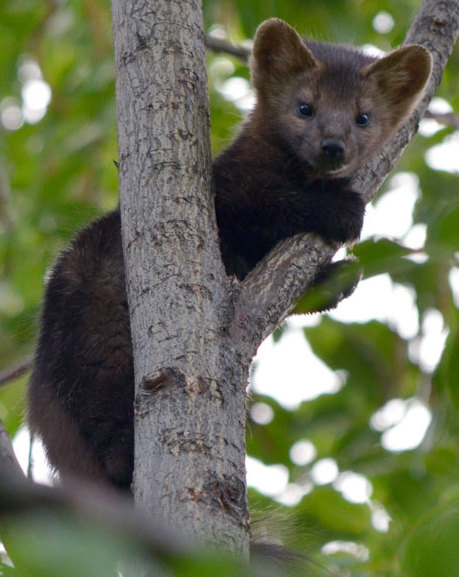
The Sable (Martes zibellina) is a small carnivorous mammal from the mustelid family, close to the marten, renowned for its dense and silky fur. It lives in the boreal forests of Siberia and the Russian Far East, as well as in Mongolia, northern China, Kazakhstan and Japan (Hokkaidō). Historically hunted intensively for its fur, it was the subject of a flourishing trade which long threatened its populations. Today, hunting management programs and captive breeding make it possible to exploit the resource while preserving wild populations. It is a solitary, discreet and territorial animal, active mainly at dusk and at night. It remains a strong cultural symbol in Russia, particularly in Siberia.
The Sable measures between 35 and 56 cm long, not including the 9 to 18 cm bushy tail. Its coat varies from light brown to almost black brown, with a characteristic light patch on the throat. Its body is elongated and flexible, adapted to life in trees and dense undergrowth. Its legs have semi-retractable claws useful for climbing and hunting.
Characteristics
Indicative values: they vary by subspecies, sex and region.
Habitat and distribution
Sable favors dense boreal forests, particularly taiga composed of conifers such as pine, spruce and larch. It favors areas with abundant undergrowth offering numerous hiding places and good availability of prey. It is also found in mixed forests and in mountains up to moderate altitudes. It avoids environments that are too open or devoid of forest cover.
CURRENT RANGE
The species is present mainly in Russia, from the Urals to the Siberian Far East, as well as in Kazakhstan, Mongolia, northeast China and Japan on the island of Hokkaidō. It has been successfully introduced into certain regions where it had disappeared due to hunting. Its distribution generally follows the extent of the Eurasian taiga. It is absent from North Africa and the Tunisian continent.
Behaviour
A solitary and territorial animal, the Sable marks its domain using odorous glandular secretions. It is mainly crepuscular and nocturnal, although it can be active during the day in winter. An excellent climber, it moves as easily on the ground as in low branches. It does not build permanent burrows but uses natural cavities, hollow stumps or abandoned burrows as temporary shelters.
Reproduction
Mating takes place in summer, between June and August, but gestation experiences delayed implantation which delays embryonic development by several months. Birth occurs the following spring, after an effective gestation of approximately one month. The female gives birth to 1 to 7 young, most often 2 to 4, in a sheltered nest. The young are weaned around two months and reach sexual maturity around 15 to 18 months.
Peculiarities
Sable fur has been considered one of the most valuable in the world for centuries, having motivated the Russian colonization of Siberia. Its delayed implantation gestation is a remarkable adaptation allowing births to be synchronized with favorable climatic conditions. The term "sable" in heraldry and the fur industry derives directly from its name.
Threats and conservation
Intensive hunting for fur has greatly reduced wild populations over the past centuries. Today, the species benefits from regulated hunting quotas and captive breeding which limits pressure on natural populations. The destruction of its forest habitat through logging remains a localized threat. Overall, populations are considered stable thanks to these management measures.
Numbers and trends vary across sources and regions. See the IUCN assessment for the latest reference data.
Gallery
1 documented photographs.
References
Profile updated 24 August 2026 · Reviewed by the TunisieVet editorial team.
Comments (0)
No comments yet.
CONSERVATION STATUS
Least concern (LC)
IUCN source, latest published assessment.
Species health
Documented diseases for this species.
See the 7 diseases of this species Find a veterinarianThis information is provided for educational purposes only and is not a substitute for a veterinary consultation. If you have any concerns about your animal's health, consult a veterinarian.
To discover around: Sable
Videos, facts, stories and records linked to this species.
Similar animals
Other species documented in Animalpedia.

TunisieVet in your pocket 📱🐾 Access your veterinary services wherever you are. [ Download the app ]
Learn more