
Presentation
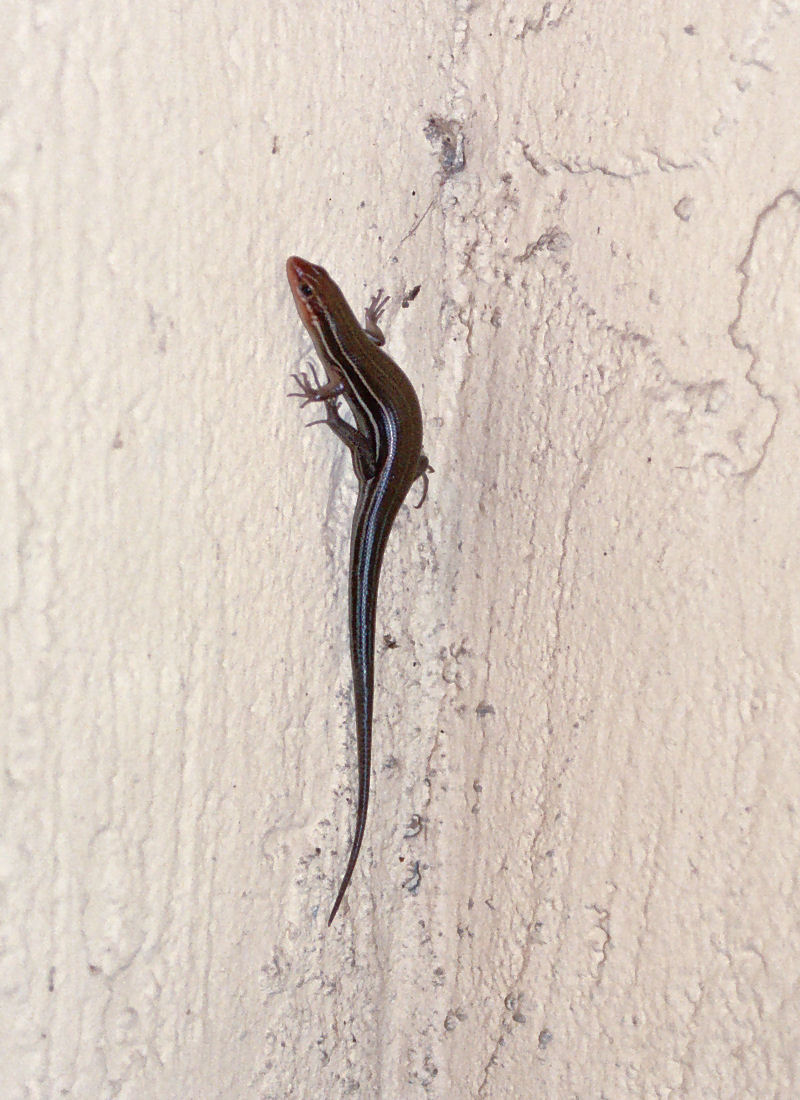
The Skink is a lizard with an elongated, cylindrical body, covered in smooth, shiny scales that give it a shiny appearance. This family brings together several hundred species distributed on almost all continents, with a great diversity of sizes and colors. In Tunisia and the desert regions of North Africa, the sand Skink is particularly well known, often nicknamed "sand fish" because of its ability to move in the sand as if it were swimming. Many species of Skinks are also raised in terrariums as new pets. Their burrowing lifestyle and their reduced or absent legs in certain species distinguish them from other lizards. They play an important ecological role by regulating insect populations.
The body is fusiform, covered with smooth, interlocking scales which limit friction when moving through sand or vegetation. The legs are often short, reduced or even absent depending on the species, which favors an undulating movement close to that of a snake. The head is conical, with no clear demarcation from the neck, making it easier to search the substrate. Coloration varies from dull brown to metallic gold depending on species and habitat.
Characteristics
Indicative values: they vary by subspecies, sex and region.
Habitat and distribution
Skinks occupy a wide variety of environments depending on the species, from sandy deserts to tropical rainforests. North African and Saharan species favor dunes and loose sandy soils suitable for burial. Other species live under stones, forest litter or in savannah areas. This adaptability explains their wide global geographic distribution.
CURRENT RANGE
The Scincidae family is present on almost all continents, with the exception of the polar regions. In North Africa, including Tunisia, the sand Skink occupies the desert and steppe zones of the Sahara and its margins. Other species are widely distributed in Asia, Oceania, southern Europe and the Americas. It is one of the most diverse and widely distributed families of lizards in the world.
Behaviour
The Skink is a mainly diurnal and solitary animal, active mainly during the hottest hours of the day in desert areas. It spends much of its time buried in sand or under stones to escape predators and regulate its body temperature. Its ability to “swim” in loose sand using undulatory body movements is a striking behavioral characteristic. Faced with danger, certain species can lose their tail by autotomy to escape a predator.
Reproduction
Reproduction is generally oviparous, with the female laying several eggs which she buries in sand or loose substrate. Some species are ovoviviparous and give birth to already formed juveniles. Incubation lasts from a few weeks to two months depending on the ambient temperature. The young are independent from hatching or birth and receive no parental care.
Peculiarities
Particularly remarkable is the ability of some Skinks to move through sand like a fish through water, thanks to a smooth body and undulating movements. In several species, the eyelids are transparent and fused, forming a sort of protective lens against sand. Caudal autotomy, that is to say the ability to voluntarily sever one's tail to escape a predator, is a trait shared with many other lizards.
Threats and conservation
The destruction and fragmentation of desert and sandy habitats, particularly through urbanization and agriculture, threaten certain local populations. The pet trade exerts collection pressure on certain species sought after in terrariums. Most common species, however, are not considered globally threatened.
Numbers and trends vary across sources and regions. See the IUCN assessment for the latest reference data.
Gallery
1 documented photographs.
References
Profile updated 01 September 2026 · Reviewed by the TunisieVet editorial team.
Comments (0)
No comments yet.
CONSERVATION STATUS
Least concern (LC)
IUCN source, latest published assessment.
Species health
Documented diseases for this species.
This information is provided for educational purposes only and is not a substitute for a veterinary consultation. If you have any concerns about your animal's health, consult a veterinarian.
To discover around: Skink
Videos, facts, stories and records linked to this species.
Similar animals
Other species documented in Animalpedia.

TunisieVet in your pocket 📱🐾 Access your veterinary services wherever you are. [ Download the app ]
Learn more