
Presentation
The Galapagos giant turtle (Chelonoidis niger) and the Aldabra giant turtle (Aldabrachelys gigantea) are the largest extant land turtles. They are distinguished by their massive domed carapace and their exceptional longevity, which make them symbols of robustness in the animal kingdom. Endemic to isolated islands, respectively the Galapagos archipelago and the Aldabra atoll, they evolved in the absence of significant terrestrial predators. Their herbivorous diet and slow metabolism allow them to survive long periods without food or water. They were intensively hunted by sailors in the 18th and 19th centuries for their meat, which greatly reduced their populations. Today protected, they are the subject of strict conservation programs.
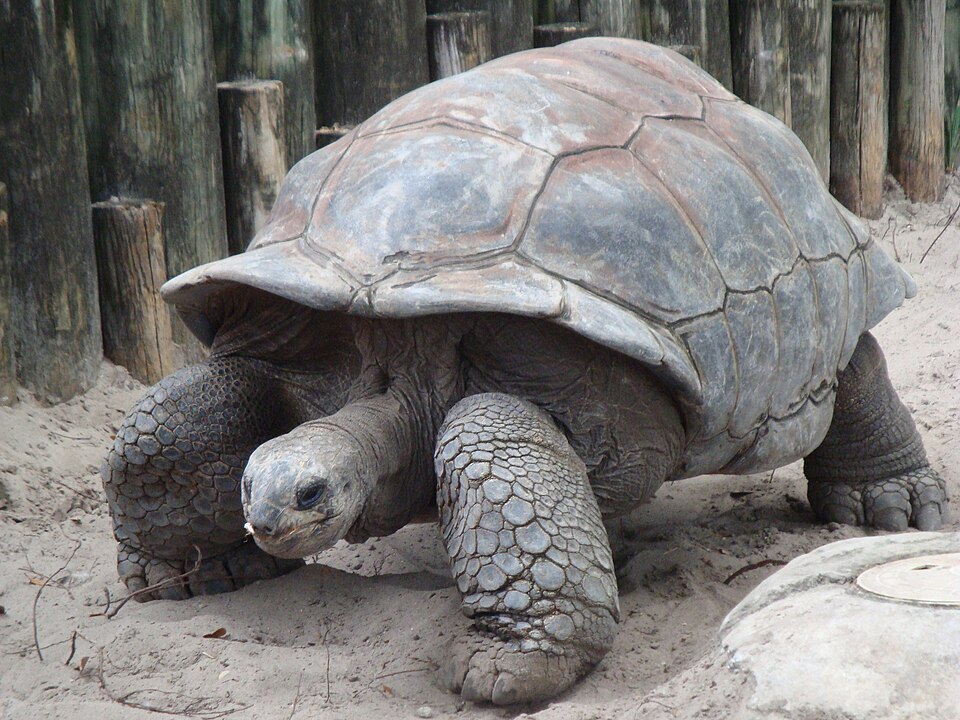
The domed carapace, dark brown to black in color, can measure more than a meter long and has a dome or saddle shape depending on the population. The limbs are thick and columnar, adapted to carrying considerable body weight. The neck is long and can stretch to reach tall vegetation, particularly in saddle-shelled individuals. The head is small in relation to the body and devoid of teeth, replaced by a sharp horny beak.
Characteristics
Indicative values: they vary by subspecies, sex and region.
Habitat and distribution
Giant tortoises live in varied island habitats including grassy areas, dry forests, scrub areas and coastal mangroves. They also frequent wetlands and temporary pools where they bathe. Their distribution is strictly limited to a few isolated islands or atolls due to their insular evolutionary origin.
CURRENT RANGE
Galapagos giant turtle is endemic to the Galapagos Archipelago, Ecuador, where several subspecies occupy distinct islands. Aldabra giant turtle is endemic to the Aldabra Atoll in the Indian Ocean, belonging to Seychelles. These isolated island populations have led to notable morphological diversification between islands.
Behaviour
A diurnal and generally solitary animal, it spends a large part of the day feeding or warming up in the sun. Its pace is very slow, consistent with its reduced metabolism. Individuals sometimes congregate around waterholes or wallowing areas, where they wallow in the mud to regulate their temperature and get rid of parasites. Males may engage in neck fighting during the breeding season to establish a hierarchy.
Reproduction
The female digs a nest in the sandy soil to lay ten to thirty eggs depending on the species. Incubation lasts several months and the temperature of the nest influences the sex of future individuals. The young, completely autonomous from hatching, receive no parental care. Sexual maturity is reached late, generally between 20 and 25 years of age.
Peculiarities
The shape of the carapace, dome or saddle, reflects a direct adaptation to the type of vegetation available on each island. The species is capable of surviving more than a year without eating or drinking thanks to water and fat reserves. Its longevity is among the highest in the animal kingdom, with some individuals having exceeded 150 years.
Threats and conservation
The introduction of rats, goats and pigs by sailors has long threatened the eggs and young as well as the vegetation on which the species depends. Historical hunting for meat and oil decimated several island populations. Climate change and the degradation of island habitats remain current threats despite protective measures.
Numbers and trends vary across sources and regions. See the IUCN assessment for the latest reference data.
Gallery
1 documented photographs.
References
Profile updated 01 September 2026 · Reviewed by the TunisieVet editorial team.
Comments (0)
No comments yet.
CONSERVATION STATUS
Vulnerable (VU)
IUCN source, latest published assessment.
Species health
Documented diseases for this species.
This information is provided for educational purposes only and is not a substitute for a veterinary consultation. If you have any concerns about your animal's health, consult a veterinarian.
To discover around: giant turtle
Videos, facts, stories and records linked to this species.
RECORD
up to 1.3 m long and 400 kg
The largest land turtle
Measurement taken on the largest wild adult individuals from Galapagos and Aldabra.
Similar animals
Other species documented in Animalpedia.

TunisieVet in your pocket 📱🐾 Access your veterinary services wherever you are. [ Download the app ]
Learn more