
Presentation
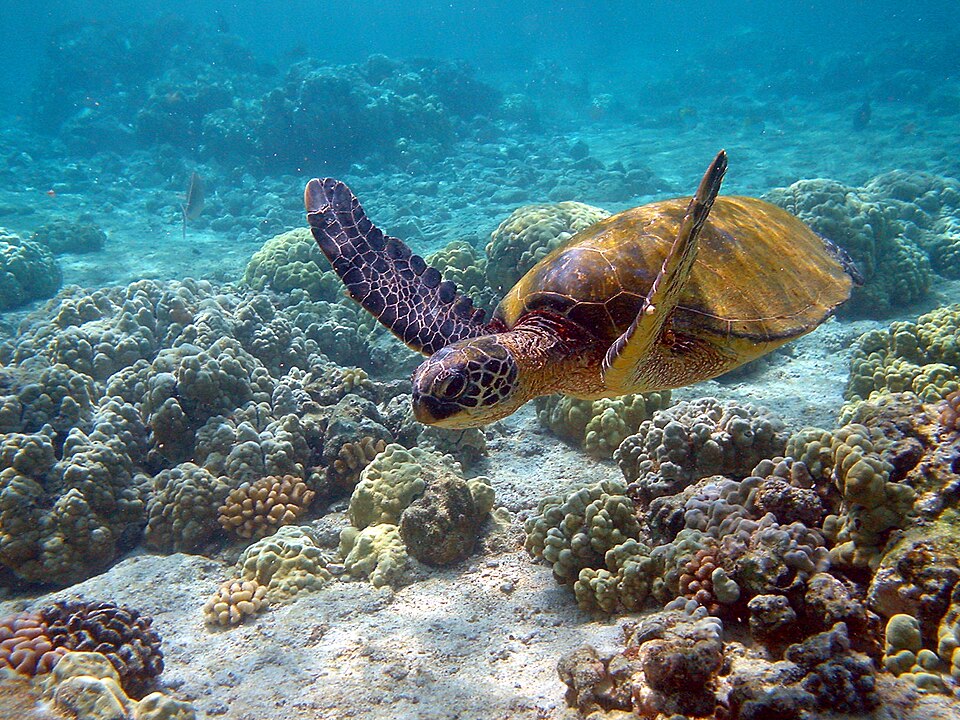
The green turtle (Chelonia mydas) is a large marine turtle present in the tropical and subtropical seas of the world, including in the Mediterranean where it frequents the Tunisian coasts. Its name comes from the greenish color of its fat, linked to its vegetarian diet as an adult. It is distinguished by a smooth, heart-shaped shell and elongated front fins adapted for swimming. This species carries out long migrations between its feeding areas and its natal nesting beaches. It is classified as endangered by the IUCN due to the degradation of its habitats and accidental fishing.
The carapace, oval and smooth, is composed of non-imbricated horny scales, olive brown to greenish in color, sometimes mottled. The head is relatively small in relation to the body and bears a single set of prefrontal scales, a distinctive feature compared to other sea turtles. The front flippers are long and powerful, each with a single visible claw. Adults exhibit sexual dimorphism marked by a longer tail in males.
Characteristics
Indicative values: they vary by subspecies, sex and region.
Habitat and distribution
green turtle frequents shallow coastal waters rich in seagrass and algae, as well as tropical to warm temperate lagoons and littoral zones. It uses sandy beaches only for females to lay their eggs. In the Mediterranean, it is observed along the Tunisian coasts, particularly in coastal feeding areas.
CURRENT RANGE
The species is present in the Atlantic, Pacific and Indian Oceans as well as the Mediterranean Sea, mainly in tropical and subtropical areas. The main nesting areas are located in the Caribbean, the eastern Mediterranean and the Indian Ocean. In Tunisia, it is observed occasionally along the coasts, with no major confirmed nesting site.
Behaviour
The green turtle is an essentially solitary animal, except during breeding periods or on certain feeding sites rich in seagrass. It can remain submerged for long periods thanks to a metabolism adapted to apnea, regularly returning to the surface to breathe. Females return to lay eggs on the beach where they were born, a behavior called natal philopatry. Outside of nesting periods, the species remains discreet and generally avoids coastal areas frequented by humans.
Reproduction
Sexual maturity is reached late, generally between 20 and 50 years old depending on the population. Females lay eggs at night on sandy beaches, digging a nest where they lay around a hundred eggs per clutch, repeated several times during the season. Incubation lasts about two months and the temperature of the nest determines the sex of the hatchlings. Young turtles return to the sea alone as soon as they hatch, a critical phase marked by high mortality due to predators.
Peculiarities
The green turtle is capable of traveling thousands of kilometers between its feeding areas and its nesting sites thanks to orientation based on the Earth's magnetic field. It is the only sea turtle whose diet becomes predominantly herbivorous as adults.
Threats and conservation
The species is threatened by the degradation and disappearance of nesting beaches linked to coastal urbanization and tourism. Accidental capture in fishing nets, plastic pollution and poaching of eggs and adults pose major threats. Global warming also affects embryo sex determination and the availability of egg-laying sites.
Numbers and trends vary across sources and regions. See the IUCN assessment for the latest reference data.
Gallery
1 documented photographs.
References
Profile updated 01 September 2026 · Reviewed by the TunisieVet editorial team.
Comments (0)
No comments yet.
CONSERVATION STATUS
Endangered (EN)
IUCN source, latest published assessment.
Species health
Documented diseases for this species.
This information is provided for educational purposes only and is not a substitute for a veterinary consultation. If you have any concerns about your animal's health, consult a veterinarian.
Related species
To discover around: green turtle
Videos, facts, stories and records linked to this species.
Similar animals
Other species documented in Animalpedia.

TunisieVet in your pocket 📱🐾 Access your veterinary services wherever you are. [ Download the app ]
Learn more