
Presentation
The Hawksbill turtle (Eretmochelys imbricata) is a sea turtle recognizable by its dorsal scale made up of interlocking plates like tiles. It lives mainly in tropical and subtropical waters, near coral reefs. Its sharp, curved bill allows it to feed on sponges and invertebrates attached to reefs. The species was historically hunted for its shell, used in jewelry under the name “tortoiseshell”. Today it is strictly protected internationally. Its presence in the Mediterranean, including the Tunisian coasts, remains exceptional and occasional.
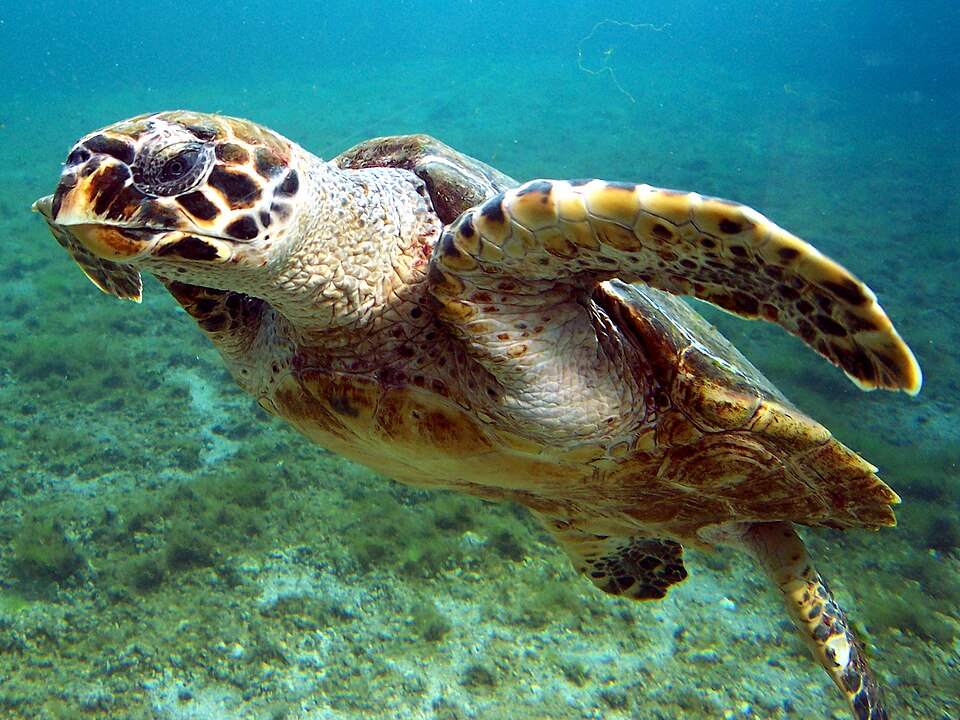
The carapace has horny scales overlapping in tiles, orange-brown mottled with yellow. The head is elongated and ends in a pointed beak reminiscent of a bird of prey, distinctive among sea turtles. The front limbs, shaped like fins, each have two claws. The posterior edge of the carapace is strongly serrated.
Characteristics
Indicative values: they vary by subspecies, sex and region.
Habitat and distribution
The species favors coral reefs, lagoons and shallow coastal areas rich in sponges. It also frequents mangroves and estuaries at certain stages of its life. Fine sand beaches serve as essential egg-laying sites.
CURRENT RANGE
Hawksbill turtle is found in tropical and subtropical waters of the Atlantic, Pacific and Indian Oceans. It frequents the Caribbean, the Red Sea and the Indo-Pacific in particular. Isolated observations exist in the Mediterranean, including occasionally off the coast of Tunisia, but the species is not established there.
Behaviour
The Hawksbill turtle is a solitary and diurnal animal, active especially near reef formations. She is an excellent swimmer and capable of diving for food between coral crevices. Females periodically return to the birthing beaches to lay eggs. Apart from reproduction, the species remains discreet and avoids contact with humans.
Reproduction
Egg-laying takes place on tropical sandy beaches, often at night. The female digs a nest and lays around a hundred eggs on average, several clutches per season. Incubation lasts about two months, with the temperature of the sand determining the sex of the hatchlings. The juveniles return to the sea as soon as they hatch, with a very low initial survival rate.
Peculiarities
Its hooked bill, the origin of its English name "hawksbill", is a unique adaptation for extracting sponges from coral faults. It is one of the rare species capable of consuming toxic sponges without suffering adverse effects. Its scale, once highly sought after, has led to a drastic decline in its populations.
Threats and conservation
The illegal trade in tortoiseshell remains a threat despite its international ban. Coral reef degradation, plastic pollution and egg poaching strongly affect the species. Bycatch in fishing gear and climate change are exacerbating its decline.
Numbers and trends vary across sources and regions. See the IUCN assessment for the latest reference data.
Gallery
1 documented photographs.
References
Profile updated 01 September 2026 · Reviewed by the TunisieVet editorial team.
Comments (0)
No comments yet.
CONSERVATION STATUS
Critically endangered (CR)
IUCN source, latest published assessment.
Species health
Documented diseases for this species.
This information is provided for educational purposes only and is not a substitute for a veterinary consultation. If you have any concerns about your animal's health, consult a veterinarian.
Related species
To discover around: Hawksbill turtle
Videos, facts, stories and records linked to this species.
Similar animals
Other species documented in Animalpedia.

TunisieVet in your pocket 📱🐾 Access your veterinary services wherever you are. [ Download the app ]
Learn more