
Presentation
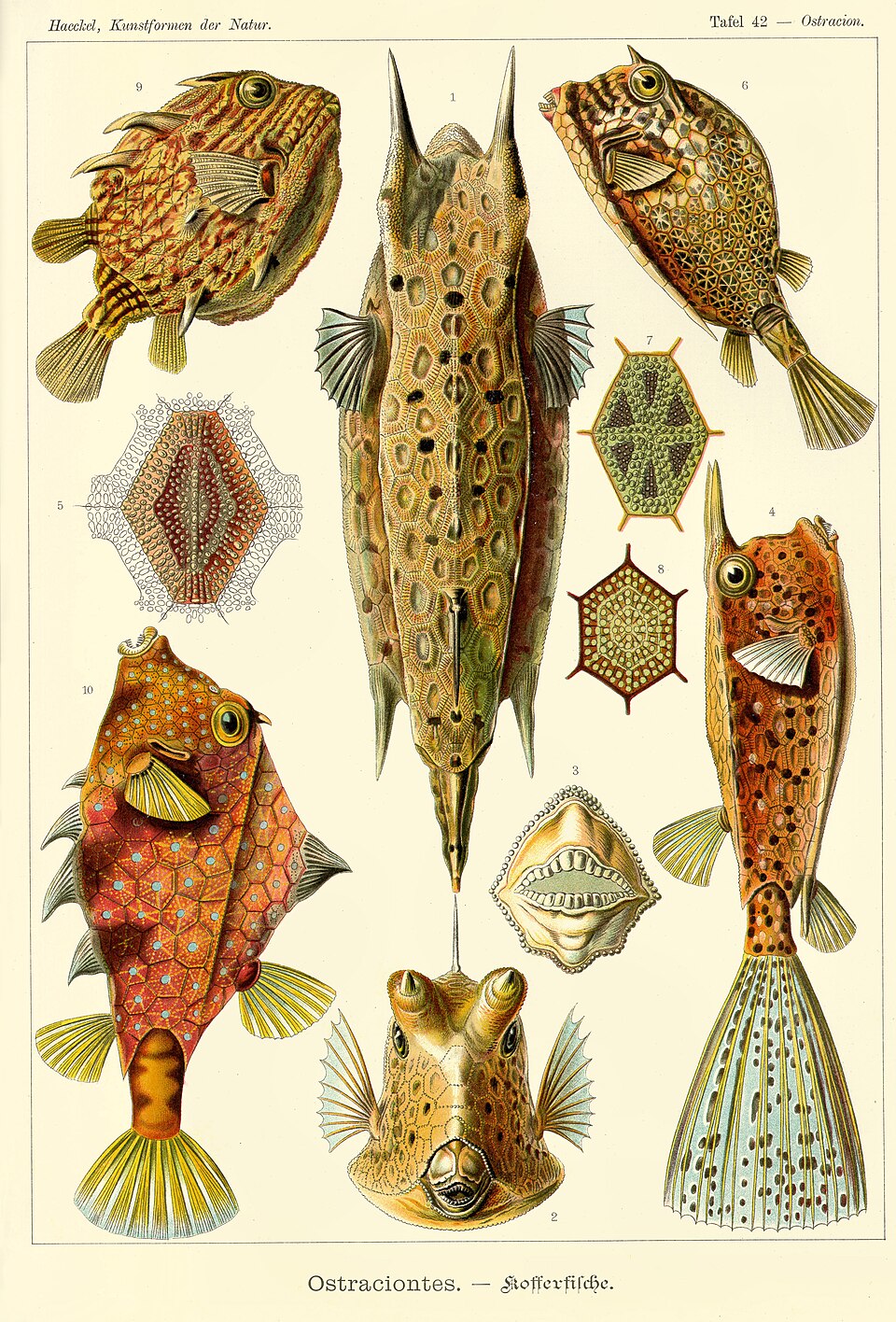
The Boxfish is a tropical marine fish of the Ostraciidae family, recognizable by its body enclosed in a rigid, box-shaped bony shell. This carapace, composed of fused bony plates, gives it an angular and unusual silhouette, often cubic or triangular in section. Only the mouth, eyes, fins and anus protrude from this protective structure. Many species feature bright colors and contrasting dot patterns. It swims slowly using small fins, compensating for its poor maneuverability with an effective chemical defense. It is found on coral reefs and lagoons in warm seas.
The body is enveloped in a rigid bony shell formed of welded hexagonal plates, leaving little flexibility to the trunk. The general shape evokes a cube or a prism depending on the species, hence its common name. Coloration varies from bright yellow to blue-green, often decorated with dark or light spots. Swimming is primarily accomplished using the dorsal, anal, and pectoral fins, with the tail serving as an occasional rudder.
Characteristics
Indicative values: they vary by subspecies, sex and region.
Habitat and distribution
Boxfish frequents coral reefs, lagoons and shallow rocky areas of tropical and subtropical seas. It likes the shelters offered by corals and rocky debris, where it can hide. Some species also tolerate seagrass beds adjacent to reefs.
CURRENT RANGE
The family Ostraciidae is widely distributed in the tropical and subtropical waters of the Indian and Pacific Oceans, with a few species occurring in the tropical Atlantic. It is absent from the Mediterranean and therefore from the Tunisian coasts. Its distribution generally follows that of coral reefs.
Behaviour
It is an essentially solitary and diurnal fish, which slowly explores its territory in search of food. Its not very agile swimming is compensated by a protective shell and, in several species, by the secretion of a skin toxin (ostracitoxin) in the event of stress. It has little tolerance for the presence of other individuals of its species and defends a restricted territory.
Reproduction
Reproduction occurs by external spawning, generally at dusk, with synchronized release of gametes into the water column. The eggs and larvae are pelagic and drift with the plankton before settling on the reef. No parental care is provided after fertilization.
Peculiarities
The rigid bony shell is a unique adaptation among fish, limiting body flexibility but providing effective protection against predators. Certain species release a toxin, ostracitoxin, capable of poisoning surrounding fish in the event of extreme stress, including in a closed aquarium. Its cubic shape has also inspired work in automotive engineering on aerodynamics.
Threats and conservation
The degradation of coral reefs, linked to global warming and pollution, constitutes the main threat to its habitat. Collection for the aquarium trade locally affects certain populations. Overall, the species is not considered globally threatened.
Numbers and trends vary across sources and regions. See the IUCN assessment for the latest reference data.
Gallery
1 documented photographs.
References
Profile updated 30 August 2026 · Reviewed by the TunisieVet editorial team.
Comments (0)
No comments yet.
CONSERVATION STATUS
Least concern (LC)
IUCN source, latest published assessment.
Species health
Documented diseases for this species.
Find a veterinarianThis information is provided for educational purposes only and is not a substitute for a veterinary consultation. If you have any concerns about your animal's health, consult a veterinarian.

TunisieVet in your pocket 📱🐾 Access your veterinary services wherever you are. [ Download the app ]
Learn more