
Presentation
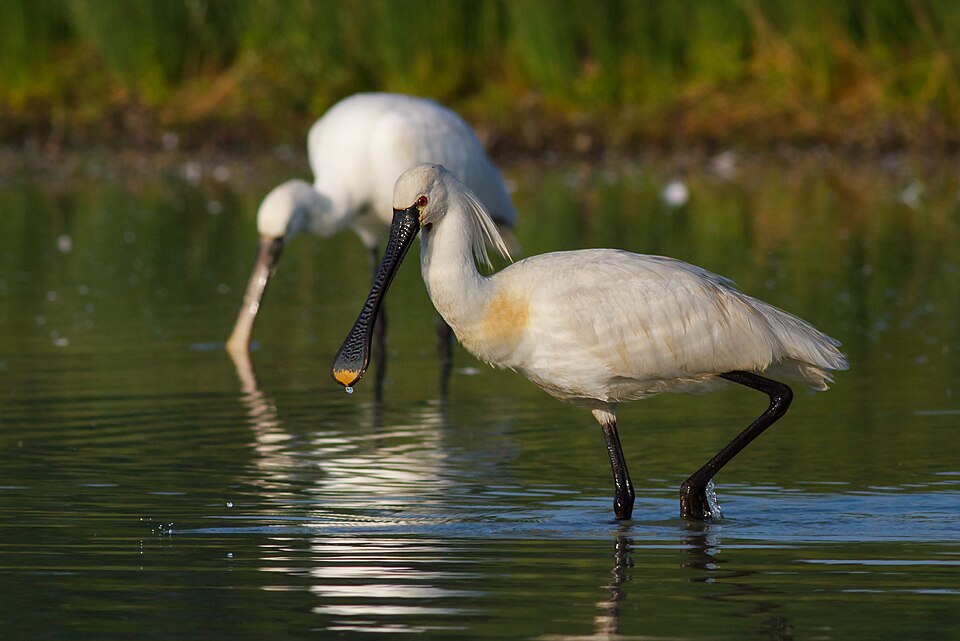
The Eurasian spoonbill is a large wading bird recognizable by its long, flat bill widened into a spoon shape at the tip. Its plumage is entirely white, adorned in adults with a crest of slender feathers on the nape and a yellow patch at the throat during breeding season. It frequents shallow wetlands where it moves slowly, sweeping the water with its partially open bill. This gregarious species often nests and feeds in groups, sometimes associated with other waders such as herons or ibises. Present in Europe, Asia, and Africa, it undertakes seasonal migrations between breeding sites and wintering grounds. In Tunisia, it is observed notably in coastal wetlands and lagoons.
The Eurasian spoonbill measures approximately 80 to 93 cm in length with a wingspan of 115 to 135 cm. Its black, long and flattened bill terminates in a characteristic yellow-tipped spoon shape. The legs are black and relatively long, adapted for walking in shallow water. Adult plumage is pure white, while juveniles show dark wing tips.
Characteristics
Indicative values: they vary by subspecies, sex and region.
Habitat and distribution
It frequents shallow wetland areas such as lagoons, marshes, deltas, estuaries and coastal lakes. It particularly favours brackish or saline waters rich in small aquatic prey. Reedbeds and isolated islets serve as protected nesting sites away from terrestrial predators.
CURRENT RANGE
The Eurasian spoonbill is found in Europe, Asia and North Africa, with fragmented breeding populations. European populations migrate to sub-Saharan Africa or the Mediterranean region to overwinter. In Tunisia, it is regularly observed as a stopover migrant and in wintering areas on coastal wetlands such as Lake Tunis or the sebkhas.
Behaviour
This gregarious species feeds, moves, and nests in colonies, sometimes mixed with other waterbirds. It is generally quiet outside the breeding season. Flight is characterized by outstretched neck and legs, unlike herons which fold their necks. It is diurnal and crepuscular, active mainly during low tide or in calm waters.
Reproduction
The Eurasian spoonbill nests in colonies, often in reedbeds, on islets or in trees near water. The female typically lays 3 to 4 eggs in a nest built from twigs and aquatic vegetation. Incubation lasts about 21 to 25 days, and both parents participate in raising the young, which fledge at 7 to 8 weeks of age.
Peculiarities
The spoon-shaped bill, unique among European waders, is its most distinctive feature. It feeds by tactile detection rather than visual hunting, allowing it to forage in murky or muddy water. Its breeding crest and yellow throat patch appear only during the breeding season.
Threats and conservation
Degradation and drying of wetland habitats pose the main threat to the species. Human disturbance at nesting sites, water pollution and illegal hunting in some regions also affect populations. Loss of breeding reedbeds reduces reproductive capacity in several parts of its range.
Numbers and trends vary across sources and regions. See the IUCN assessment for the latest reference data.
Gallery
1 documented photographs.
References
Profile updated 07 September 2026 · Reviewed by the TunisieVet editorial team.
Comments (0)
No comments yet.
CONSERVATION STATUS
Least concern (LC)
IUCN source, latest published assessment.
Species health
Documented diseases for this species.
Find a veterinarianThis information is provided for educational purposes only and is not a substitute for a veterinary consultation. If you have any concerns about your animal's health, consult a veterinarian.
Similar animals
Other species documented in Animalpedia.

TunisieVet in your pocket 📱🐾 Access your veterinary services wherever you are. [ Download the app ]
Learn more