
Presentation
Tasmanian Devil is a carnivorous marsupial endemic to the island of Tasmania, Australia. It is the largest carnivorous marsupial still alive since the disappearance of the thylacine. Its black coat, stocky build and hoarse nighttime cries gave it its name given by the first European settlers. It plays the role of a natural renderer by feeding on carrion. The species is today threatened by a transmissible facial tumor disease which has decimated a large part of the wild populations.
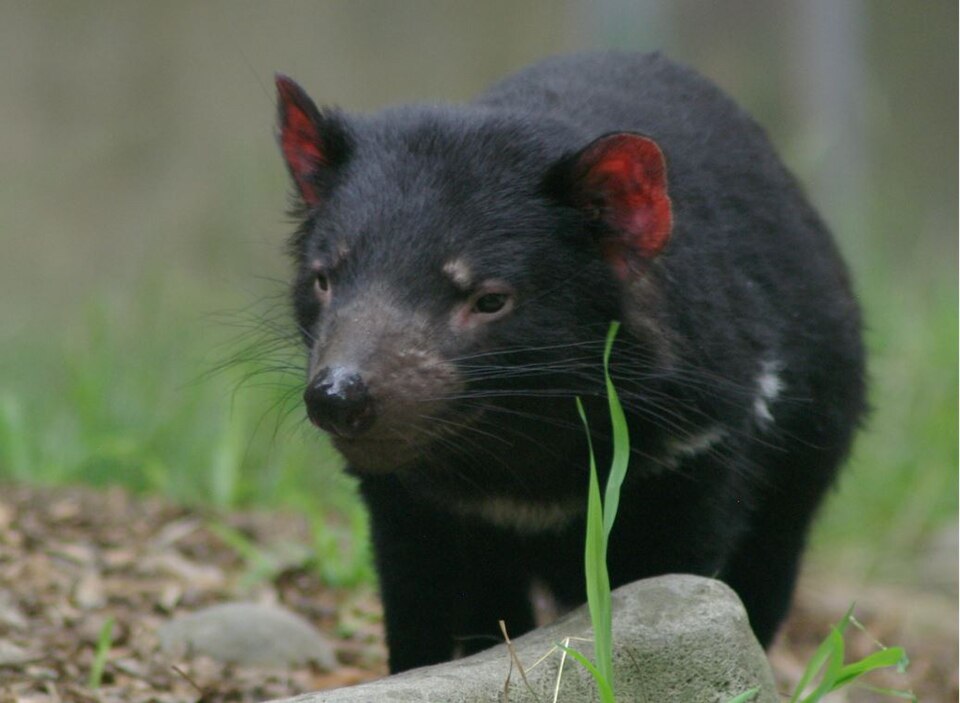
The Tasmanian Devil has a stocky body, a broad head, and a powerful jaw in proportion to its body size. Its coat is predominantly black, often marked with a white stripe on the chest or sides. It emits guttural vocalizations and shrill cries during meals or confrontations. Its bite is among the most powerful in the animal kingdom when compared to its body mass.
Characteristics
Indicative values: they vary by subspecies, sex and region.
Habitat and distribution
Tasmanian Devil frequents a wide variety of environments, from sclerophyll forests to coastal areas to grasslands. It has also been able to adapt to habitats modified by humans, such as the edges of agricultural areas. It needs natural shelters such as burrows or caves to rest during the day.
CURRENT RANGE
The species is endemic to the island of Tasmania, south of mainland Australia. It was once present on the Australian continent, before disappearing there several thousand years ago, probably due to competition with the dingo. Experimental reintroduction programs have recently been attempted on the Australian continent.
Behaviour
It is a solitary and mainly nocturnal animal, resting during the day in burrows, caves or dense vegetation. It fiercely defends its food by emitting cries and adopting threatening postures towards its conspecifics. Gathering around carrion can lead to noisy and impressive fights. Despite its aggressive reputation, it generally avoids contact with humans.
Reproduction
The female gives birth after a very short gestation of around three weeks, giving birth to around twenty poorly developed young. Only four of them, corresponding to the number of teats available in the pouch, usually survive. The young remain in the marsupial pouch for several months before being weaned. Sexual maturity is reached around the age of two.
Peculiarities
The Tasmanian Devil is capable of consuming up to 40% of its body weight in a single food intake. A transmissible facial tumor disease, unique in the animal kingdom in its mode of transmission by bite, has seriously affected populations since the 1990s. Its strong body odor, released in cases of stress, contributes to its reputation as a repulsive creature.
Threats and conservation
Devil's Facial Tumor Disease (DFTD) is the main threat, having reduced some populations by more than 80%. Road collisions and habitat loss linked to agricultural expansion are also worsening its decline. Conservation programs, including disease-free captive and island populations, have been established to preserve the species.
Numbers and trends vary across sources and regions. See the IUCN assessment for the latest reference data.
Gallery
1 documented photographs.
References
Profile updated 24 August 2026 · Reviewed by the TunisieVet editorial team.
Comments (0)
No comments yet.
CONSERVATION STATUS
Endangered (EN)
IUCN source, latest published assessment.
Species health
Documented diseases for this species.
See the 8 diseases of this species Find a veterinarianThis information is provided for educational purposes only and is not a substitute for a veterinary consultation. If you have any concerns about your animal's health, consult a veterinarian.
To discover around: Tasmanian Devil
Videos, facts, stories and records linked to this species.
RECORD
approximately 553N
The most powerful bite relative to size
Bite force measured in adults, the highest in the kingdom of current mammals relative to b...
Similar animals
Other species documented in Animalpedia.

TunisieVet in your pocket 📱🐾 Access your veterinary services wherever you are. [ Download the app ]
Learn more