
Presentation
The Armadillo is a burrowing mammal recognizable by its segmented carapace composed of articulated bony plates. Native to the Americas, it brings together around twenty species distributed mainly in South and Central America, some extending as far as the southern United States. This discreet and nocturnal animal feeds mainly on insects which it digs up using its powerful claws. It plays an important ecological role by aerating the soil and regulating insect populations. Although little known to the general Tunisian public, it is attracting growing interest as an exotic animal of curiosity. Several species of Armadillos are today threatened by deforestation and hunting.
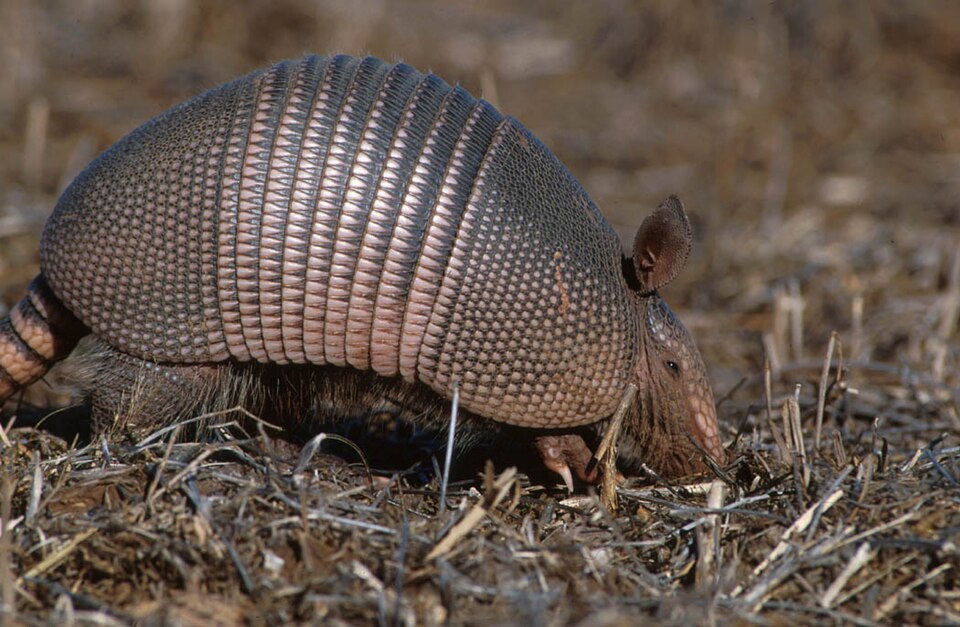
The Armadillo is distinguished by its carapace made up of bony plates covered with keratin, arranged in articulated bands which give it a certain flexibility. Its short but powerful limbs have sturdy claws adapted for digging. The size and number of bands vary between species, ranging from small fairy Armadillo to large giant Armadillo. Its tail and head may also be partially protected by bony plates.
Characteristics
Indicative values: they vary by subspecies, sex and region.
Habitat and distribution
Armadillo frequents varied environments depending on the species, including dense tropical forests, savannahs and semi-arid steppe zones. It favors soft soils conducive to digging burrows, which serve as daytime shelter and refuge from predators. Some species also adapt to drier environments close to the desert. Its ability to dig quickly allows it to colonize varied habitats across the Americas.
CURRENT RANGE
Armadillo originates from the American continent, with a majority presence in South and Central America. One species, the nine-banded Armadillo, has extended its range into the southern and central United States. The different species occupy varied habitats ranging from tropical forests to more arid and steppe zones. It is not present in the natural state in Africa or Tunisia.
Behaviour
The Armadillo is a mainly nocturnal and solitary animal, which digs deep burrows using its powerful claws. It has an excellent sense of smell compensating for poor eyesight, which allows it to locate its prey underground. Fearful, it quickly flees to its burrow in case of danger, although some species like the three-banded Armadillo can curl into a ball for protection. It communicates little and leads an essentially terrestrial and burrowing life.
Reproduction
Armadillo reproduction varies between species, with gestation lasting approximately two to four months. The nine-banded Armadillo has the particularity of giving birth to genetically identical quadruplets from a single fertilized egg. The young are born with a soft shell that gradually hardens over the first few weeks. Sexual maturity is generally reached between one and two years depending on the species.
Peculiarities
Armadillo is one of the few mammals with a bony external carapace, a unique feature among terrestrial vertebrates. The nine-banded Armadillo consistently gives rise to monozygotic quadruplets, a rare phenomenon in the animal kingdom. Some species, like the three-banded Armadillo, can curl up completely into a ball to protect themselves from predators. He is also known for his ability to hold his breath for up to several minutes while crossing streams.
Threats and conservation
The Armadillo faces the destruction of its natural habitat linked to deforestation and agricultural expansion. It is also hunted in certain regions for its meat or because of its reputation as an animal harmful to crops. Illegal trafficking for the trade in curiosities, particularly its shell, constitutes an additional threat to certain species. The giant Armadillo is particularly vulnerable due to its slow reproduction.
Numbers and trends vary across sources and regions. See the IUCN assessment for the latest reference data.
Gallery
1 documented photographs.
References
Profile updated 24 August 2026 · Reviewed by the TunisieVet editorial team.
Comments (0)
No comments yet.
CONSERVATION STATUS
Least concern (LC)
IUCN source, latest published assessment.
Species health
Documented diseases for this species.
This information is provided for educational purposes only and is not a substitute for a veterinary consultation. If you have any concerns about your animal's health, consult a veterinarian.
To discover around: Armadillo
Videos, facts, stories and records linked to this species.
RECORD
About 20 living species
Only mammal with an articulated bony carapace
Unique group of current mammals with a carapace made up of mobile dermal bony plates.
Similar animals
Other species documented in Animalpedia.

TunisieVet in your pocket 📱🐾 Access your veterinary services wherever you are. [ Download the app ]
Learn more