
Presentation
The Tree frog is a small anuran amphibian belonging to the Hylidae family, recognizable by its smooth, often bright green skin and its adhesive pads on the ends of its fingers. This genus brings together numerous species distributed throughout the world, including the green Tree frog (Hyla arborea) common in Europe and North Africa. It lives near fresh water points but readily climbs vegetation thanks to its remarkable adhesion abilities. Its powerful nocturnal song, produced by an inflatable vocal sac, serves mainly to attract mates during breeding. Tree frog is a biological indicator sensitive to the quality of its environment. It constitutes an important link in wetland ecosystems by regulating insect populations.
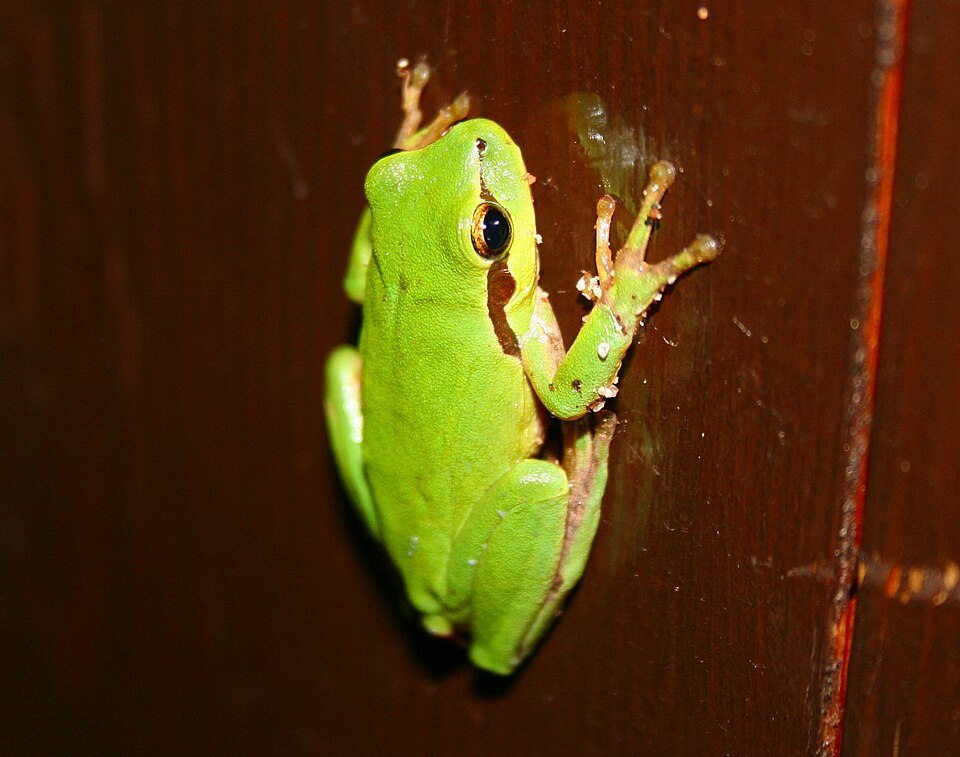
Tree frog typically measures between 3 and 5 cm in length, with smooth skin and a bright green color that can vary depending on light and stress. Its fingers end in adhesive suction cups allowing it to climb on vertical and smooth surfaces. Its large, prominent eyes and thin silhouette distinguish it from other stockier amphibians such as frogs.
Characteristics
Indicative values: they vary by subspecies, sex and region.
Habitat and distribution
The Tree frog frequents wetlands, ponds, ponds and streams bordered by dense vegetation which serves as a daytime refuge. It also likes meadows and forest edges located near water points necessary for its reproduction. Water quality and the presence of aquatic vegetation are essential to its survival.
CURRENT RANGE
The genus Tree frog is widely distributed in Europe, North Africa and Asia, with species adapted to varied climates. In Tunisia, green Tree frog is present in certain humid areas in the north of the country. Its distribution depends closely on the availability of permanent or temporary fresh water points.
Behaviour
The Tree frog is a primarily nocturnal and arboreal animal, spending the day hidden in dense vegetation near water. Males emit a characteristic, sonorous song to attract females during the breeding season, particularly in spring. Outside of the breeding season, the species remains discreet and solitary, moving little.
Reproduction
Reproduction takes place in spring in stagnant water points where females lay several hundred eggs grouped in gelatinous masses. The larvae, called tadpoles, develop in water for several weeks before metamorphosing into terrestrial juveniles. Sexual maturity is generally reached after two to three years.
Peculiarities
The Tree frog can change color slightly depending on temperature, brightness and its state of stress, a phenomenon of adaptive mimicry. Its digital suction cups allow it to adhere to smooth surfaces such as glass or slippery leaves. Male song can be heard several hundred meters away during breeding nights.
Threats and conservation
The destruction and drying of wetlands is the main threat to Tree frogs populations. Water pollution by agricultural pesticides particularly affects aquatic larvae, which are very sensitive to pollutants. Climate change and habitat fragmentation are also aggravating the decline observed in several regions.
Numbers and trends vary across sources and regions. See the IUCN assessment for the latest reference data.
Gallery
1 documented photographs.
References
Profile updated 31 August 2026 · Reviewed by the TunisieVet editorial team.
Comments (0)
No comments yet.
CONSERVATION STATUS
Least concern (LC)
IUCN source, latest published assessment.
Species health
Documented diseases for this species.
This information is provided for educational purposes only and is not a substitute for a veterinary consultation. If you have any concerns about your animal's health, consult a veterinarian.
Similar animals
Other species documented in Animalpedia.

TunisieVet in your pocket 📱🐾 Access your veterinary services wherever you are. [ Download the app ]
Learn more