
Presentation
The tuatara is a reptile endemic to New Zealand, often described as a "living fossil" because it is the sole surviving member of the order Rhynchocephalia, a group that appeared approximately 200 million years ago. Its appearance resembles that of a sturdy lizard, with a spiny crest running along its back, but its internal anatomy differs significantly from that of modern lizards. It possesses a functional parietal eye in juveniles, sensitive to light, which becomes covered by skin as it matures. Active primarily at night, it lives in burrows that it sometimes shares with seabirds. Its growth and metabolism are exceptionally slow, resulting in remarkable longevity. Today it survives only on a few protected coastal islands of New Zealand, sheltered from introduced predators.
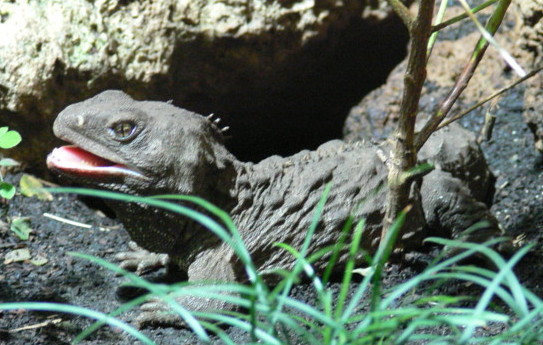
The tuatara measures between 45 and 80 cm in length depending on sex and population, with males being larger than females. Its skin ranges from grayish to greenish, scattered with small light-colored spots, and a dorsal crest composed of flexible triangular ridges runs along its back. It is distinguished from lizards by the absence of an external ear, by teeth fused to the jaw (acrodont teeth), and by a skull structure with two complete temporal arcades, an archaic feature unique among living reptiles.
Characteristics
Indicative values: they vary by subspecies, sex and region.
Habitat and distribution
Tuatara inhabit temperate coastal and island environments, including areas of low forest, scrubland, and coastal grasslands. They live in burrows that they dig themselves or take over from nesting seabirds, in loose soils suitable for burrowing. Their range today is restricted to islands free from introduced mammalian predators.
CURRENT RANGE
The species is strictly endemic to New Zealand. It disappeared from the mainland due to predation by introduced species, and now survives only on roughly thirty small islands off the coast, as well as in a few fenced mainland reserves where it has been reintroduced.
Behaviour
The tuatara is a solitary and territorial animal, active mainly at dusk and night, though it also practices daytime thermoregulation by basking in the sun near its burrow. It tolerates lower body temperatures than most reptiles, allowing it to remain active in the temperate, cool climate of New Zealand. Its very slow metabolism results in growth spread over several decades and relatively low overall activity. It digs or occupies burrows, sometimes shared with puffins or other nesting seabirds.
Reproduction
Tuatara reach sexual maturity late, at 10 to 20 years of age. The female lays 6 to 15 eggs, which she buries in sandy or loose soil after a gestation period lasting over a year. Egg incubation is particularly prolonged, taking 12 to 15 months, and the temperature of the nest determines the sex of the hatchlings. The intervals between successive breeding events can span several years.
Peculiarities
The tuatara possesses a functional third parietal eye during its first months of life, a unique trait among living reptiles. It is the only living representative of the order Rhynchocephalia, a group otherwise extinct for tens of millions of years. Their lifespan can exceed 100 years, and males lack a copulatory organ, a feature rare among reptiles.
Threats and conservation
The main historical threat was the human introduction of predators, notably rats, which decimated mainland and island populations by consuming eggs and juveniles. Climate warming represents a current significant threat, as it disrupts the sex ratio determined by incubation temperature. Strict conservation programs, including predator eradication on certain islands and reintroductions, help maintain existing populations.
Numbers and trends vary across sources and regions. See the IUCN assessment for the latest reference data.
Gallery
1 documented photographs.
References
Profile updated 09 September 2026 · Reviewed by the TunisieVet editorial team.
Comments (0)
No comments yet.
CONSERVATION STATUS
Near threatened (NT)
IUCN source, latest published assessment.
Species health
Documented diseases for this species.
This information is provided for educational purposes only and is not a substitute for a veterinary consultation. If you have any concerns about your animal's health, consult a veterinarian.
To discover around: Tuatara
Videos, facts, stories and records linked to this species.
RECORD
1 surviving order out of 2 main reptile orders
Last representative of a reptile order
The tuatara is the only living species of Rhynchocephalia, an order otherwise extinct for...
Similar animals
Other species documented in Animalpedia.

TunisieVet in your pocket 📱🐾 Access your veterinary services wherever you are. [ Download the app ]
Learn more