Presentation
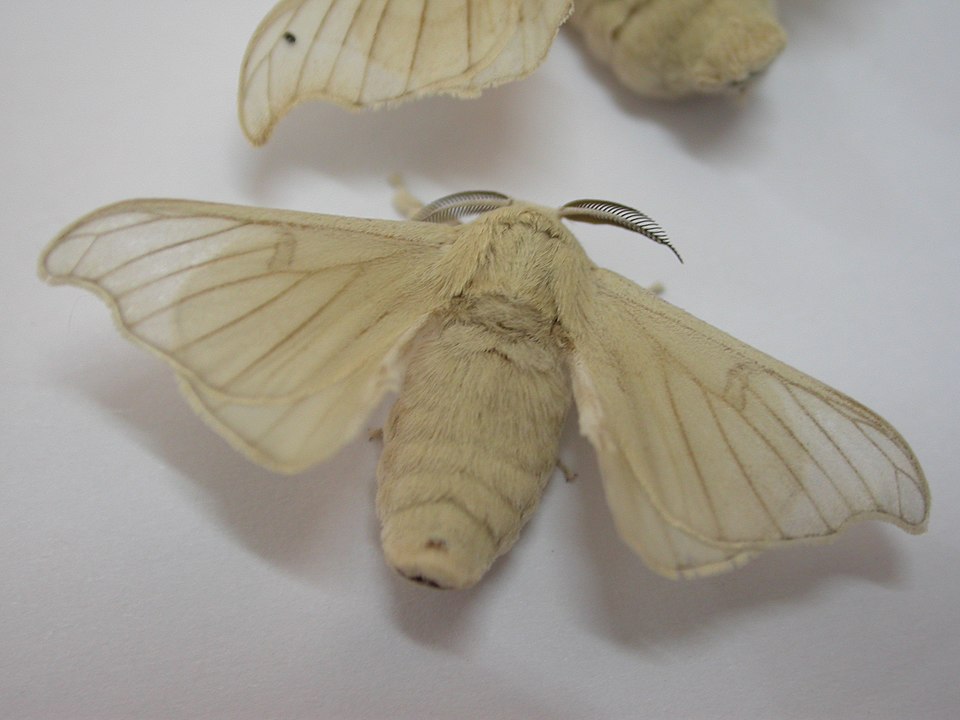
The silkworm (Bombyx mori) is the larva of a moth that has been domesticated in China for thousands of years for silk production. It no longer occurs in the wild and depends entirely on human care, a phenomenon called complete domestication. Its caterpillar feeds exclusively on mulberry leaves and produces a cocoon of continuous silk thread before transforming into a moth. This insect is the foundation of sericulture, a craft and industrial activity practiced in many countries. The adult, a whitish moth, barely flies and lives for only a few days.
The larva is a whitish segmented worm that can reach 7 to 8 cm before forming its cocoon. The adult moth has a stocky body covered with pale scales and reduced wings that are poorly suited for flight. The species has lost much of its capacity for independent survival due to selective breeding. The cocoon, made of a single silk thread that can measure several hundred meters, is the feature most exploited by humans.
Characteristics
Indicative values: they vary by subspecies, sex and region.
Habitat and distribution
The silkworm no longer exists in a natural habitat and lives only in captivity, in silk farms or structures dedicated to sericulture. It requires a constant supply of mulberry leaves and controlled temperature conditions. No viable wild populations are known today.
CURRENT RANGE
Originally from China, the species spread throughout Asia, then to the Mediterranean basin and other regions of the world through human rearing. Sericulture is practiced today mainly in Asia, particularly in China and India, the world's leading silk producers. A few traditional farms still exist in North Africa and Mediterranean Europe.
Behaviour
The silkworm's behavior is mainly governed by cycles of larval feeding and molting. Before pupating, the caterpillar carefully spins a silk cocoon around itself to protect itself during metamorphosis. The adult, unable to fly effectively, moves little and devotes itself only to reproduction. The species shows no defensive or escape behavior, having lost these instincts through domestication.
Reproduction
The female moth lays several hundred eggs shortly after mating, then dies quickly. The eggs hatch into larvae after incubation, and the complete cycle from egg to larva to cocoon to moth takes approximately six to eight weeks depending on rearing conditions. Reproduction is entirely managed by breeders as part of sericulture.
Peculiarities
The silkworm is one of the few insects fully domesticated, unable to survive without human intervention. Its cocoon produces a remarkable continuous silk thread, exploited since ancient times for textile weaving. This close relationship with humans dates back over 5000 years in China.
Threats and conservation
Existing only in a domestic state, the species is not threatened with extinction and is not subject to conservation concerns. Its survival depends solely on the continued practice of sericulture by humans. Competition from synthetic fibres has, however, reduced demand for natural silk in some regions.
Numbers and trends vary across sources and regions. See the IUCN assessment for the latest reference data.
Gallery
1 documented photographs.
References
Profile updated 31 August 2026 · Reviewed by the TunisieVet editorial team.
Comments (0)
No comments yet.
CONSERVATION STATUS
Least concern (LC)
IUCN source, latest published assessment.
Species health
Documented diseases for this species.
Find a veterinarianThis information is provided for educational purposes only and is not a substitute for a veterinary consultation. If you have any concerns about your animal's health, consult a veterinarian.
Similar animals
Other species documented in Animalpedia.

Be among the first to use our app. Sign up and get early Google Play access.
Discover