
Presentation
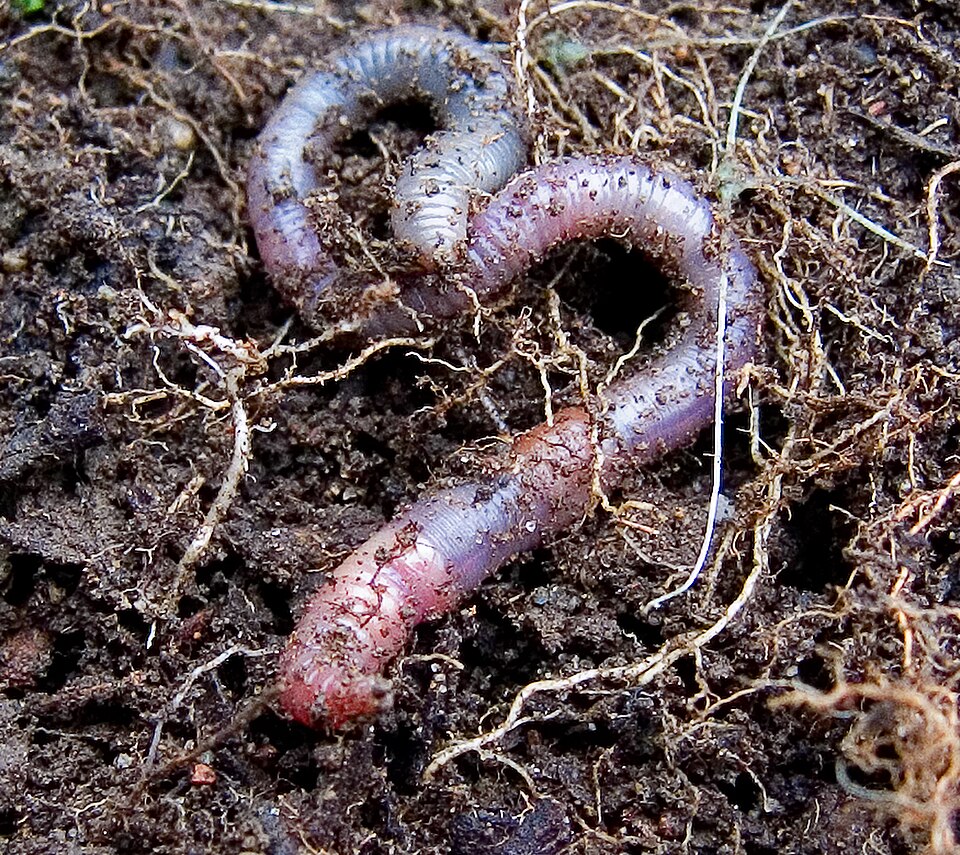
The earthworm is a segmented annelid that lives mainly in loose, moist soils. Its cylindrical body, without legs, is covered in mucus that aids its movement and allows gas exchange through the skin. It plays a major role in aerating and enriching soils by tunneling and breaking down organic matter. Found on nearly every continent, it is regarded as an indicator of terrestrial ecosystem health. Size varies greatly by species, from a few centimetres to over a metre in some tropical species. It is widely used in agriculture, as fishing bait, and in composting.
The body is made up of rings (segments) called metameres, each fitted with tiny bristles that aid movement. It has a clitellum, a thickened glandular region visible on the adult, which plays a role in reproduction. Without eyes or lungs, it senses light and breathes through its moist skin.
Characteristics
Indicative values: they vary by subspecies, sex and region.
Habitat and distribution
They colonize loose, moist soils rich in organic matter, whether in forests, meadows, or cultivated areas. They avoid soils that are too dry, too sandy, or waterlogged permanently. They are also commonly found in gardens and farmland near human settlements.
CURRENT RANGE
Earthworms are found on all continents except Antarctica, in temperate and tropical regions with favorable soils. In Tunisia, several species are common in farmland, gardens, and wetlands in the northern part of the country. Their distribution depends mainly on soil moisture and organic richness rather than overall climate.
Behaviour
A burrowing animal that is mainly active at night, it avoids light and dryness by staying in its tunnels. It comes to the surface after rain, when its tunnels become waterlogged and oxygen-poor. Its life is solitary, with no social structure or actively defended territory.
Reproduction
Earthworms are hermaphrodites but typically practice cross-fertilization between two individuals. The clitellum secretes a protective cocoon in which fertilized eggs develop outside the parent's body. Young worms hatch after several weeks and resemble miniature adults, with no distinct larval stage.
Peculiarities
A severed earthworm can sometimes regenerate part of its body, but it does not split into two individuals as the common misconception suggests. Its skin must remain moist at all times to permit cutaneous respiration, which explains its underground lifestyle. Charles Darwin devoted one of his final works to studying its essential role in soil formation.
Threats and conservation
Intensive use of pesticides and chemical fertilizers significantly reduces earthworm populations in agricultural soils. Soil compaction from farm machinery and urbanization also limit its habitat. No common species is currently threatened globally, but local declines affect soil fertility.
Numbers and trends vary across sources and regions. See the IUCN assessment for the latest reference data.
Gallery
1 documented photographs.
References
Profile updated 31 August 2026 · Reviewed by the TunisieVet editorial team.
Comments (0)
No comments yet.
CONSERVATION STATUS
Least concern (LC)
IUCN source, latest published assessment.
Similar animals
Other species documented in Animalpedia.

TunisieVet in your pocket 📱🐾 Access your veterinary services wherever you are. [ Download the app ]
Learn more