
Presentation
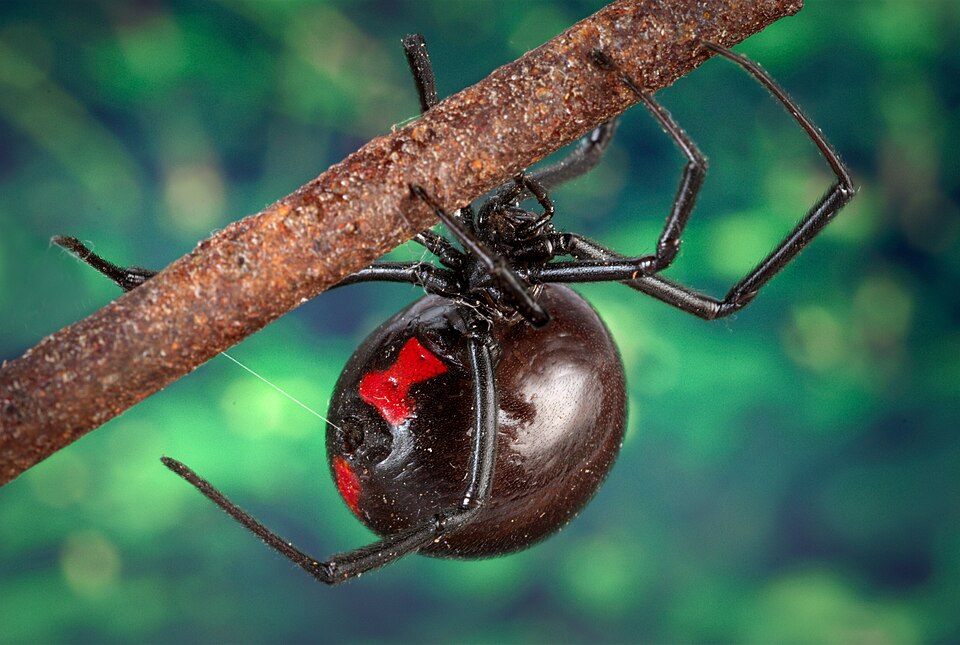
The black widow is a venomous spider belonging to the genus Latrodectus, known for the toxicity of its neurotoxic venom. It gets its name from the presumed behavior of the female, which occasionally devours the male after mating, though this occurrence is less systematic than commonly believed. Its globular, shiny black body often bears a red hourglass-shaped mark on the abdomen. Discreet and not particularly aggressive, it only bites humans through accidental contact or direct threat. Present on several continents, it favors dark, sheltered spots, both in its natural habitat and near human dwellings.
The female measures about 1.5 cm in body length, considerably larger than the male, which rarely exceeds a few millimeters. Its glossy black spherical abdomen bears the famous hourglass-shaped red mark, which varies among species of the genus. Eight thin, long legs allow it to move with agility across its irregular web. Sexual dimorphism is very pronounced, with the female being markedly larger and more dangerous than the male.
Characteristics
Indicative values: they vary by subspecies, sex and region.
Habitat and distribution
The black widow inhabits dry, sheltered areas such as woodpiles, brush, rock crevices, and building corners. It readily adapts to human-modified environments like garages, sheds, and gardens. It is found in desert regions as well as urban and suburban settings. It avoids overly damp locations or areas exposed to direct sunlight.
CURRENT RANGE
The genus Latrodectus is found on nearly all continents, with distinct species according to region: North and South America, Africa, southern Europe, Asia, and Oceania. In North Africa and the Maghreb, certain species of the genus inhabit arid and semi-arid zones. It is absent from the coldest regions of the globe.
Behaviour
Solitary and sedentary, the black widow generally remains close to its web, which it builds in dark spots sheltered from wind and light. It is not particularly aggressive toward humans and only bites if it feels directly threatened or crushed. The sexual cannibalism behavior, which gave rise to its name, sometimes occurs after mating but is not systematic. It spends most of the day still, waiting for vibrations on its web that signal the presence of prey.
Reproduction
After a cautious courtship ritual, the male mates with the female at the risk of being devoured by her. The female then lays her eggs in a silk cocoon, which she keeps close to her web. Each cocoon can hold several hundred eggs, though only a small proportion of the hatchlings survive to adulthood. The juveniles disperse rapidly after hatching to avoid cannibalism among siblings.
Peculiarities
The venom of the black widow contains a neurotoxin, alpha-latrotoxin, which causes intense muscle pain and cramping in humans, a condition called latrodectism. Despite the potency of this venom, bites are rarely fatal to a healthy adult thanks to available medical treatments. The red hourglass-shaped mark on its abdomen likely serves as a warning signal to predators. The name 'black widow' stems from the sexual cannibalism behaviour observed in certain females.
Threats and conservation
The species is not threatened and receives no particular protection. It is sometimes eliminated by humans due to fear of its toxicity, particularly near dwellings. Pesticides used against other pests may indirectly affect local populations.
Numbers and trends vary across sources and regions. See the IUCN assessment for the latest reference data.
Gallery
1 documented photographs.
References
Profile updated 28 August 2026 · Reviewed by the TunisieVet editorial team.
Comments (0)
No comments yet.
CONSERVATION STATUS
Least concern (LC)
IUCN source, latest published assessment.
Species health
Documented diseases for this species.
Find a veterinarianThis information is provided for educational purposes only and is not a substitute for a veterinary consultation. If you have any concerns about your animal's health, consult a veterinarian.
To discover around: Black Widow
Videos, facts, stories and records linked to this species.
Similar animals
Other species documented in Animalpedia.

📱 عندك صفحة على فايسبوك؟ باهي… أما وين موقعك؟ الصفحة وحدها ما تكفيش. موقعك يخلي الناس تلقاك، يعرفوك أكثر ويثقو في خدمتك. 🌐 موقع باسم مشروعك 📲 يخدم أربعة وعشرين ساعة 🤝 يعطي ثقة واحترافية .📈 يعاونك تكبّر خدمتك خلّيه موجود وين الناس تلوّج عليه 🚀نعملولك موقع يشرّف مشروعك
WhatsApp