
Presentation
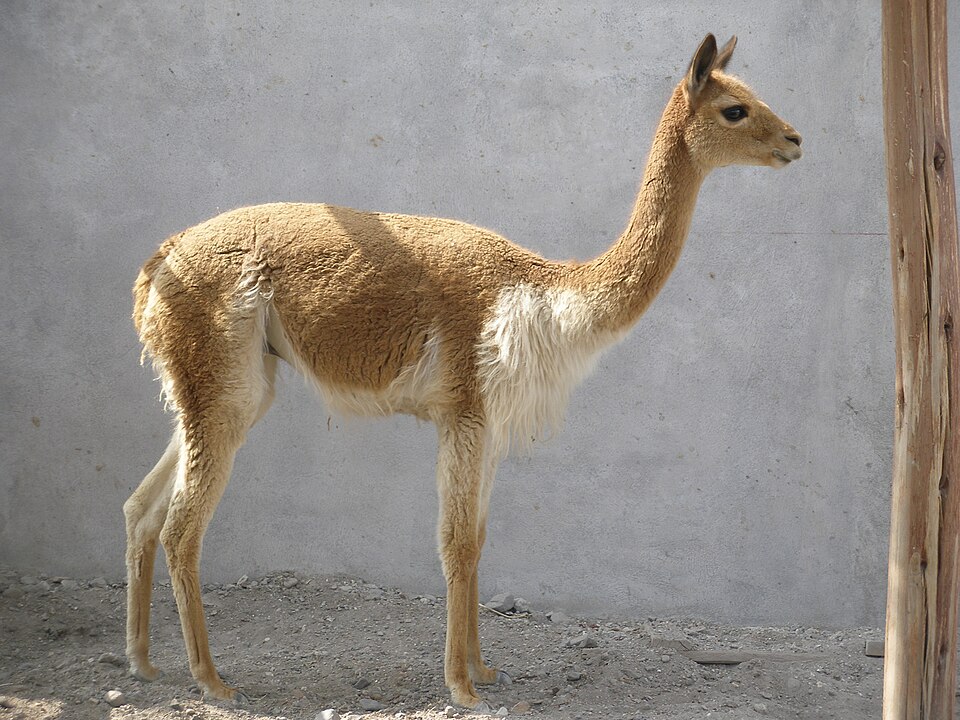
The Vicuna (Vicugna vicugna) is a wild camelid living in the high altitudes of the Andes of South America. It is renowned for having one of the finest and most valuable natural textile fibers in the world. Smaller and more slender than the guanaco, to which it is close, it lives in family herds structured around a dominant male. Long threatened by poaching for its wool, the species has been the subject of effective protection programs in Peru, Bolivia, Chile and Argentina. It remains a Peruvian national symbol, even appearing on the country's coat of arms.
The Vicuna has a slender body, a long neck and slender legs suitable for walking at altitude. Its fleece is fine, dense and tawny in color on the back, with a whitish belly and throat. It measures approximately 90 cm at the withers and weighs between 35 and 65 kg. Its continuously growing foot pads and incisors are adaptations to a rocky, arid environment.
Characteristics
Indicative values: they vary by subspecies, sex and region.
Habitat and distribution
Vicuna frequents the Andean highlands, generally between 3,500 and 5,000 meters above sea level. It favors high altitude steppes, called puna, characterized by short vegetation and a cold and dry climate. This mountain environment offers little cover but allows good visibility against predators. The species avoids wooded areas and overly rugged terrain.
CURRENT RANGE
Vicuna is native to the central Andes, distributed mainly between Peru, Bolivia, Chile and Argentina. Peru is home to the largest population, with reserves dedicated to its conservation. Reintroduced populations also exist in Ecuador. Its distribution area remains strictly linked to the Andean highlands.
Behaviour
The Vicuna lives in small family groups consisting of a territorial male, several females and their young. Single males form distinct herds on the outskirts of family territories. The species is diurnal, very vigilant and able to quickly detect predators thanks to excellent eyesight. In case of danger, it emits a high-pitched alarm cry and flees at high speed over rough terrain.
Reproduction
Mating season usually occurs between March and April, depending on local populations. Gestation lasts about eleven months and ends with the birth of a single calf, called “Vicunaau”. The young stand and follow their mother shortly after birth, a behavior adapted to the presence of predators. It is weaned around eight months of age and leaves the family group as it approaches sexual maturity.
Peculiarities
Vicuna fiber is considered one of the finest and most expensive in the textile world. Unlike the llama and alpaca, the Vicuna has never been fully domesticated, although traditional captures (chaku) allow periodic shearing without killing. It appears on the national coat of arms of Peru as a symbol of the Andean fauna. Its ability to live at very high altitudes relies on blood rich in red blood cells adapted to the low oxygen content.
Threats and conservation
The Vicuna was hunted intensively for its wool until the 20th century, leading to a severe population collapse. Strict protection measures and controlled mowing programs have enabled a clear recovery of populations since the 1970s. Illegal poaching, however, persists locally for the raw fiber trade. The degradation of high altitude pastures and climate change pose additional threats.
Numbers and trends vary across sources and regions. See the IUCN assessment for the latest reference data.
Gallery
1 documented photographs.
References
Profile updated 20 August 2026 · Reviewed by the TunisieVet editorial team.
Comments (0)
No comments yet.
CONSERVATION STATUS
Least concern (LC)
IUCN source, latest published assessment.
Species health
Documented diseases for this species.
See the 8 diseases of this species Find a veterinarianThis information is provided for educational purposes only and is not a substitute for a veterinary consultation. If you have any concerns about your animal's health, consult a veterinarian.
Similar animals
Other species documented in Animalpedia.

TunisieVet in your pocket 📱🐾 Access your veterinary services wherever you are. [ Download the app ]
Learn more