
Presentation
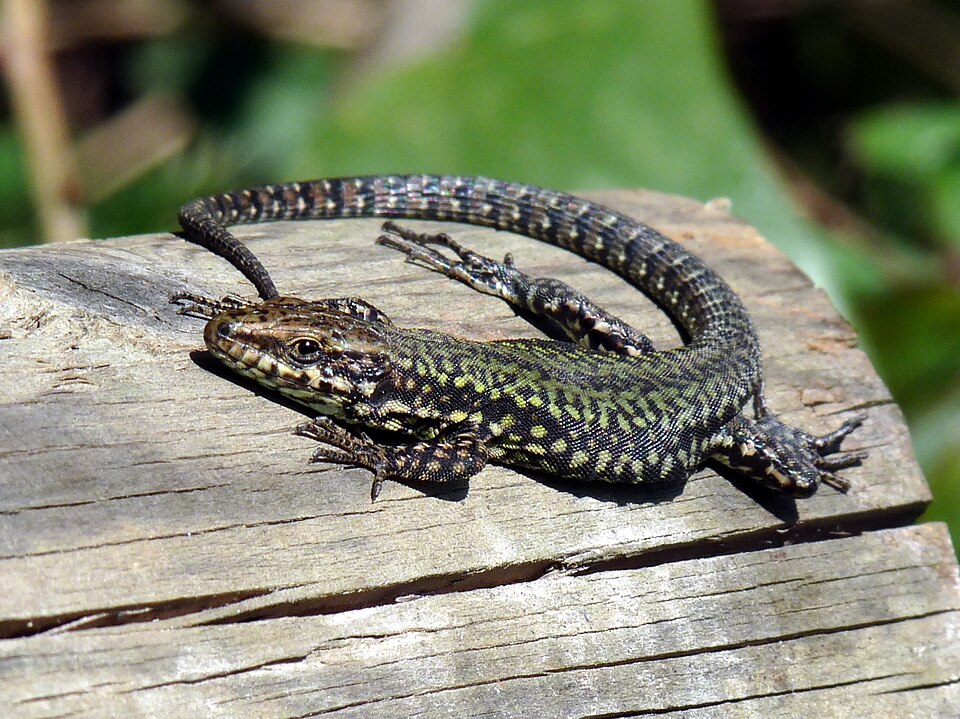
The Wall Lizard (Podarcis muralis) is a small squamate reptile widely distributed in Europe, often seen on old walls, rocks and sunny embankments. Its slender and flattened body, its brown-gray coloring with dark spots and its great agility make it a discreet but familiar species in gardens and rocky areas. It moves in rapid leaps and takes refuge in the slightest crack at the slightest danger. Diurnal and heliophilous, it spends a large part of the day thermoregulating in the sun. This species is one of the most studied among European lizards due to its wide distribution and its ability to adapt to the urban environment. It is not present in Tunisia, its natural area being limited to Europe and a few bordering regions of Asia Minor.
The Wall Lizard has a slender, dorsoventrally flattened body, measuring on average 16 to 20 cm including the tail. Its coloring varies from brown to gray with patterns of dark spots and lines, the belly can be whitish, yellowish or orange depending on the population. Males often display brighter colors than females, especially during the breeding season. Its thin, clawed fingers give it excellent grip on vertical and rough surfaces.
Characteristics
Indicative values: they vary by subspecies, sex and region.
Habitat and distribution
The Wall Lizard likes rocky environments, dry stone walls, sunny embankments and urban areas such as gardens, ruins and railway tracks. It looks for habitats offering both areas of solar exposure and numerous hiding places. Its ecological plasticity allows it to colonize both natural and heavily anthropized areas.
CURRENT RANGE
The species is widely distributed in Europe, from northern Spain to the Balkans, and also present in Asia Minor. It has been successfully introduced in several regions outside its native range, notably in North America, thanks to its strong adaptability. It is absent from Tunisian territory and more widely from the African continent in its natural state.
Behaviour
A diurnal and territorial species, the Wall Lizard spends the majority of its time basking on mineral surfaces. Males actively defend a territory against their peers through intimidating postures and chases. It hibernates during the cold months in protected crevices and returns to full activity in spring. Like other lizards, it can practice caudal autotomy, that is, severing its tail to escape a predator.
Reproduction
The breeding season takes place in spring, after emerging from hibernation. The female generally lays one to two clutches per year, each numbering 2 to 10 eggs, deposited in loose soil or under stones. Incubation lasts approximately 6 to 8 weeks depending on ambient temperature. Juveniles are autonomous from hatching and reach sexual maturity around one to two years of age.
Peculiarities
Wall Lizard is able to partially regenerate its tail after autotomy, a defense mechanism against predators. It exhibits great variability in coloring depending on local populations, which has led to the description of numerous subspecies. Its high tolerance for urban environments makes it a preferred study model in evolutionary ecology.
Threats and conservation
The species is not globally threatened due to its wide distribution and good adaptability. Locally, the destruction of dry stone walls and intensive urbanization can reduce its favorable habitats. Predation by domestic cats also constitutes pressure on certain urban populations.
Numbers and trends vary across sources and regions. See the IUCN assessment for the latest reference data.
Gallery
1 documented photographs.
References
Profile updated 02 September 2026 · Reviewed by the TunisieVet editorial team.
Comments (0)
No comments yet.
CONSERVATION STATUS
Least concern (LC)
IUCN source, latest published assessment.
Species health
Documented diseases for this species.
This information is provided for educational purposes only and is not a substitute for a veterinary consultation. If you have any concerns about your animal's health, consult a veterinarian.
To discover around: Wall Lizard
Videos, facts, stories and records linked to this species.
Similar animals
Other species documented in Animalpedia.

TunisieVet in your pocket 📱🐾 Access your veterinary services wherever you are. [ Download the app ]
Learn more