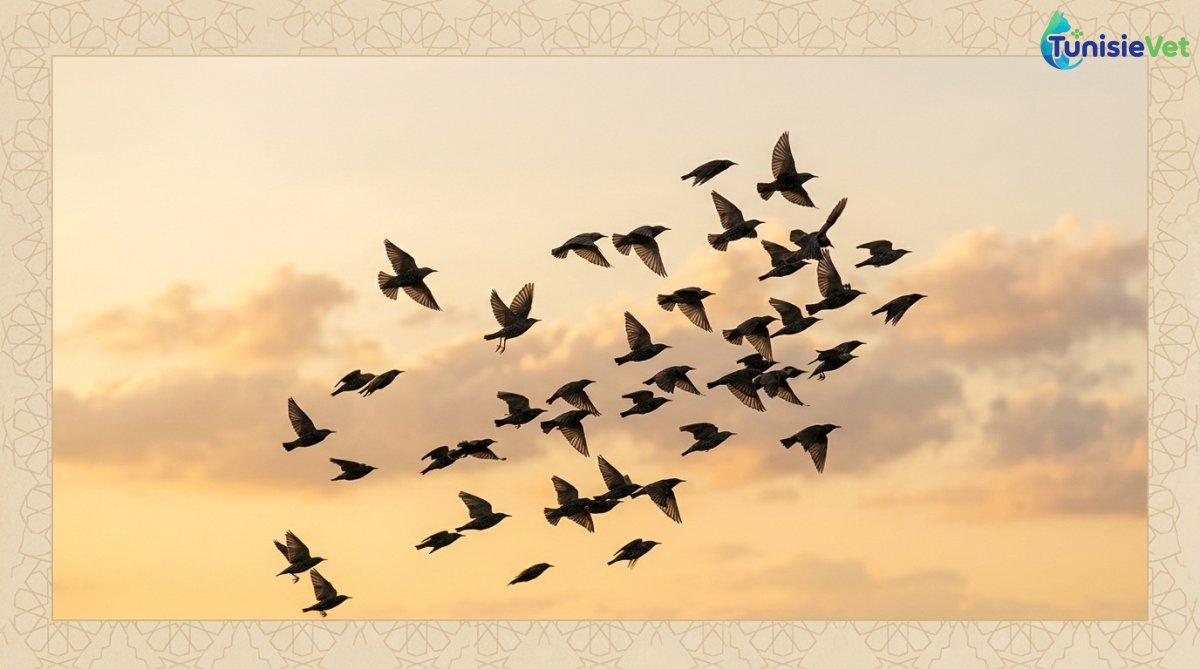
In the sky, birds spread their wings and fold them without ever falling. The Qur'an invites us to contemplate this silent wonder as proof of the divine power that sustains all life.
Every day, flocks of birds cross the sky above our heads, sometimes gliding motionless, sometimes beating their wings with vigor, without ever falling. This sight, which we observe without paying attention, is nonetheless mentioned in the Qur'an as a sign for reflection.
The verse from Surah Al-Mulk
In Surah Al-Mulk, Allah addresses directly those who look up to the sky and watch birds in flight.
﴿ أَوَلَمْ يَرَوْا إِلَى الطَّيْرِ فَوْقَهُمْ صَافَّاتٍ وَيَقْبِضْنَ ۚ مَا يُمْسِكُهُنَّ إِلَّا الرَّحْمَٰنُ ۚ إِنَّهُ بِكُلِّ شَيْءٍ بَصِيرٌ ﴾
"Have they not seen the birds above them, spreading their wings and folding them? Only the Most Merciful sustains them. Indeed, He is, over all things, Seeing."
(Surah Al-Mulk, verse 19)
This verse does not describe an isolated miracle reserved for one particular bird, but a phenomenon that each of us can observe at any moment: the perfect balance of a wing that opens and closes, carrying a body far heavier than the air surrounding it. According to Qur'anic scholars, this image is given as proof accessible to all, requiring neither knowledge nor wealth to grasp. One need only look up.
An invitation to reflection, not merely to wonder
The scholars point out that this verse is part of a series of verses in Surah Al-Mulk that invite humanity to observe creation — the sky, the stars, the earth — to recognize in them the hand of the Creator. The bird thus becomes a sign among others, closer and more daily than the distant stars mentioned in the neighboring verses.
It is reported that early scholars emphasized the word "Ar-Rahman," the Most Merciful, used precisely at this point: it is not only power that holds the bird in the air, but a mercy that extends to every creature, even the smallest, even that whose flight seems to go without saying.
From this verse, scholars draw a simple lesson: if Allah sustains the bird in the sky thus, with no cord or visible support, He is all the more capable of providing for the needs of every creature on earth. This image has often been connected, in tradition, to the idea of trust in the provision granted by Allah to every living being.
A gaze to direct toward the birds of today
In Tunisia as elsewhere, it is enough to observe swallows above rooftops, seagulls along the coasts, or storks crossing the sky during migration season to find again that same wonder described in the verse. This flight that seems so natural remains, at the scale of science itself, of remarkable complexity: the structure of hollow bones, the arrangement of feathers, the precision of wing muscles are all details that invite contemplation rather than indifference.
To remember this verse is also to recall that every bird we encounter in the sky deserves respect and protection. Not to destroy a nest without reason, to leave a point of water accessible to thirsty birds in summer, to avoid frightening or wounding them: these are simple gestures that extend, at our scale, the kindness that the Qur'an attributes to the Most Merciful toward His creatures. Caring for the birds flying above us is to honor a sign that the Qur'an precisely invites us not to ignore.