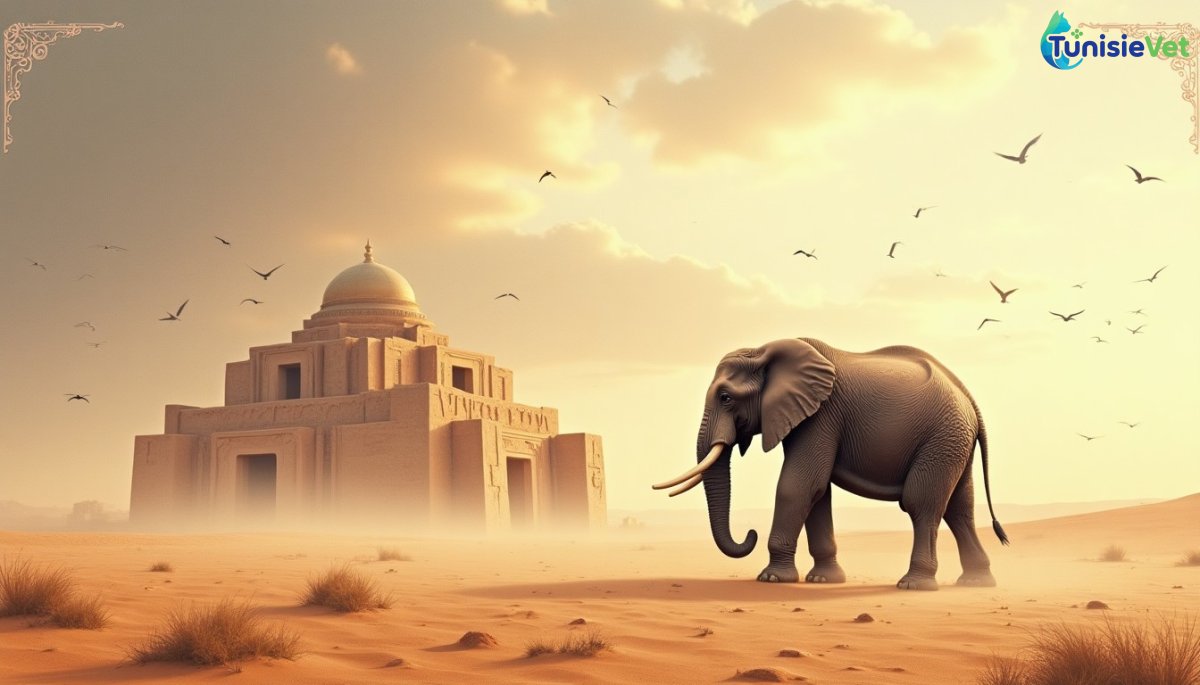
In the year the Prophet ﷺ was born, a massive army advanced toward Mecca, riding a formidable elephant. What this animal refused to do would change the course of history.
3 min read · Published 5 days ago · 15 views
In the year of the birth of the Prophet Muhammad ﷺ, known as the "Year of the Elephant," a king named Abraha, the Abyssinian governor of Yemen, marched toward Mecca with a powerful army. His goal was to destroy the Kaaba, the sacred House built by the prophet Abraham and his son Ishmael. Among his troops was an elephant, a rare and impressive animal in that region of Arabia, meant to intimidate the Meccans and clear the way for the destruction of the sanctuary.
An animal that refuses to advance
According to accounts transmitted by the Quranic commentators, when Abraha's army reached the outskirts of Mecca, the elephant, said to be named Mahmoud, came to an abrupt halt. It obstinately refused to move forward toward the Kaaba, even though it would go in any other direction. No matter how much the men struck it, pricked it, or tried to turn it toward other directions before bringing it back to the holy city, the animal would lie down or back away whenever directed toward the sanctuary. This behavior, reported by the Quranic exegetes, was perceived by many as a sign: even the most powerful mount in the army refused to take part in the desecration of the sacred place.
Publicité
Publicité
Faced with this unexpected obstacle, Abraha nonetheless ordered the march to continue. It was then, according to the Quranic account, that divine punishment fell upon the army: birds named Ababil came and threw baked clay stones at the soldiers, spreading destruction through their ranks.
The testimony of the Quran
This event is reported in an entire chapter of the Quran, titled Al-Fil ("The Elephant"), which takes its name from this celebrated mount:
"Have you not seen how your Lord dealt with the Companions of the Elephant? Did He not make their plan go astray? And He sent against them birds in flocks, striking them with stones of baked clay, and He made them like eaten straw."
(Surah Al-Fil, verses 1 to 5)
Thus, the army that seemed invincible was destroyed, and the Kaaba was preserved without any human having to defend it. The exegetes emphasize that this episode, which occurred shortly before the birth of the Prophet ﷺ, foretold the special protection granted by God to this sacred place, and by extension to the events that would follow in the life of the last Messenger.
An animal at the heart of a divine sign
It is striking to note that in this account, the elephant itself seems to have perceived what men refused to see: the gravity of the act it was being asked to commit. Its obstinate refusal, despite coercion, appears as a first sign before the punishment that was to follow. Some commentators see in this an illustration of the sensitivity that God has placed in His creation, including in animals, which are sometimes capable of perceiving what human pride overlooks.
This story invites us to direct a careful and compassionate gaze toward the animals around us. Far from being mere instruments in service of human projects, they too are creatures of God, worthy of respect and gentleness. Caring for them, respecting their nature, and never constraining them through violence is also a way to remember that all creation bears witness to divine wisdom.