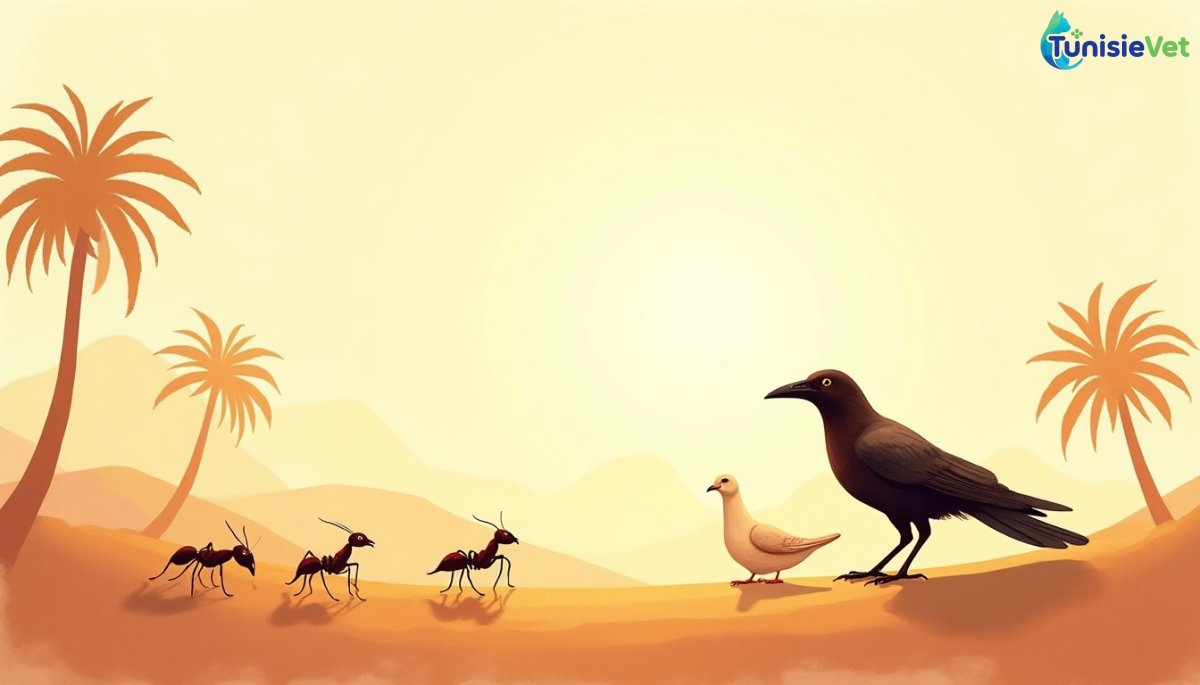
From the ant that alerts its colony to the raven that teaches a son of Adam, animals move through prophetic narratives as silent messengers. Why do they return so often in these stories?
In the Qur'an and the hadith, animals almost never appear as mere backdrop. They emerge at the precise moment a prophet needs a sign, a lesson, or a trial. This repeated presence raises a question: why did the Creator choose so often to speak to humanity through His creatures?
Creatures bearing meaning
The Qur'an reminds us that every creature forms, in its own way, a community like that of humans. In Surah Al-An'âm, it is said:
﴿ وَمَا مِن دَابَّةٍ فِي الْأَرْضِ وَلَا طَائِرٍ يَطِيرُ بِجَنَاحَيْهِ إِلَّا أُمَمٌ أَمْثَالُكُم ۚ مَّا فَرَّطْنَا فِي الْكِتَابِ مِن شَيْءٍ ۚ ثُمَّ إِلَىٰ رَبِّهِمْ يُحْشَرُونَ ﴾
There is no beast on earth nor bird that flies on its wings except that they are communities like yourselves. We have neglected nothing in the Book. Then to their Lord they will be gathered. (Surah Al-An'âm, verse 38)
This verse establishes an essential principle: animals are not mere story accessories, but beings in their own right, themselves inscribed in the divine plan. This is why they occupy such a natural place in the history of the prophets.
Messengers in the trials of the prophets
Several narratives illustrate this role. When the prophet Noah ﷺ built the ark, it was the entire animal kingdom that was saved with him, pair by pair, according to what Surah Hood relates. When the prophet Solomon ﷺ passed through the valley of the ants, an ant warned its companions to shelter themselves so as not to be crushed by the armies—an episode reported in Surah An-Naml—and Solomon smiled upon understanding its language. When Abraham ﷺ doubted the resurrection, God showed him how four birds, cut into pieces and then restored, came back to life, a sign mentioned in Surah Al-Baqara. And when Cain, son of Adam, did not know what to do with his brother's body, a raven taught him, by scratching the earth, how to bury him, according to the account in Surah Al-Mâ'ida.
In each of these episodes, the animal is not secondary: it carries the message, reveals a truth, or accompanies the trial of the prophet. The ant teaches vigilance and mercy, Abraham's birds answer an existential question, the raven conveys knowledge that man did not yet possess.
A pedagogy for all times
It is reported in Sahih al-Bukhari that the Prophet Muhammad ﷺ told the story of a man forgiven by God for giving water to a thirsty dog, and that of a woman punished for letting a cat she had locked away starve. These accounts, set outside the time of the earlier prophets, confirm the same logic: the animal becomes a mirror that reveals the quality of the human heart.
If animals return so often in these stories, it may be because they speak a universal language, accessible to all generations: that of fragile life, of care, of silent obedience to the order of the Creator. They remind man that he is not alone the steward of the earth, but that he shares it with entire communities, worthy of respect.
From Solomon's ant to the dog given water by a stranger, these narratives teach us one simple truth: caring for an animal, even the most humble, is an act that counts before God. It is a precious reminder for our daily lives: to observe nature with gentleness, to protect the creatures around us, and to recognize in them the signs of a wisdom that surpasses us.