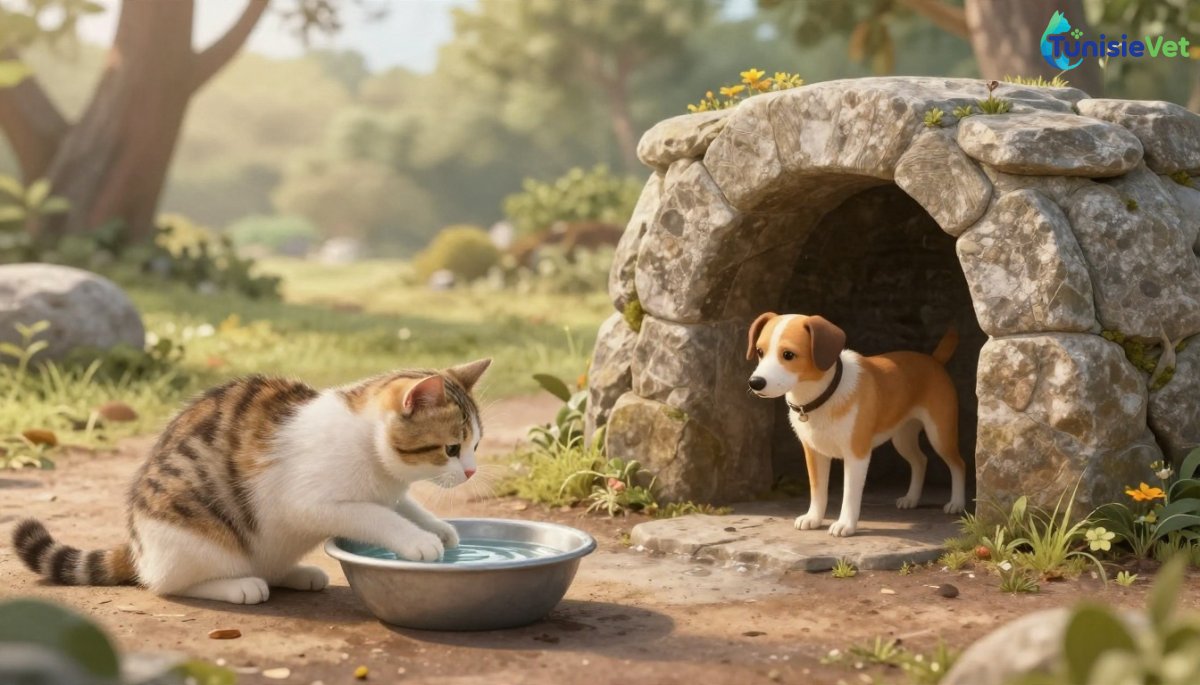
In two accounts from the Islamic tradition, a confined cat and a thirsty dog remind us that an animal's fate sometimes depends on human actions.
A woman had confined a cat. She gave it neither food nor drink, and she did not let it go free to find something to eat among the small creatures of the earth. The animal died in this way. This account, related in Sahih al-Bukhari and Sahih Muslim, shows the seriousness of the suffering inflicted on a creature under one's care.
A Life Entrusted to Our Care
In this hadith, the Prophet Muhammad ﷺ reports that the woman was punished because of the cat. The account does not give the woman a name and does not specify where she lived. It draws attention to the essential facts: the animal was held captive, deprived of food and water, with no way to provide for its own needs.
The cat could not open the door of its confinement by itself. Its situation depended on the person who had shut it in. The hadith thus reminds us that an animal living among humans is not an object that can be forgotten: it is a living being that feels hunger and thirst. Caring for it requires regular attention to its needs.
An Act of Kindness Toward a Thirsty Dog
Another account, also related in Sahih al-Bukhari and Sahih Muslim, tells of a man who was walking along a path and suffered from intense thirst. He found a well, went down into it and drank. On climbing back out, he saw a panting dog that was eating dirt because of its thirst. The man realized that the dog was experiencing a thirst similar to the one he had just felt himself.
He then went back down into the well, filled his shoe with water and held it in his mouth so he could climb back up. Once out, he gave the dog water to drink. God accepted his deed favorably and forgave him. The account does not say whether the dog had an owner: it highlights the attention the man paid to its distress and the water he brought it.
Regarding this account, the companions asked the Prophet Muhammad ﷺ whether there was a reward for showing kindness to animals. He taught them that there is a reward for good done to every living being. This answer gives a broad scope to the act performed at the well: kindness is not limited to animals we know or that live under our own roof.
These two accounts invite us to look at animals with attention and compassion. For those who live with us, this begins with simple and consistent acts: making sure they have water, suitable food and the care they need. A dependent presence deserves that we take the time to look after it.