StoryForestFarmland & grasslandsBeliefs and teachings
The revelation given to the bee: what does it mean?
In the Qur'an, Allah says He 'inspired' the bee. What does this particular revelation to such a tiny insect mean, and what does it teach us about divine wisdom and the remarkable organization of the hive?
3 min read · Published 1 week ago · 16 views
Among the most astonishing verses of the Qur'an is one in which Allah speaks directly to the bee, inspiring it to behave in a specific way. This passage, found in the surah that bears the name of this very insect, Surah An-Nahl ("The Bees"), invites the believer to reflect on how all of Creation obeys a divine order, even in its smallest details.
The verse of divine inspiration
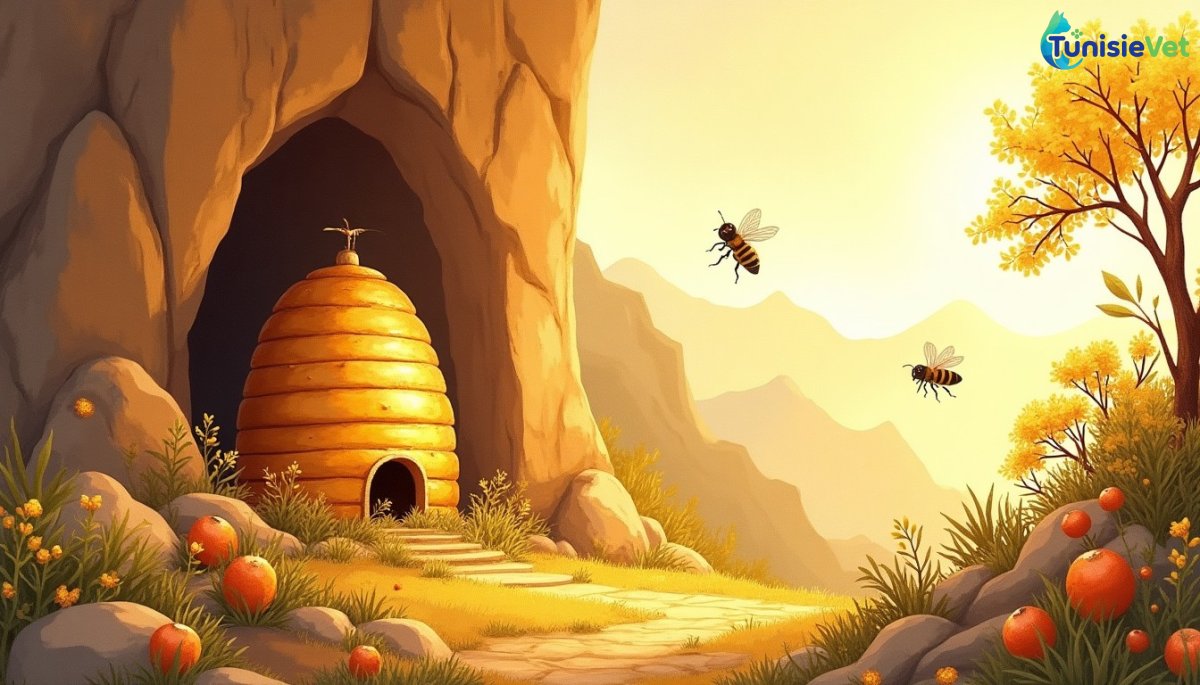
Allah explains in it that He inspired the bee to build its dwellings in the mountains, in the trees, and in the dwellings built by men, and then to feed on all kinds of fruit and flowers, traveling thus on the paths that its Lord has made easy for it.
And your Lord inspired the bee, saying: "Make your dwellings in the mountains, in the trees, and in the structures which men build."
(Surah An-Nahl, verse 68)
The verse that follows clarifies that the bee then feeds on all the fruits and follows the paths of its Lord, paths made 'easy' for it, and that from its body comes forth a drink of various colors, in which is healing for men. This honey, the fruit of collective work of extraordinary precision, is thus presented as a sign for those who reflect.
An inspiration distinct from prophetic revelation
It is important to emphasize, as many Islamic scholars remind us, that the Arabic word "awha" (inspire) used here does not carry the same meaning as the revelation given to the prophets. It is an instinct, an instinctive guidance placed by Allah within the very nature of the animal, which allows it to accomplish without learning a task of remarkable complexity: building perfect hexagonal cells, organizing a social hierarchy, communicating through precise dances, and transforming nectar into honey.
According to certain scholars, this verse illustrates how Allah governs all of His Creation, from the greatest to the smallest, with each creature receiving from its Lord what is necessary to fulfill the function assigned to it. The bee becomes thus, in the Qur'an, a symbol of order, discipline, and usefulness in service to other creatures, since the honey it produces directly benefits mankind.
Publicité
Publicité
A lesson for mankind
Commentators of the Qur'an have often noted the symbolic significance of this passage: a tiny creature, lacking reason in the human sense, yet accomplishes a work of remarkable organization simply by following the inspiration that its Creator has placed within it. The believer is thus invited to reflect on his own place in Creation, and on how he too might follow with constancy the guidance that is destined for him.
The Prophet Muhammad ﷺ also recommended the use of honey as a remedy, which is reported notably in Sahih al-Bukhari, thus confirming the therapeutic value mentioned in the Qur'anic verse.
This story reminds us that every creature, even the tiniest, holds a place willed by Allah and fulfills a function useful to the balance of the world. Caring for bees, respecting their habitat, and refraining from destroying without necessity these insects so precious for pollination and honey production fully embodies the kindness toward animals that the Qur'an invites us to cultivate daily.