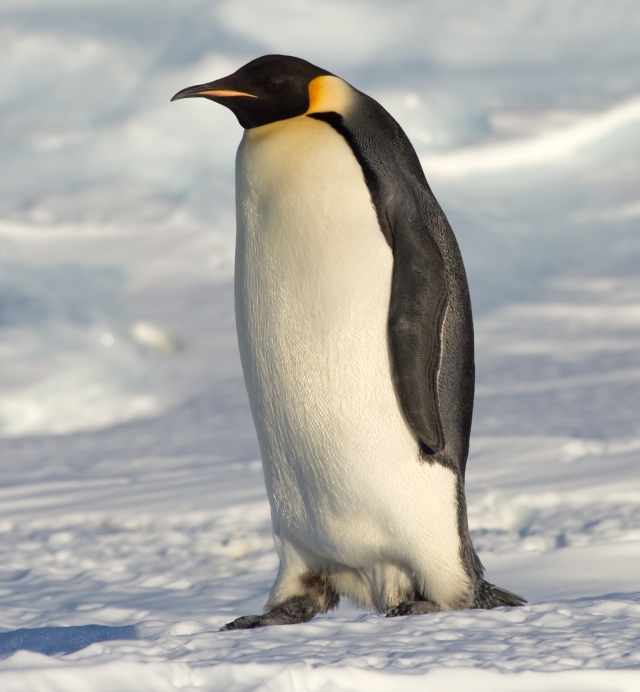
The emperor penguin survives Antarctic temperatures thanks to four combined defenses: extremely dense plumage, a thick layer of fat, a heat exchange system in the legs, and above all a collective "turtle" organization where thousands of individuals huddle together, continually rotating from the edge to the center.
Publicité
Publicité
Outstanding individual insulation
With around 100 feathers per square centimeter, the emperor penguin has the densest plumage of all birds. These short and rigid feathers overlap in several layers, trapping a thin film of air which limits heat loss to the outside. Under the skin, a layer of fat that can be around 3 cm thick acts as additional insulation, essential for an animal that faces winds down to −50°C with wind chill.
At the level of the legs, devoid of feathers and therefore particularly exposed, a counter-current heat exchanger limits losses: the arteries which bring warm blood from the heart run alongside the veins which bring cooled blood from the extremities, allowing heat transfer before the blood leaves the body. The legs thus remain just above the freezing point, avoiding freezing while saving energy.
The collective turtle, a unique strategy among birds
Faced with winter storms, emperor penguins group together in very dense clusters, sometimes several thousand individuals packed shoulder to shoulder. This collective behavior, documented by polar scientific institutes, is based on a constant rotation: the birds on the periphery, the most exposed to the wind, gradually move towards the more sheltered center, while those in the center migrate outwards. This permanent rotation distributes the cold evenly among all members of the group and can raise the temperature at the heart of the cluster several degrees above the ambient temperature.
This collective strategy is inseparable from the reproductive cycle of the species: the male incubates the single egg placed on his legs, under a fold of skin called the brood pouch, for approximately two months during which he fasts completely, immobile in the heart of the southern winter, sometimes losing almost half of his body mass before the female returns.