
Presentation
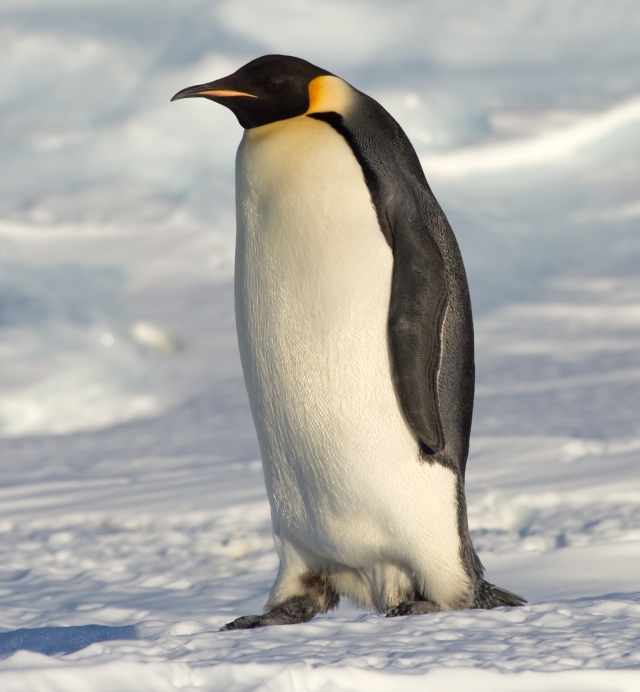
Emperor penguin is the largest and heaviest of all penguins. It is a flightless seabird endemic to Antarctica, perfectly adapted to the extreme conditions of the frozen continent. Its distinctive black and white plumage, combined with yellow and orange ear patches, makes it easily recognizable.
The Emperor penguin has a tapered and laterally compressed body, ideal for swimming. Its dense plumage has around 100 feathers per cm², providing exceptional thermal insulation. The forelimbs are transformed into rigid fins, while the hind legs located far back facilitate aquatic propulsion. Its eyes are large and adapted for underwater vision.
Did you know?
How do penguins recognize their chicks?
Characteristics
Indicative values: they vary by subspecies, sex and region.
Habitat and distribution
The Emperor penguin inhabits exclusively the coastal and marine areas of Antarctica. It breeds on fast ice and spends much of the year at sea, feeding in the cold, nutrient-rich waters. Its habitat is characterized by extremely low temperatures and severe weather conditions.
CURRENT RANGE
Emperor penguin is endemic to Antarctica, with a circumpolar distribution. It is found around the entire Antarctic continent, with around 278,000 individuals estimated in the wild. The main breeding colonies are located on the coastal ice floes of the mainland and neighboring islands.
Behaviour
The Emperor penguin is an excellent swimmer, reaching speeds of 9 km/h in water. It is a highly social species forming colonies that can number thousands of individuals. On land, it moves clumsily by walking or crawling on its belly. It is known for its ability to fast for several months while breeding, with males sustaining fasts of more than four months.
Reproduction
The Emperor penguin has a unique reproductive cycle: pairs form in austral autumn and the female lays a single egg in May-June. The male balances the egg on his feet and covers it with a fold of skin called a brood pouch for about two months, without eating. Chicks are raised in community crèches (nurseries) while adults hunt at sea.
Peculiarities
The Emperor penguin has several remarkable adaptations: it can dive deeper than any other bird, reach exceptional speeds underwater, and withstand extreme fasts. Its blood contains natural anticoagulants to resist nitrogen desaturation. Males can withstand temperatures exceeding -40°C without eating for months, an extraordinary physiological feat.
Threats and conservation
Emperor penguin is currently classified as Near Threatened (NT). The main threats include climate change, which reduces the extent of sea ice essential for its reproduction, and overfishing reducing the availability of its prey. Marine pollution and contaminants also represent growing risks for this iconic Antarctic species.
Numbers and trends vary across sources and regions. See the IUCN assessment for the latest reference data.
Gallery
1 documented photographs.
References
UICN — Liste rouge des espèces menacées
Profile updated 29 August 2026 · Reviewed by the TunisieVet editorial team.
Comments (0)
No comments yet.
CONSERVATION STATUS
Near threatened (NT)
IUCN source, latest published assessment.
Species health
Documented diseases for this species.
This information is provided for educational purposes only and is not a substitute for a veterinary consultation. If you have any concerns about your animal's health, consult a veterinarian.
To discover around: Emperor penguin
Videos, facts, stories and records linked to this species.
Similar animals
Other species documented in Animalpedia.

TunisieVet in your pocket 📱🐾 Access your veterinary services wherever you are. [ Download the app ]
Learn more