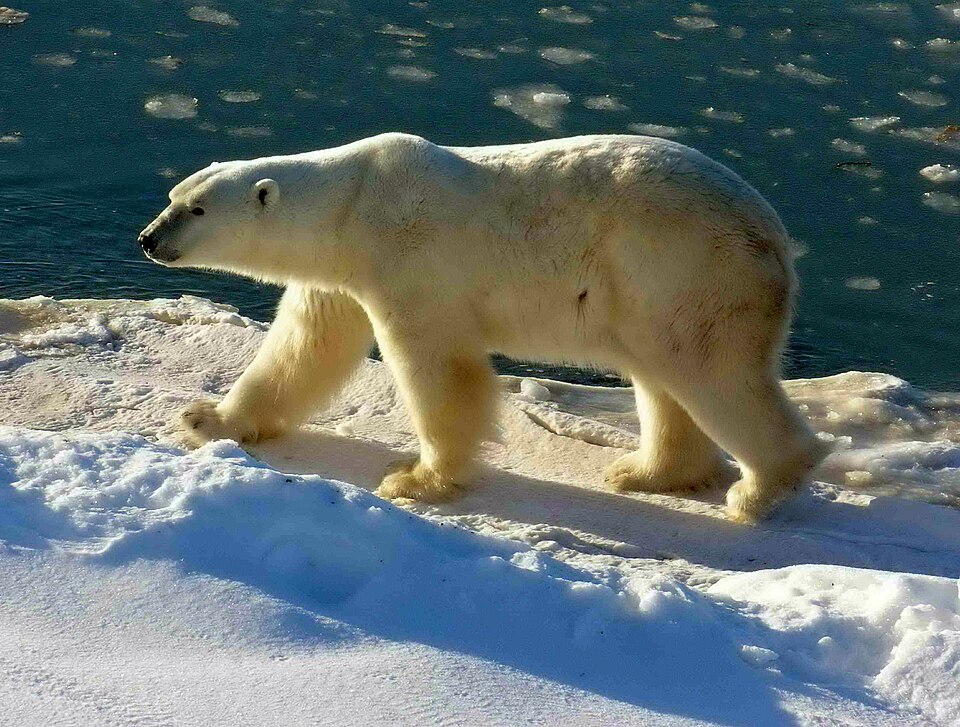
The polar bear avoids freezing thanks to a combination of thick subcutaneous fat (up to about 10 cm), an insulating double coat, and black skin under translucent hair. This insulation is so effective that the real physiological challenge of the species is to evacuate the heat produced during exercise, not to keep warm.
Three-level insulation
Under the skin, a layer of blubber can reach around ten centimeters thick on the back and hindquarters, serving as both an energy reserve and a thermal barrier against the icy water of the Arctic, whose temperature is around 0°C. Above, the coat is double: a dense, woolly undercoat traps air, while long, hollow jar hairs cover it. These hollow hairs do not conduct heat towards the skin like optical fibers - this image, long popularized, is today dismissed by biologists: their hollow structure diffuses light rather than transporting it, which explains the white appearance of the coat without transmitting solar radiation to the epidermis.
The skin itself is black, a characteristic shared with other Arctic mammals: this dark pigmentation maximizes the absorption of the little solar radiation that reaches the skin through the coat, while the apparent white of the hair ensures camouflage on the ice floe.
The real problem: overheating
Paradoxically, this almost perfect insulation especially exposes the polar bear to the risk of overheating during rapid travel or hunting. Running or swimming requires significant muscular effort, and the heat produced is difficult to escape through such a thickness of fat and fur. To compensate, the animal favors slow, energy-efficient movements, and dissipates heat through poorly insulated areas such as the muzzle, ears and pads, where the coat is thinner and the skin vascularization is more superficial.