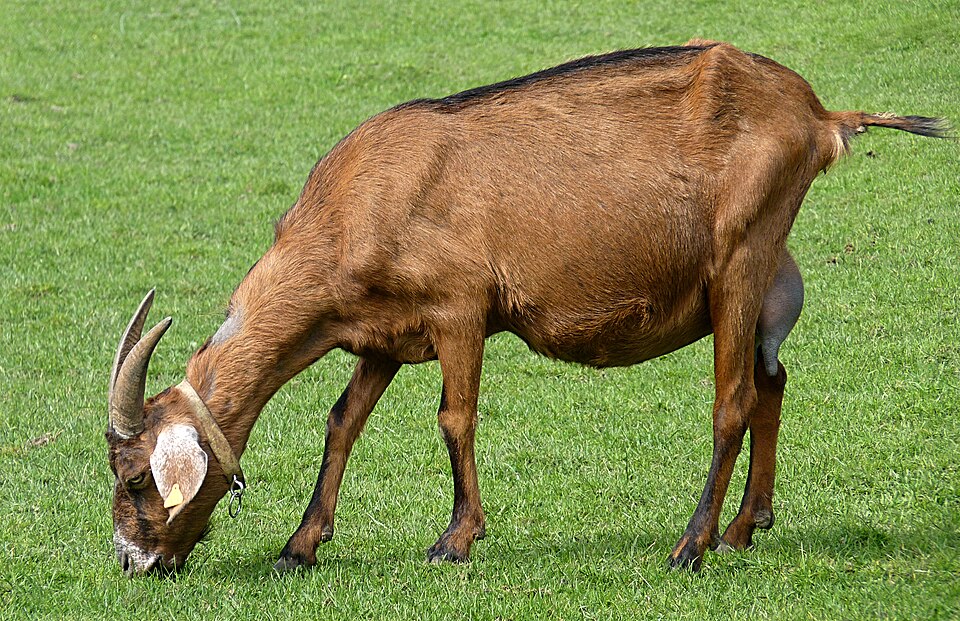
The pupil of goats is a horizontal slit, and not a perfect rectangle, because this elongated shape from one side of the face to the other widens the panoramic visual field: associated with laterally placed eyes, it offers a field of vision close to 320-340°, allowing one to monitor the horizon almost without turning the head, a vital condition for a prey herbivore watching for the arrival of a predator.
An eye that rotates to stay horizontal
The most studied feature in the goat is the compensatory rotation of the eyeball: when the animal lowers its head to graze, its eyes rotate in their sockets so that the pupillary slit remains aligned with the ground, therefore horizontal in relation to the environment, whatever the inclination of the skull. Researchers have measured this compensation and shown that it can reach around 50° of eye rotation, an adjustment much greater than that observed in predators with round or vertical pupils. This mechanism permanently maintains a clear strip of horizon in the visual field, useful for spotting suspicious movement even with the head buried in the grass.
The horizontally elongated shape also plays an optical role: it limits the glare coming from the sun above while allowing more light coming from the horizontal plane to pass through, improving the contrast on the ground and the sides. Combined with pupils capable of constricting strongly in broad daylight and opening widely at dusk, this architecture promotes functional vision at dawn and dusk, important times of activity for the species.
A signature shared by prey herbivores
This horizontal slit is not unique to the goat: sheep, horses and many other herbivorous ungulates have the same adaptation, which contrasts with the vertical pupils of ambush predators like the cat or fox, more adapted to the precise estimation of distances during a hunt. In the domestic goat, as in its wild ancestors, this ocular organization remains above all a tool for early detection of threats rather than a tool for close visual precision. For any ocular abnormality observed in an animal (opacity, redness, discomfort), a veterinary consultation remains recommended.