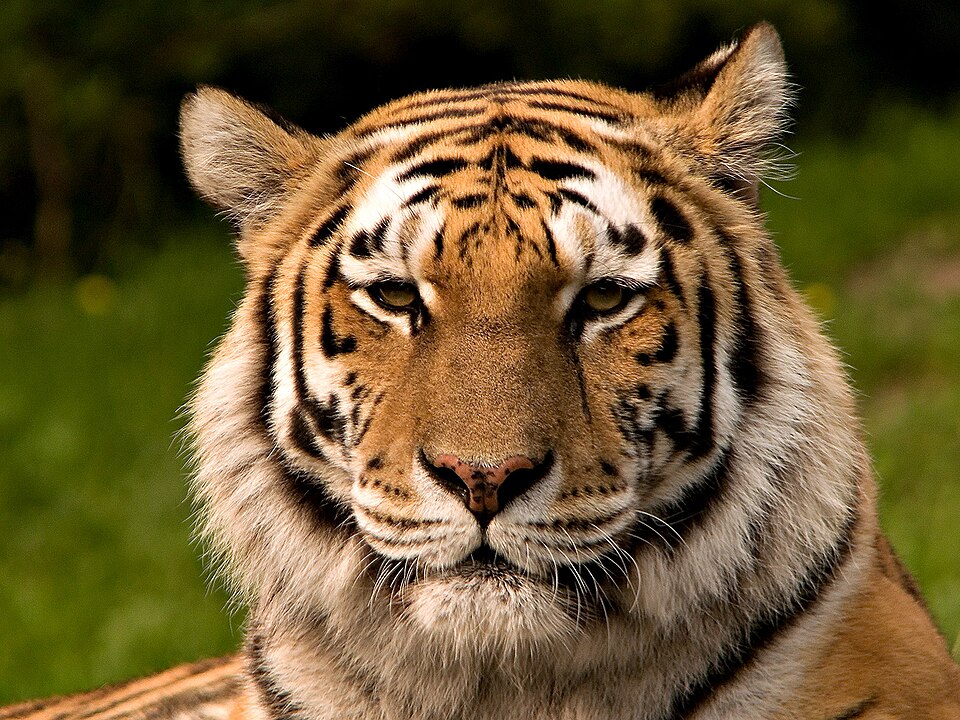
The tiger's stripes break the outline of its body in tall grass and forest thickets, preventing its prey from distinguishing its silhouette. This camouflage works all the better as the ungulates it hunts, such as the sambar deer or the wild boar, have difficulty perceiving the orange-red color of its coat, which visually blends into green and brown.
Camouflage adapted to the vision of prey
The retina of deer and bovids has few receptors sensitive to red and orange: their vision is dichromatic, centered on blue and green. For these species, the tiger's tawny coat blends in with the dry vegetation or the play of shadows, while a trichromatic human eye perceives it as vivid and contrasting. The black bands break the contours of the body, legs and head: this is what we call disruptive camouflage, which prevents the prey's brain from reconstituting an animal shape recognizable from a distance, especially in dappled light under the canopy.
Lesser known fact: the striped pattern is not just a matter of hair. The tiger's skin is itself streaked, with areas of darker skin corresponding to the stripes visible on the surface, a point documented in particular by zoos and conservation institutes that study the species in captivity. If you shaved a tiger, you would still see the pattern under the fur.
A unique print, like an identity card
Each tiger has its own pattern of stripes, as individual as a human fingerprint: width, spacing, curvature and number of stripes vary from one animal to another, including between siblings of the same litter. This variability is exploited by field researchers, who identify and track wild individuals from camera trap photographs, without capture or physical marking.