How does the chameleon protect itself from its predators?
25 views · 1 week ago
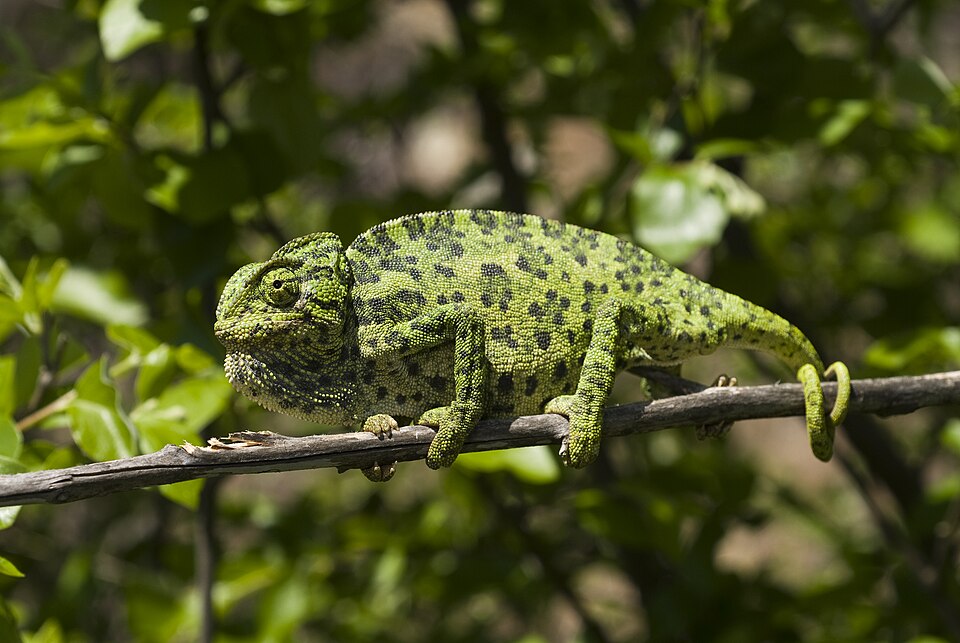
The common chameleon primarily protects itself by avoiding detection: its laterally flattened body, slow gait and rocking back and forth imitate a leaf tossed in the wind, while its independently moving eyes survey 360° around it without the slightest revealing head movement.
A silhouette and behavior designed to disappear
The shape of the body of Chamaeleo chamaeleon, compressed on the sides like a leaf seen in profile, reduces the shadow cast and breaks the contours which attract the eye of birds of prey or snakes. Associated with very slow progression on the branches, this morphology limits movement signals, the main trigger for visual detection in predators. When danger is perceived, the animal can also freeze completely, sometimes for several minutes, an immobility strategy that exploits the inability of many predators to distinguish completely static prey from the surroundings.
Its bulging eyes, protected by sealed eyelids leaving only a small pupil opening, can rotate independently of each other by nearly 180° each, offering almost panoramic vision without moving the body. This 360° surveillance makes it possible to detect a predator approaching from behind while keeping attention on potential prey in front of it, a unique advantage among reptiles.
Publicité
Publicité
The change in skin tone, obtained thanks to superimposed pigment cells (chromatophores) responding to nervous and hormonal signals, serves above all to communicate an emotional state, a defensive posture or reproductive readiness, and not a simple active camouflage: a stressed chameleon can thus suddenly darken to signal its aggressiveness to a predator or a rival rather than to blend into the decor.
Presence in Tunisia and last resort
In northern Tunisia, where the species frequents hedges, olive groves and coastal scrub, these passive strategies are generally sufficient against local birds and small carnivores. If a predator approaches despite everything, the chameleon can hiss, inflate its body and present a wide open mouth as a final deterrent warning before fleeing.