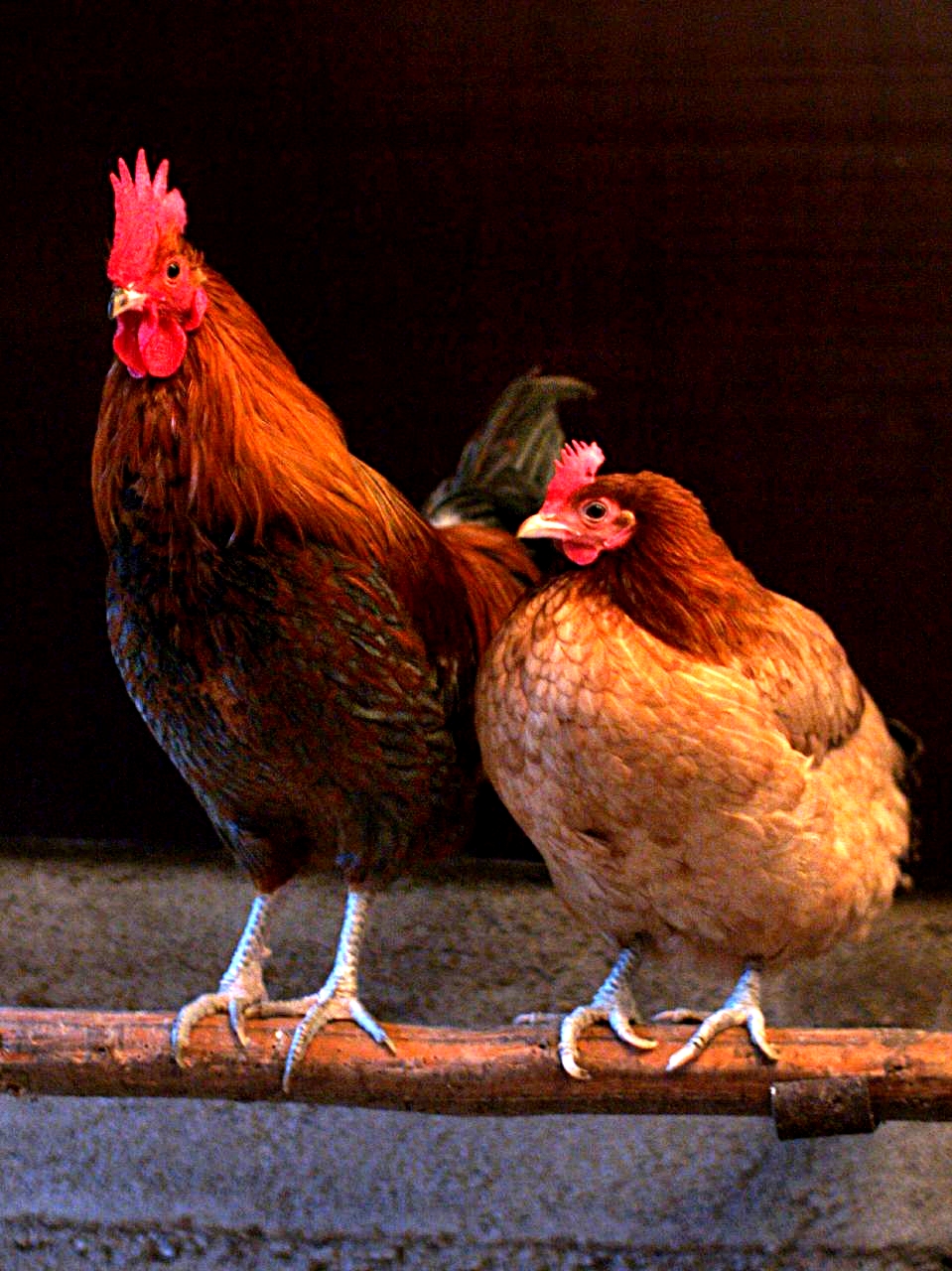
Chickens sleep perched because this behavior is inherited from the bankiva rooster, their wild ancestor living in the forests of South-East Asia: climbing on a branch at night allows them to escape terrestrial predators such as foxes, mustelids or snakes which prowl on the ground.
An ancestral reflex still active
The bankiva perches several meters high in the canopy to sleep in safety, out of reach of nocturnal hunters. Despite millennia of domestication and the selection of breeds that are sometimes too heavy to fly, the domestic chicken retains this instinct: even in a secure henhouse, it will systematically seek a high point for the night rather than staying on the ground.
This behavior is made possible without muscular effort thanks to a particular tendon mechanism: when the bird's leg bends at the level of the tarsus while lowering onto the perch, the deep flexor tendon, which passes at the back of the joint, automatically tenses and closes the fingers around the support. This passive locking allows the hen to remain perched and asleep all night without expending energy to maintain its grip, and without risk of falling even in the event of complete muscle relaxation.
Publicité
Publicité
The choice of perch is not trivial either: in a group, the dominant individuals occupy the highest places, a direct reflection of the social hierarchy (the pecking order) which structures the barnyard. Subordinate subjects find themselves on lower levels, sometimes even on the ground if there is not enough space.
What this implies for the layout of the henhouse
This biology has concrete consequences: a henhouse must offer perches large enough (several centimeters in diameter, with rounded edges) for the fingers to curl correctly, placed at varied heights to limit dominance conflicts, and in sufficient numbers so that each hen has access to a place at night. A lack of access to perches increases stress and aggressive behavior within the group.