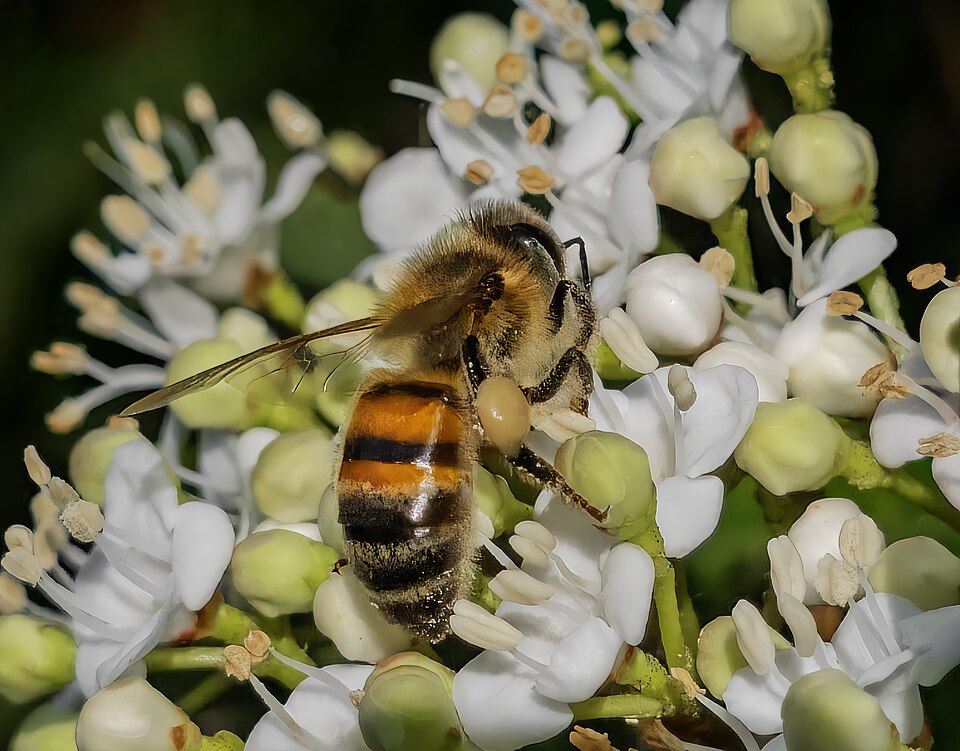
A forager bee which has located a food source returns to the hive and performs a wiggling dance on the vertical rays: the angle of its course in relation to the vertical indicates the angle between the direction of the sun and that of the flowers, while the duration of the vibrating phase provides information on the distance to be covered.
A coded language deciphered by von Frisch
The Austrian ethologist Karl von Frisch highlighted this behavior in the middle of the 20th century, work rewarded with the Nobel Prize in Physiology or Medicine in 1973. In the darkness of the hive, the bee traces a figure eight in a loop: the central part, called "wriggling", is traveled head first by vibrating the abdomen at high frequency, around 13 cycles per second. The orientation of this course in relation to the vertical of the ray transposes the horizontal solar angle: if the source is straight on the axis of the sun, the dance is vertical; if it is 40° to the left of the sun, the course tilts 40° to the left.
The duration of the wriggling phase increases with the distance to be covered, according to a relationship specific to each colony but generally linear: of the order of a second of dancing can correspond to several hundred meters. Beyond a few meters, the bee goes from a round dance (near source, without precise directional indication) to a complete wriggling dance.
Publicité
Publicité
Smell plays an essential complementary role: the forager carries the volatile compounds of the visited flower on its body, and sometimes regurgitates a droplet of fragrant nectar that the surrounding workers touch with their antennae. This chemical signature helps recruits recognize the correct floral species once there, with the dance only providing an approximate vector and distance.
A compass that adapts to polarized light
Bees perceive the polarization of light from the sky, which allows them to maintain a solar reference even on partially overcast days, as long as a patch of blue sky remains visible. This symbolic communication system, one of the most elaborate known among invertebrates, remains debated as to the real precision perceived by bees recruited in the field.