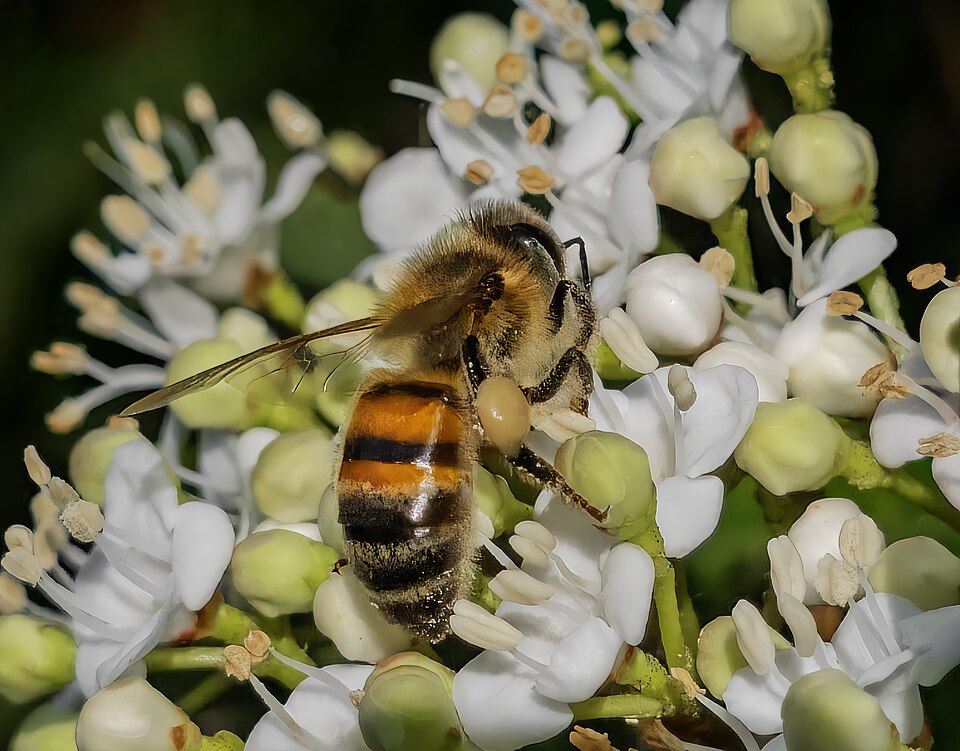
The domestic bee finds its hive by combining several navigation systems: a solar compass capable of detecting polarized light even on overcast skies, a memory of visual landmarks in the landscape, an internal calculation of its trajectory (integration of the path) and, once close, the characteristic odor of its colony.
A combination of navigation systems
The compound eyes of the bee contain specialized photoreceptors, located in a dorsal area called the DRA region, sensitive to the orientation of light polarized by the atmosphere. Even when the sun is obscured by clouds, part of the sky scatters this polarized light in a predictable pattern, allowing the insect to maintain a constant heading. This celestial compass works in conjunction with an internal clock that compensates for the apparent movement of the sun throughout the day.
During the flight, the bee continuously adds the distance and direction of each segment traveled thanks to a mechanism called path integration, or dead reckoning navigation: it thus permanently knows in which direction and at what distance the hive is located, without needing to return via the path taken on the outward journey. This internal vector is completed by the memorization of fixed elements of the landscape (isolated trees, borders, color contrasts) that the bee associates with points along its path, a bit like landmarks.
Publicité
Publicité
When immediately approaching the colony, it is the sense of smell that takes over: each hive has its own chemical signature, linked to the queen's pheromones and the mixture of waxes and resins, which guides the foragers towards the exact entrance among neighboring hives that are very similar visually.
Learning through reconnaissance flights
This system is not innate in its details: the young foragers first carry out short orientation flights around the hive, in circles of increasing radius, before leaving to forage far away. These outings allow them to memorize the appearance of the hive from several angles and the layout of the surrounding landscape, essential learning so that the visual cues and the integration of the route can then be used effectively during harvesting flights, which can cover several kilometers.