How does a spider know when prey is caught in its web?
57 views · 1 month ago
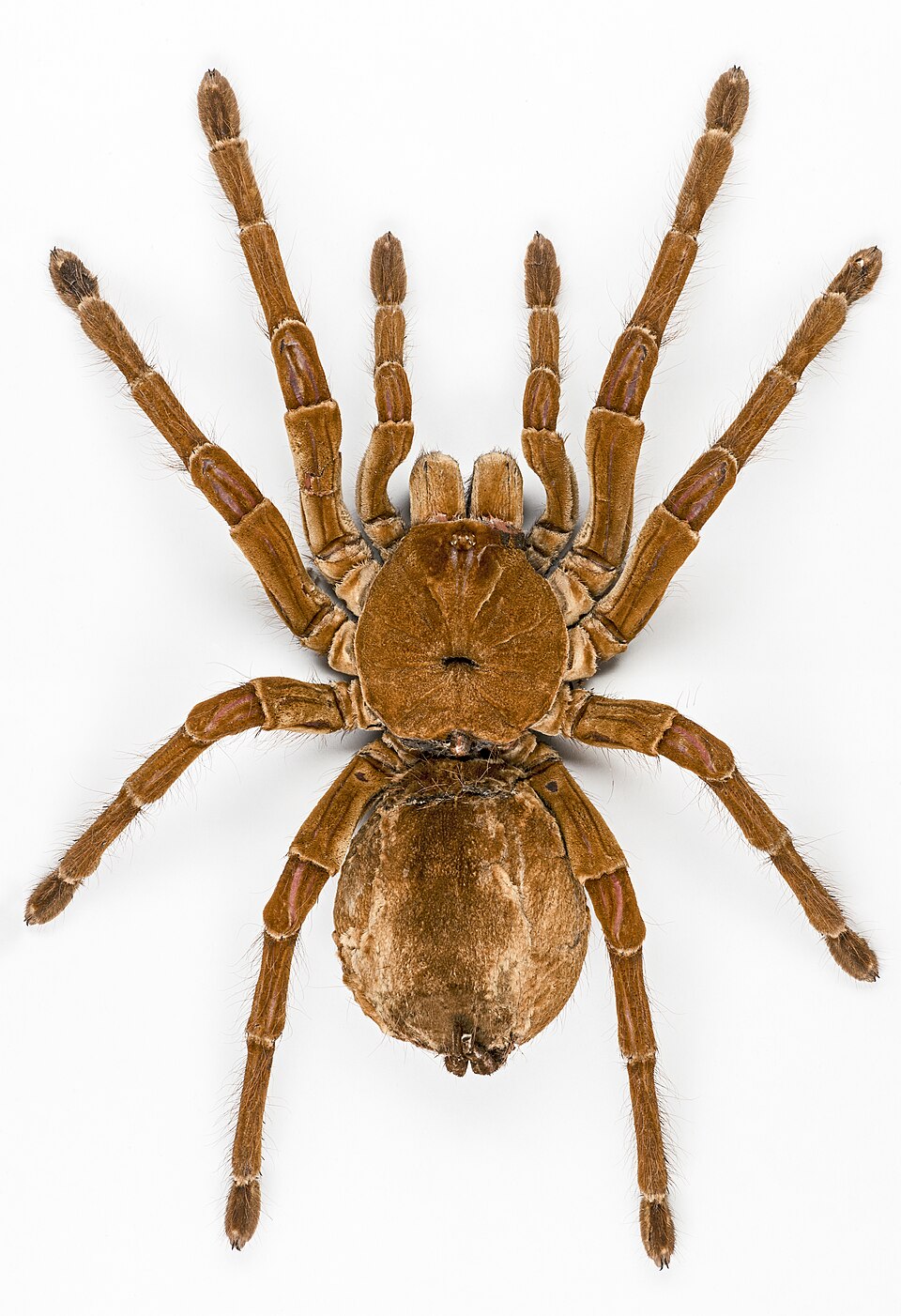
The Leblond's Mygale does not detect its prey thanks to a geometric web, but thanks to the vibrations of the ground and its silk, captured by lyrical organs located on its legs: tiny sensory slits which measure the micro-deformations of the cuticle and make it possible to distinguish an insect's step from the blowing of the wind.
Voltage sensors rather than ears
Unlike weaver spiders which stretch an aerial spiral web, Theraphosa blondi lines the entrance and interior of its burrow with silk threads. This mat serves as a sensory extension: each vibration transmitted to the ground or to the silk slightly deforms the exoskeleton at the level of the legs, where the lyriform organs are located, small groups of parallel slits covered with a membrane. When a leg flexes under vibration, these slits compress and excite sensory neurons connected directly to the nervous system.
The spider can thus analyze several parameters of the signal: its frequency, its amplitude and its duration. The footsteps of an insect or a small vertebrate produce regular and repeated trains of vibrations, while the wind or the fall of a leaf generates more irregular signals, often unique and of low frequency. In a few tens of milliseconds, the tarantula can thus judge whether the signal corresponds to potential prey even before seeing it, its vision otherwise remaining quite limited.
Publicité
Publicité
Once the vibration is deemed “interesting”, the animal orients itself towards the source by comparing the intensity perceived by the different legs, a form of mechanical triangulation, then rushes out of the burrow to capture the prey by surprise.
A stalking hunt, not a web trap
This dependence on tactile vibrations, rather than a sticky trap, explains the tarantula's way of life: it remains crouched near its silk-lined burrow and pounces on prey detected by the ground, unlike orbital spiders which exploit a suspended web to intercept flying insects.